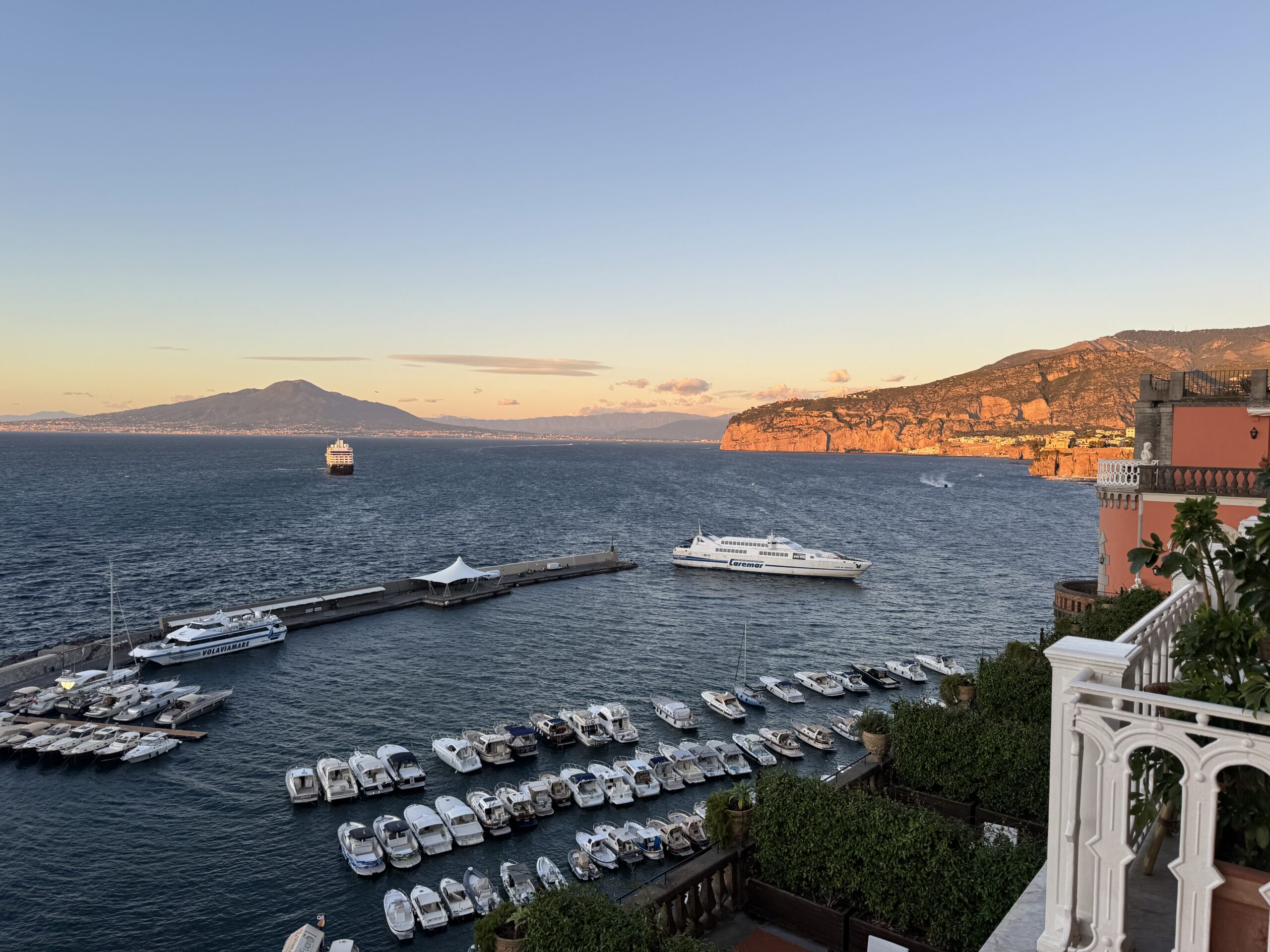
Our first “general geography” post of the great 2025 European adventure has arrived! In this one, we’ll take a look at the general geography of the Campania area, Sorrento, and Capri/the Amalfi Coast. If you know someone who has vacationed in Italy before, then they’ve probably at least passed through this area. Having visited for myself now, I have no trouble figuring out why.
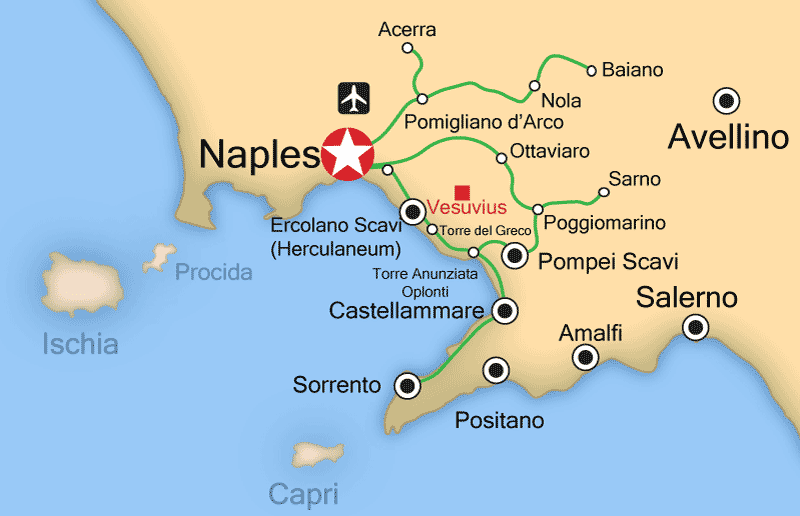
The area that Elizabeth, Pam, and I explored from midafternoon on October 5 to early on the morning of October 7 (this was a very fast-paced portion of our vacation) roughly spans the Bay of Naples between Naples and Sorrento on the map above. This bay is dominated by the broad sweep of Mount Vesuvius at its head. You can always see the mountain as long as it’s clear enough outside.
Naples itself is a large city of almost 1 million people. The downtown core is located right on the water with the airport to the northeast and train station (we used both!) directly to the east of it. From there, suburbs sprawl outward in every direction, including on the lower slopes of Vesuvius itself. The drivers are terrifying. I can’t tell you if the driver who picked us up from the airport and took us to Pompeii/Sorrento, was good and just forced into awful situations by the maniacs around him, or if he was a maniac himself. Not sure how much it really matters. Either way, you wouldn’t want to be around it.
Pompeii is on the southern side of Mount Vesuvius. The ancient townsite is quite literally buried within the suburbs so that you may be at a pizza shop on the side of one busy street, and then you literally cross the street and are suddenly entering a land of ancient ruins. It’s really stunning how well the caretakers keep the grounds from getting absorbed into the background town. You would never know what’s going on all around Pompeii.
There is a range of mountains just south of Pompeii. If you’re an American cast into this region basically out of the blue on a rainy day, and clouds cover up Vesuvius at first, you might think that range of mountains is actually the volcano. They are not – it’s a small limestone range known as the Lattari Mountains that form the backbone of the Sorrento peninsula. To get from the Naples area to the Sorrento peninsula, you have to take a road down a winding mountain road right along (but also way above) the water. There’s actually an incredible viewpoint in the area:
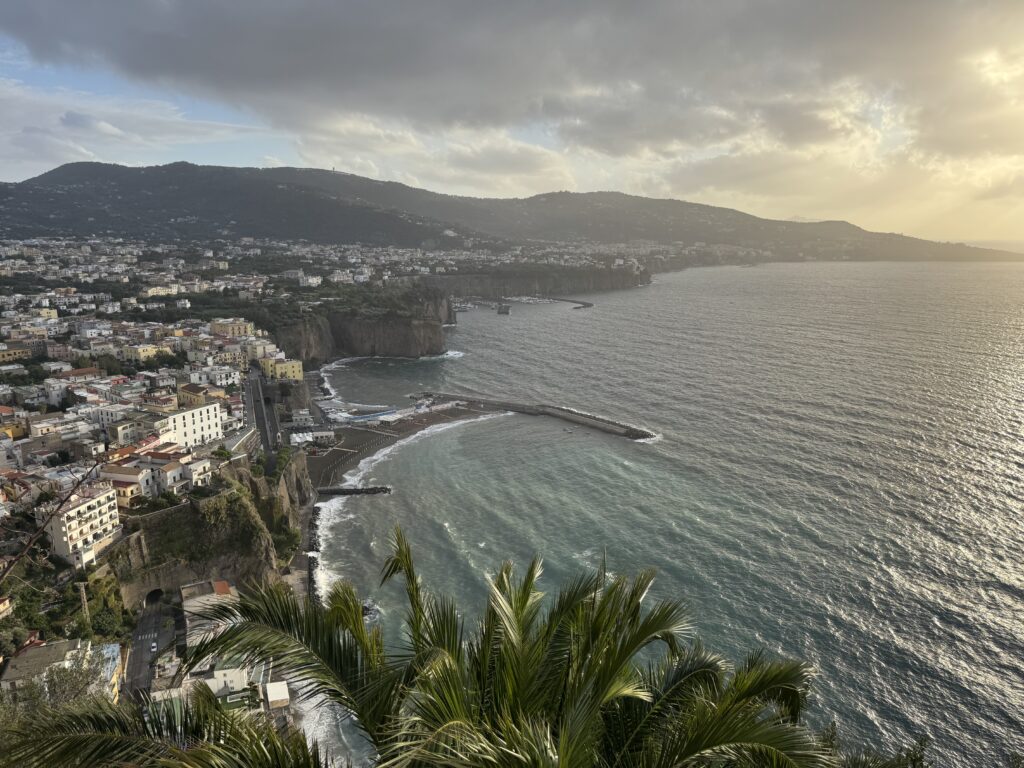
And from there, you’re on the Sorrento peninsula. Separated by those low mountains, the northern coast encompasses the lovely lemon-growing town of Sorrento and a few other coastal spots. Sorrento is full of narrow streets packed to the brim with tourists, an incredible retail district with some of the highest-end fashion shopping I’ve ever seen, restaurants, and luxurious hotels on the cliffsides along the water. Many of those hotels were stunningly cheap in early October, so I thought maybe tourist season was over. Hint: it wasn’t.
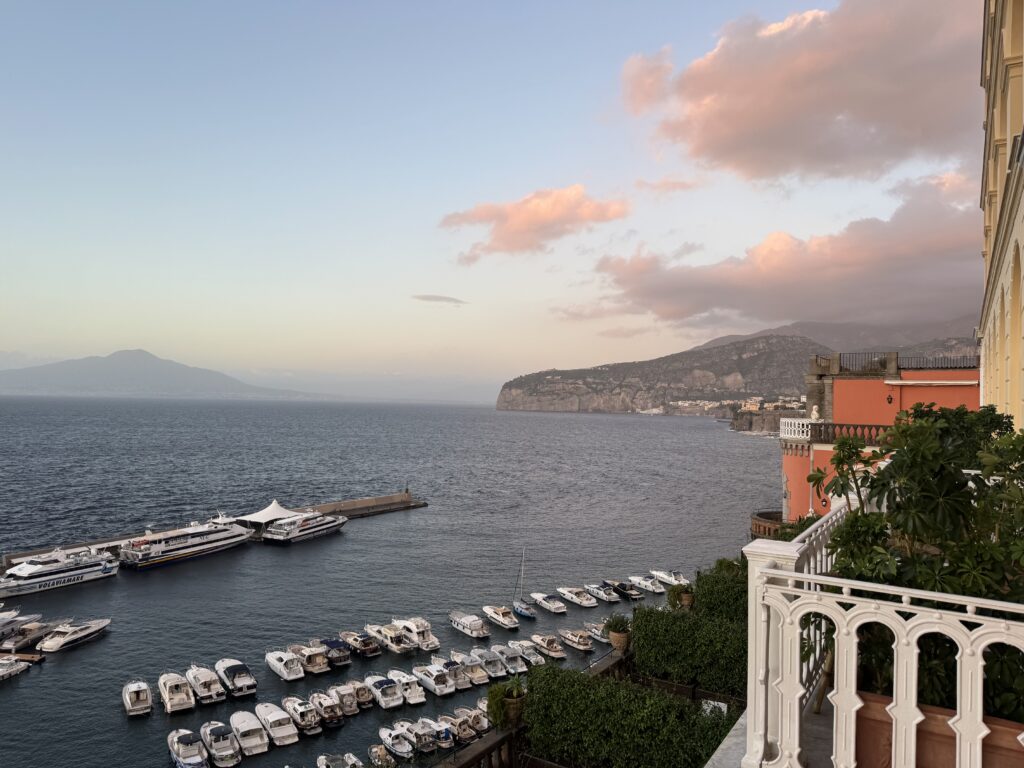
Pam and her travel planner Vanessa booked the Hotel Vittoria Excelsior for Pam, Elizabeth, and myself to stay at. While I appear to have not been smart enough to take a picture of the front of the Vittoria, here is a picture from the harbor way below:
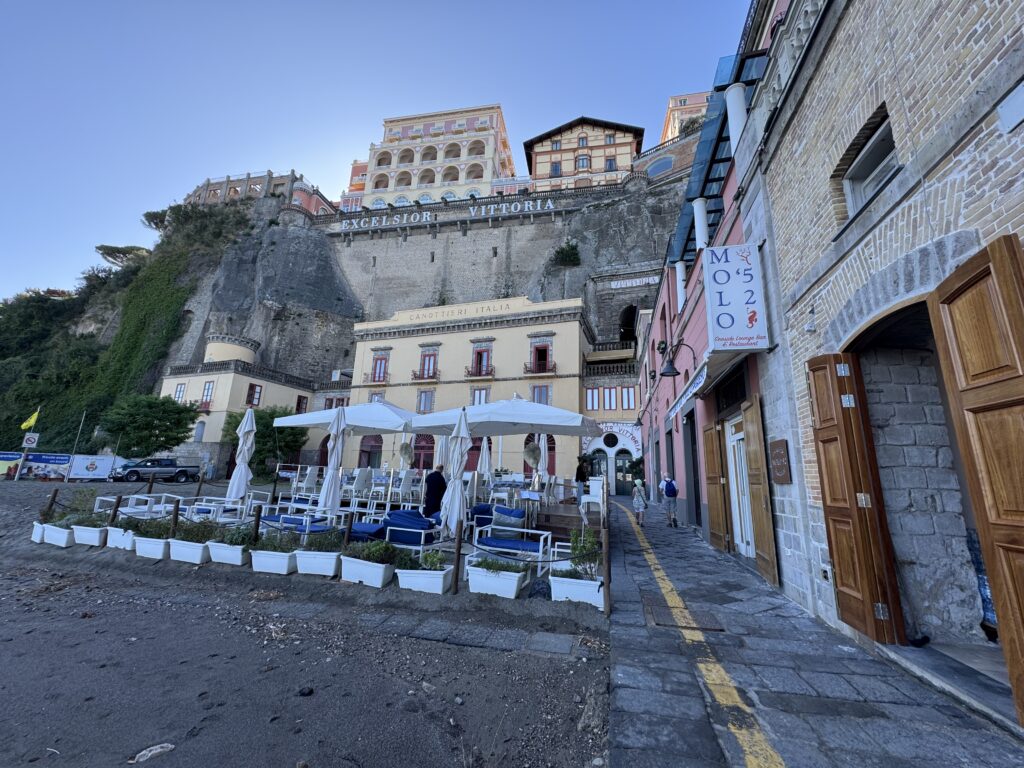
So the hotel is high enough up on the cliffside that you have to take an elevator from a cave beneath it (which apparently sometimes doubles as a wedding reception venue) to reach the ground level. That gives it a great view over the water. Please reference the sunset photo from our suite’s balcony if you don’t believe me. Or, heck, I can throw in another one.
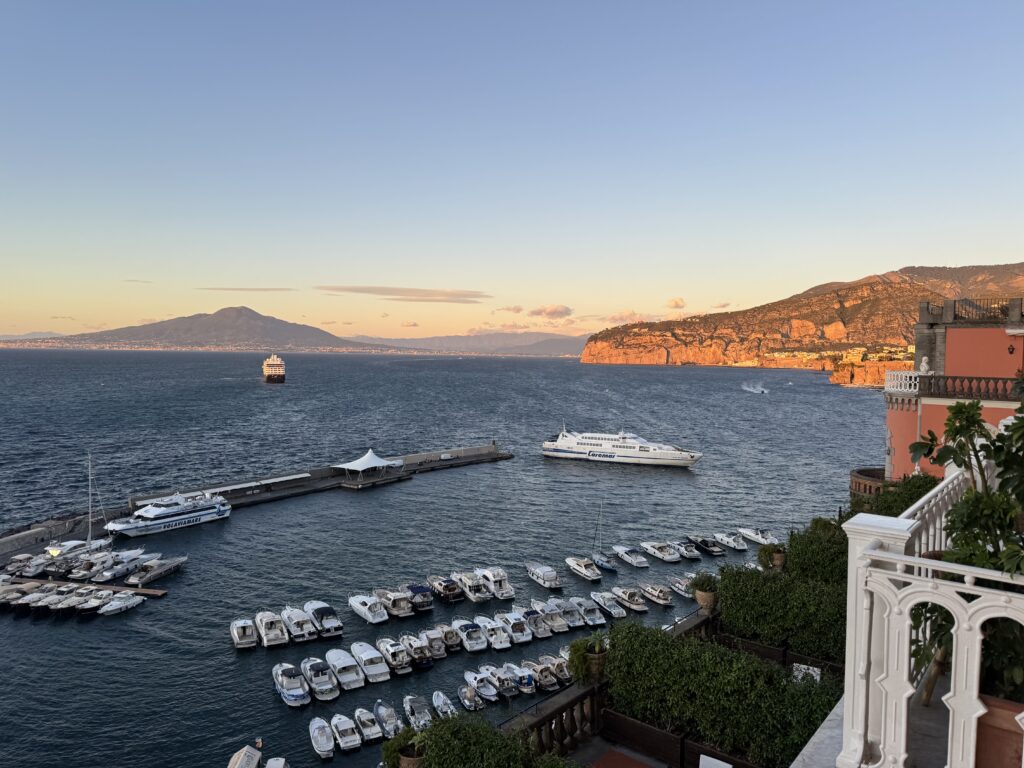
The view alone made this hotel top-notch, and that’s before you get into some of the amenities. For one, there is a Michelin-star restaurant inside of it. We’ll talk more about that dining experience in the “food of Sorrento” post, but just know that it was a spectacle AND spectacular. The suite the three of us stayed in was impressive, too; our rooms were separated by a common entryway (watch out for jammed thumbs when you open the door, because Europeans don’t believe in doorknobs for some reason). Elizabeth and I had the balcony you see above attached to our room, along with a palatial bathroom complex featuring a huge bathtub, heating floor, and bidet. The Vittoria didn’t end up being anyone’s absolute favorite place to stay across the entire vacation, but it was far from the bottom, and it might have been the fanciest hotel I’d ever stayed in at the moment we arrived.
I would be remiss if I didn’t mention the rest of the Sorrento peninsula and nearby, considering the next blog post in this series (after Pompeii) covers our adventures by water. As I said before, Sorrento and its neighboring communes dominate the northern coastal regions. The Lattari Mountains taper off from east to west – there are 4,000-foot peaks north of Salerno, but by the time you reach the very tip of the peninsula the spine of it is short enough that a network of winding roads and villas has sprung up. From Positano to the east, though, the peninsula is entirely cut in half without road access between them. And this southern coast is, of course, the world-famous Amalfi Coast. Much the same as the northern half, the Amalfi Coast has a bunch of limestone cliffs, sparkling harbors, and people who are ready to bring you wine at a moment’s notice. It’s truly a tourist’s heaven.
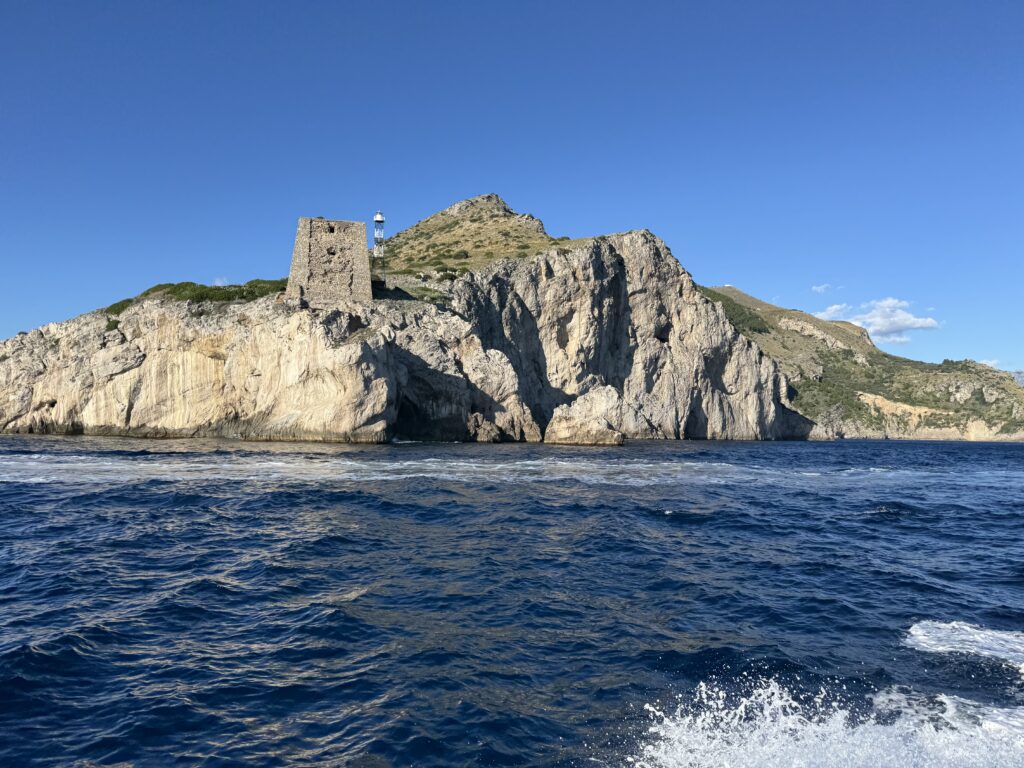
And finally, to wrap up our geography tour of the first region of our trip, we should briefly mention the island of Capri. You’ve heard of it, presumably. If this entire area is a rich tourist’s haven, then Capri is where the richest rich people go to seclude themselves from the poor people who are only kind of rich. There are a few ferries to one of the two harbors on the island, but otherwise it’s kind of a BYOB (bring your own boat) situation. The cliffs, arches, rock formations, and caves are all a little more dramatic on Capri.
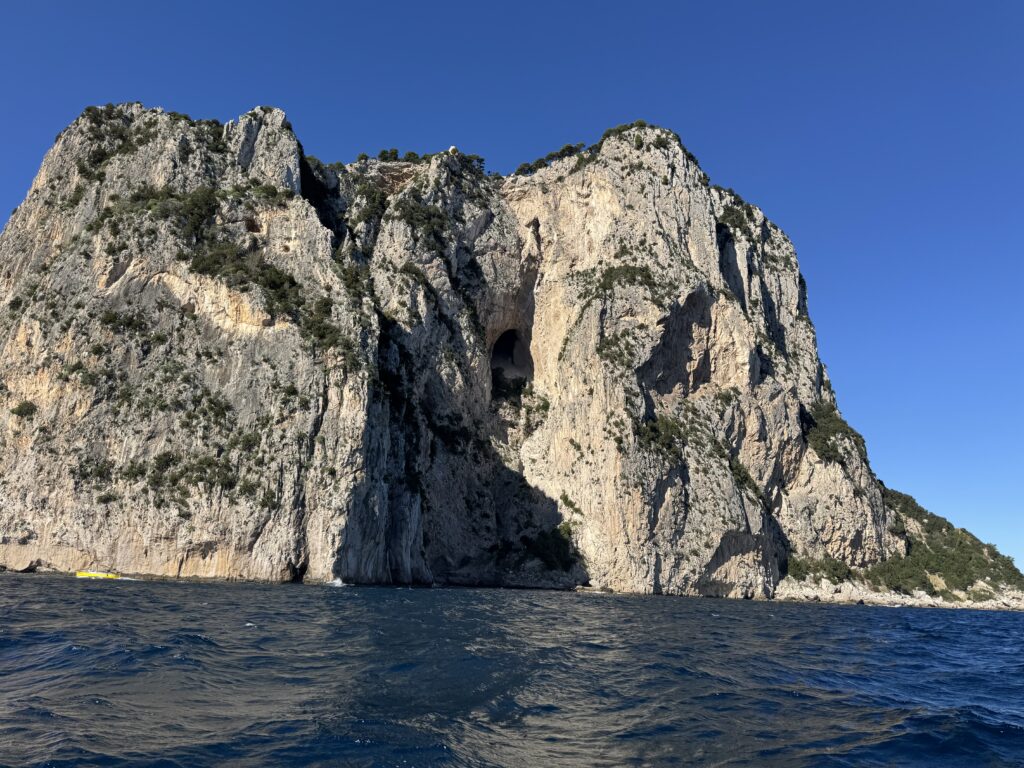
Alright. That’s the geography of the Campania/Bay of Naples area. This was the part of the trip I had the least role in planning, since I’m usually more of a mountain guy than a coastal guy. But as you’re about to see, we were all in for an insane treat to start our vacation.
