Here in the good old United States, it’s impressive to come across a building that’s still standing from more than a couple hundred years ago. A few of them exist – mostly cliff dwellings or earthen structures from the indigenous cultures – but there’s a reason that when I visited Las Cruces/Mesilla with my parents and Elizabeth, we made a stop at the oldest church in town. A free-standing structure built in the 1600s is an unusual sight in North America!
Such is not the case when you visit Rome. Nowhere else on Earth does the old mix so throughly with the new, the ancient with the Renaissance, the modern with the Middle Ages. For someone like me, there’s almost no cooler feeling than looking around and realizing that your life – all 27 years of it at this point – was basically exactly 1% of the length of time of which Rome has been one of the cities of the world. Isn’t that mind-boggling?
And now it was time to take that tricky math and apply it to a specific building. Just down the street from Elizabeth, Pam, and my hotel was the Colosseum itself. For those who didn’t know the history (not me, of course), Pam’s travel planner had booked us a tour guide. She kept up a steady stream of information that kept the two of them more than satisfied. I learned some stuff from her as well, and I don’t mean that as a back-handed compliment. If you can throw out facts about ancient Rome that I didn’t know, you’re doing something well.
For those of us who don’t have an Italian tour guide handy, here are some fun facts. The Colosseum (or, colloquially, the Flavian Amphitheatre) was built in the 70s AD under the Roman emperor Vespasian and his sons Titus and Domitian. At its peak it could seat about 50,000-80,000 Romans, contemporary to your average-sized college football stadium these days. In fact, considering the stadium that we know as the “LA Colosseum” regularly has like 10,000-15,000 USC fans at most, I think we can argue pretty definitively that the Romans had the edge in spectator sports over modern America. This is especially true when you learn how the Romans used the Colosseum. It was the one-stop shop for days-or-weeks-long festivals, gladiator contests, and big sporting events. Want to watch some guy get mauled to death by a half-starved lion? Go to the Colosseum. Want to see some random slaves from that was last year duel it out until the slightly deranged emperor Commodus decides their fate? Go to the Colosseum!
Much of the original structure of the building is still standing, though there are some caveats. An earthquake in 1349 caused major damage to the superstructure which has since been reinforced by modern renovations. But still – there’s no mistaking where you are, even from the outside.
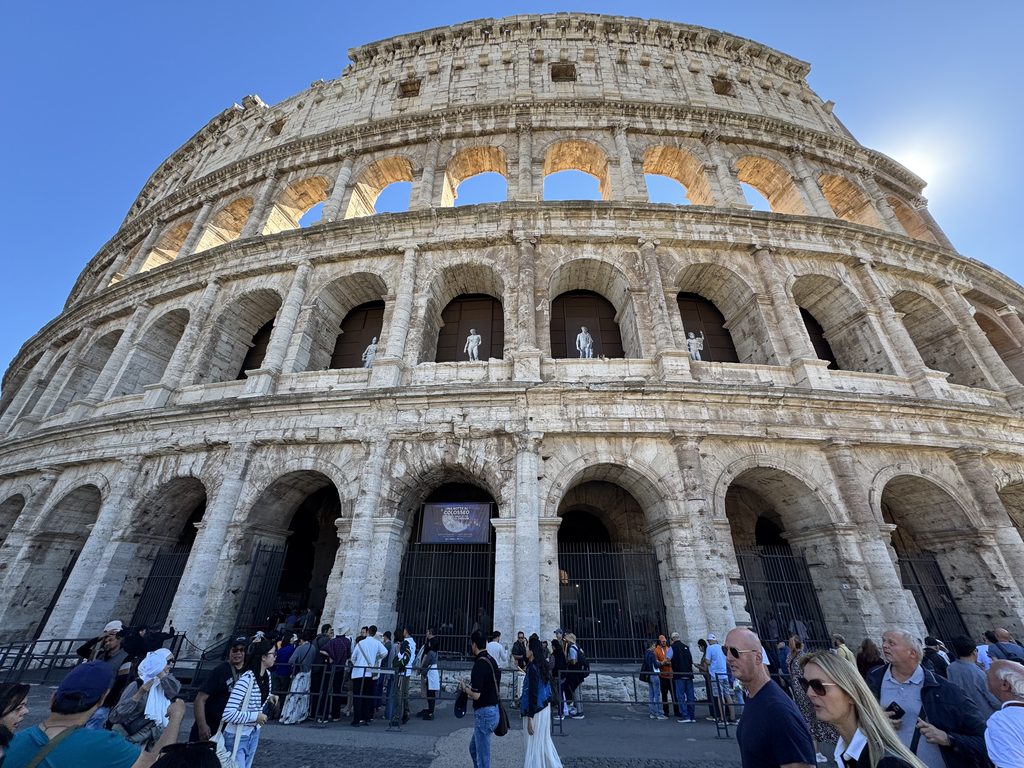
Goosebumps.
The security measures to get inside the stadium are actually kind of insane. You have to hand a guard your passport and get checked out and everything. This is kind of an issue because the Colosseum is one of the most notorious hotbeds of pickpockets in the world. Fortunately for me, Elizabeth is the Meister designated to worrying about what could go wrong with stuff like that. She kept our passports nice and safe, and because of our private tour we got escorted through a super-fast-track line. Just like that, the three of us and our guide were inside the Colosseum.
The arena skeleton was something to behold while walking through it. This is not an exaggeration: if it weren’t for the chunks of marble and concrete missing everywhere, you could convince me that we were underneath a Big Ten team’s stadium on a beautiful American fall Saturday. That’s how uncannily similar the architecture was. If anything, the Romans did things way more gracefully; without the technical crutch of reinforced steel, they were forced to use the ever-powerful arch in their designs far more.
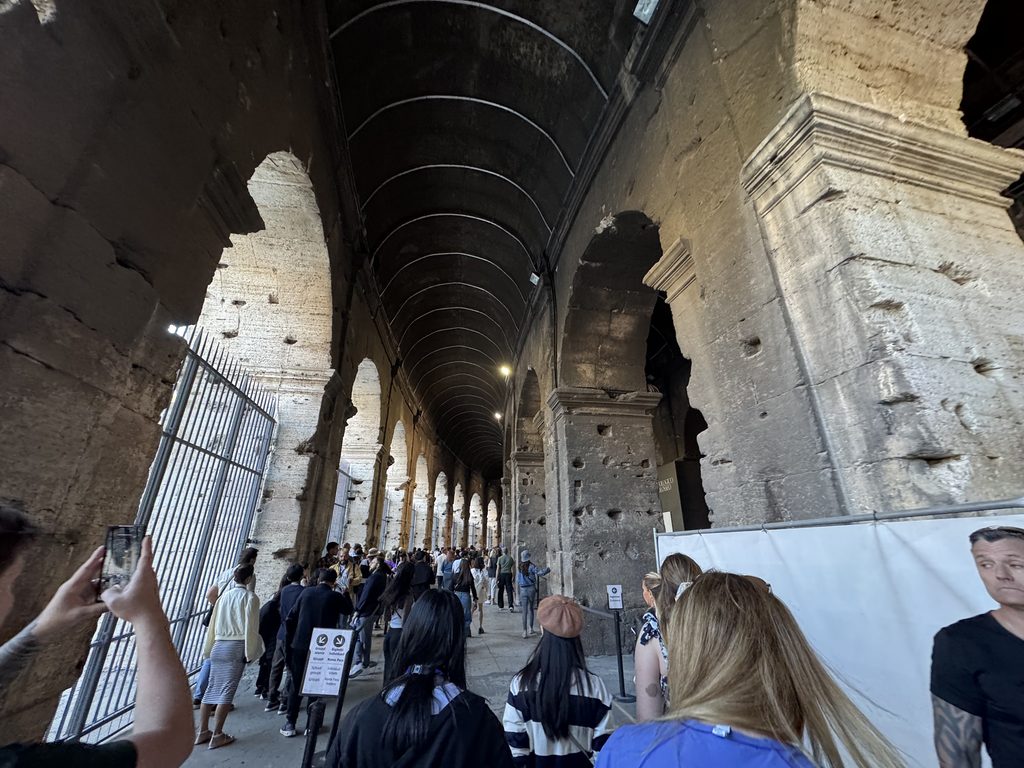
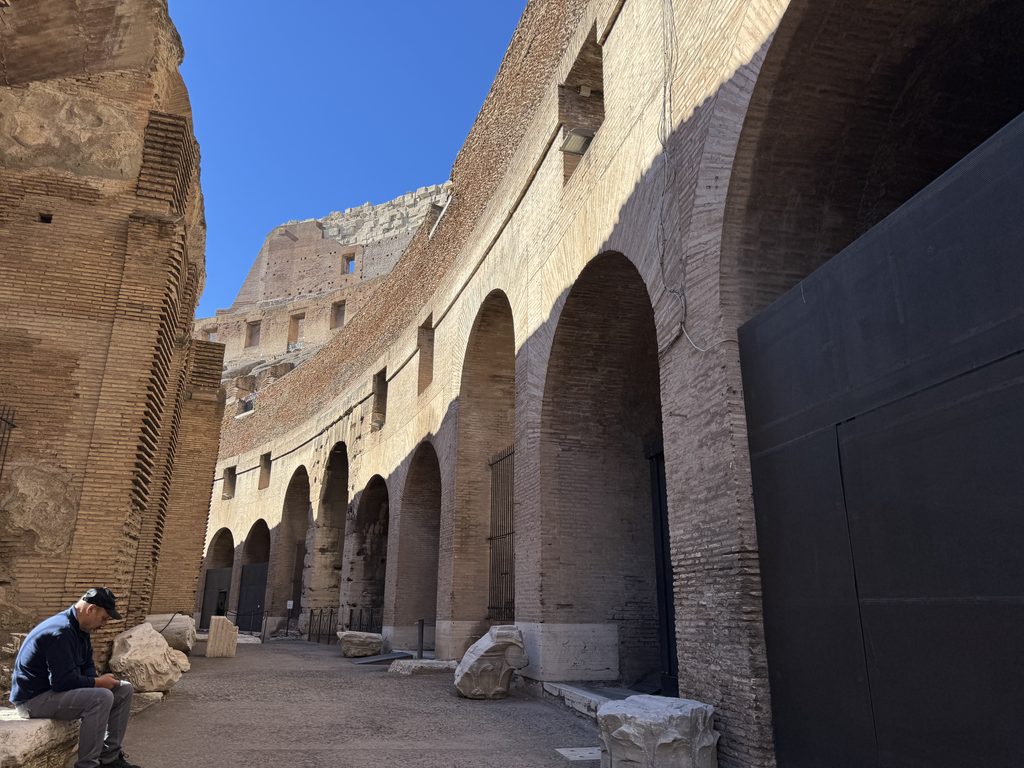
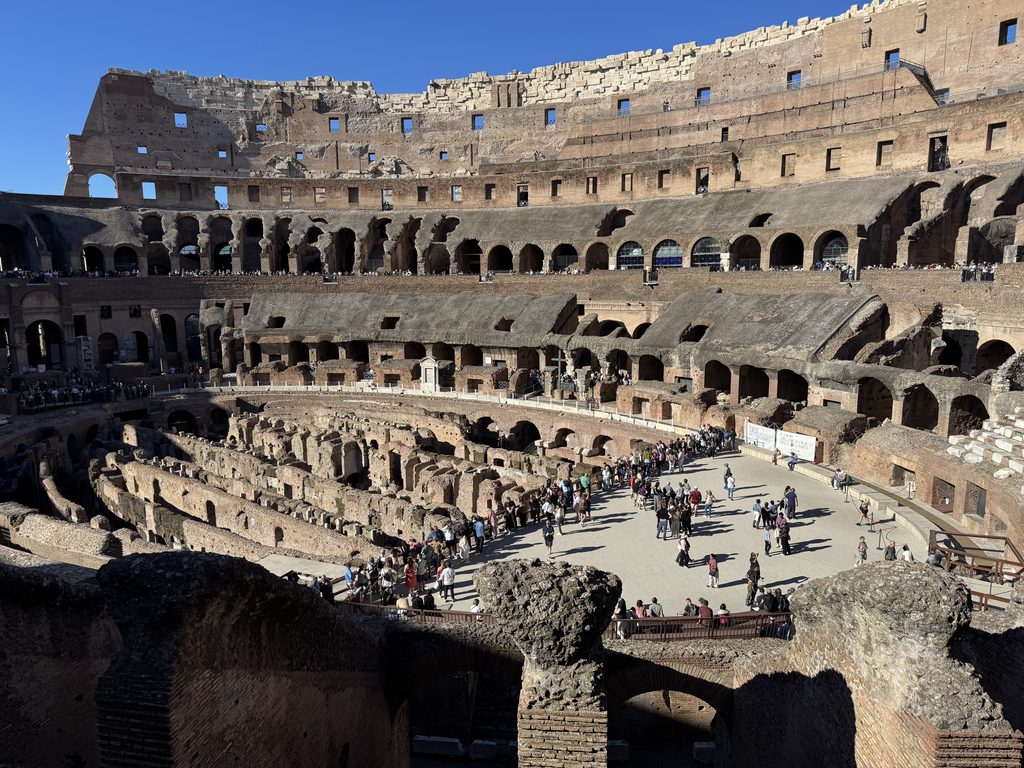
But as impressed as I was by the superstructure of the amphitheater, it had nothing on the interior. The word “breath-taking” gets overused, particularly when it comes to manmade structures. But this made me pull up short:
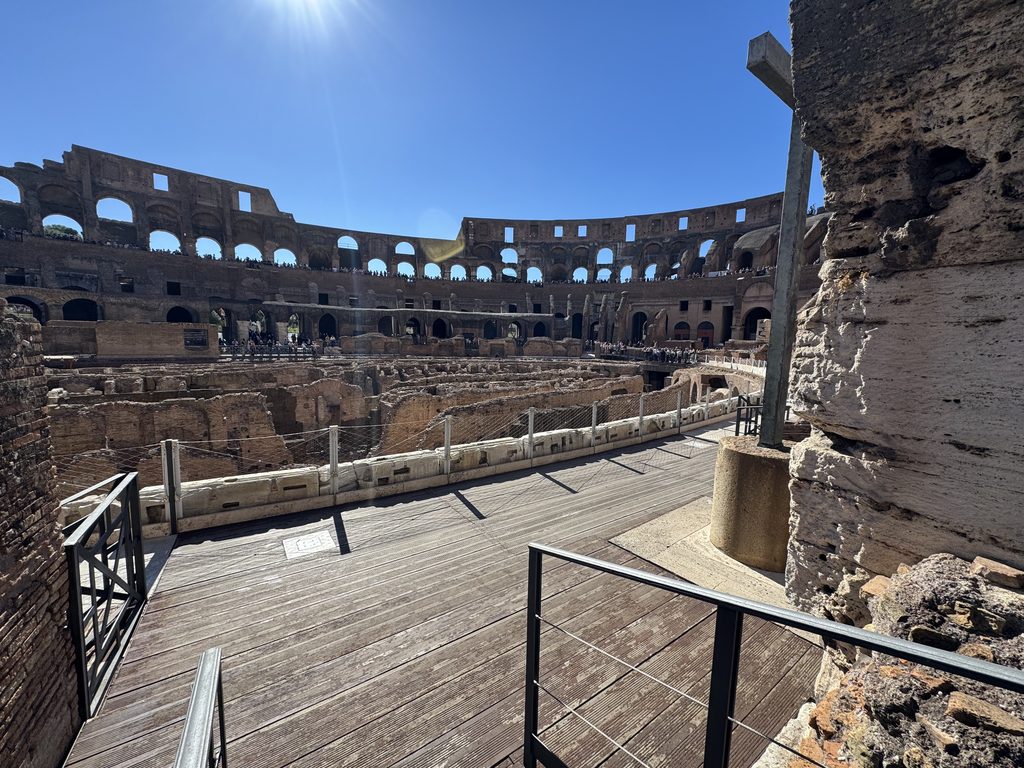
Think of all the history that went on inside those walls!
The everyday Rome visitor gets to see the view from the right side of the picture above, where there is a small public viewing area. I don’t mean to disparage that view, which is transcendent in its own right. But the cool part of our private tour is that we got to go into the bowels of the Colosseum itself – deep underground to see the system of passages and elevators that allowed contestants and animals to dramatically emerge onto the center stage. We had to go surprisingly far down to get to the subterranean level and the secret gladiator entrance. Speaking of gladiators:
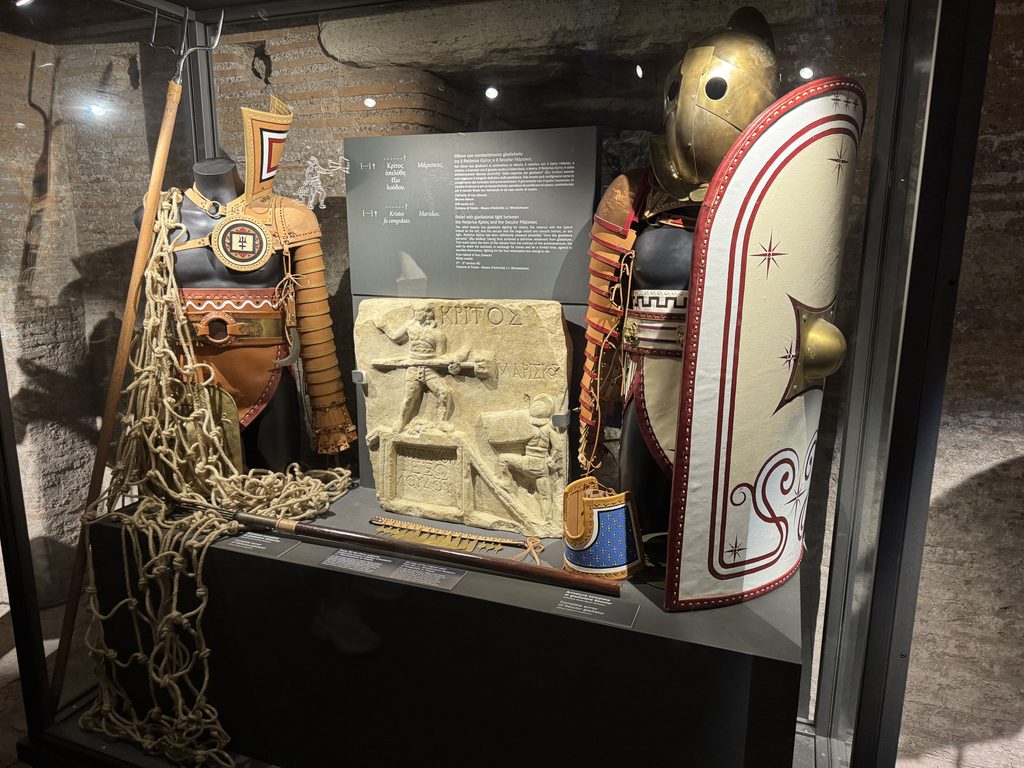
There were all sorts of displays of gladiatorial gear in the basement that alone were worth the price of admission (probably. I never saw the price of admission, and thanks to Pam for that).
We wandered the passages underneath the floor of the stadium. In my head, I was imagining what it must have felt like to be a gladiator. You could hear the roar of tens of thousands of people above you while sitting in these dank, damp corridors. You could probably hear the roars of the animals you were about to fight to the death somewhere nearby. The stink of the unwashed masses, the massive social and political ramifications of the events, all of it: how did a gladiator take it in? Were people back then less introspective and a little more practical on account of the whole “life expectancy of about 25 years” thing? This is all of the stuff that flashes through my mind while touring the Colosseum. Elizabeth, meanwhile, liked the bricks.
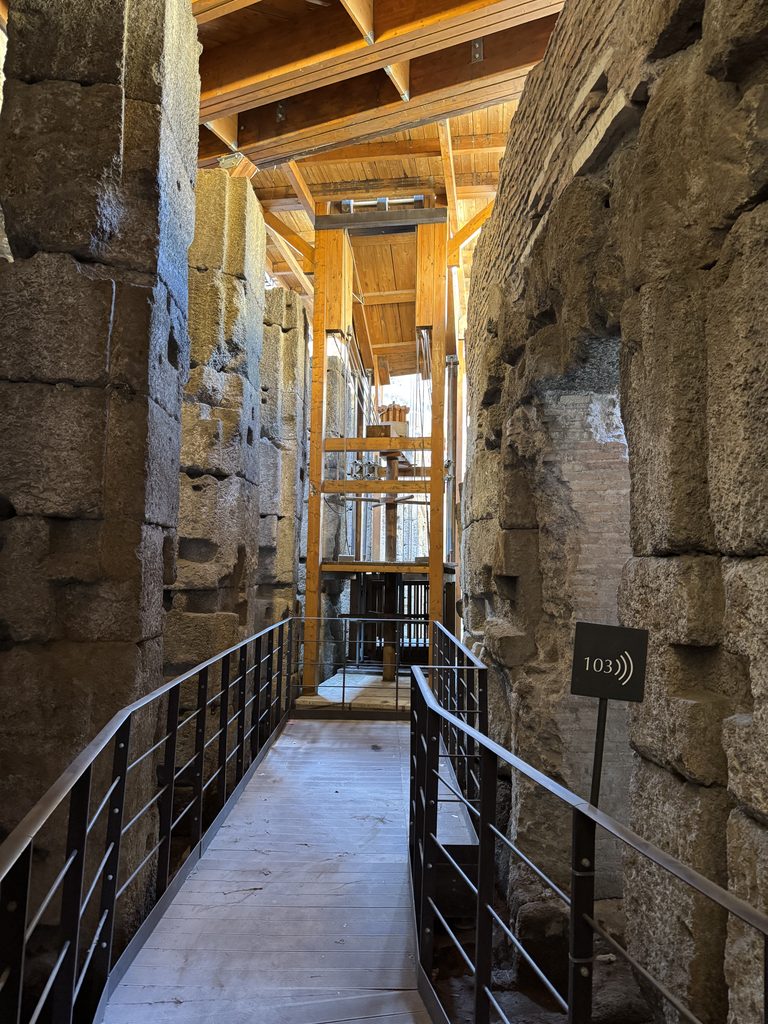
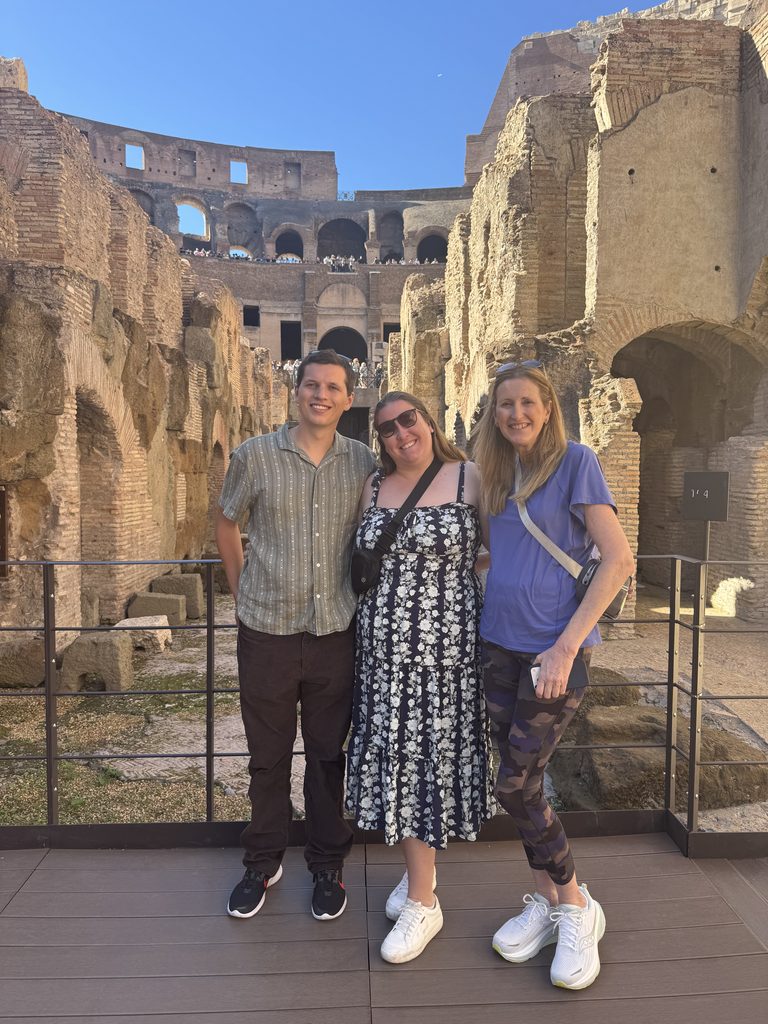
And finally, our tour guide led us topside so that we could see the stadium surface and the seating. Interestingly, I found myself thinking that the “playing field” was smaller than expected. Maybe it comes of going to a lot of football and baseball games where the field dimensions are 120+ yards on the long side. Even then, when you go the ground level of a college football stadium, the field level always looks smaller than you think it does from the bleachers. The Internet informs me that the Colosseum is more like 60 yards by 90 yards on the floor. It does look proportionally a little more cramped compared to a movie like The Gladiator.
You could also wander right over to a section of seating that had recently been refurbished by the building caretakers. That seating would have been for noblemen, senators, generals, etc. Some of the marble still showed the inscriptions of the senators who had reserved that spot (I have questions. What did subsequent generations do once that senator died. Replace the entire section of marble?).
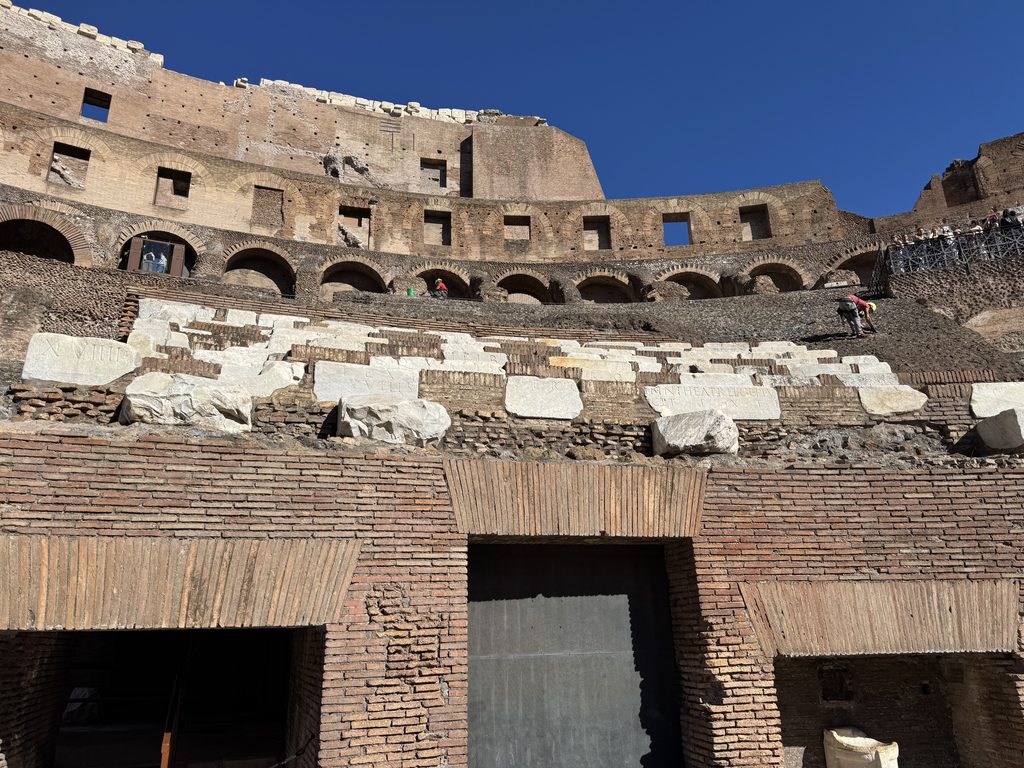
The gleaming white of the marble added another element to my mind’s eye. When the Colosseum was first built, that marble would have been all over the place instead of the much-less-aesthetically pleasing concrete + brick. The problem, of course, is that that marble has just been sitting around for centuries, tempting those with building projects of their own. There are big holes visible all over the structure where somebody bored into the Colosseum, removed the marble, and reused it for their own purposes. The Catholic church apparently was quite resourceful in doing so. This prompted very different reactions among our group: Elizabeth was shocked into the moral outrage of righteous indignation, while I took a more pragmatic view and respected the Church’s ability to reduce, reuse, recycle even back during the Renaissance era. We have continued that debate ever since.
The seats weren’t the only surviving marble. Small pieces of ornately carved figureheads survive, as do inscriptions:
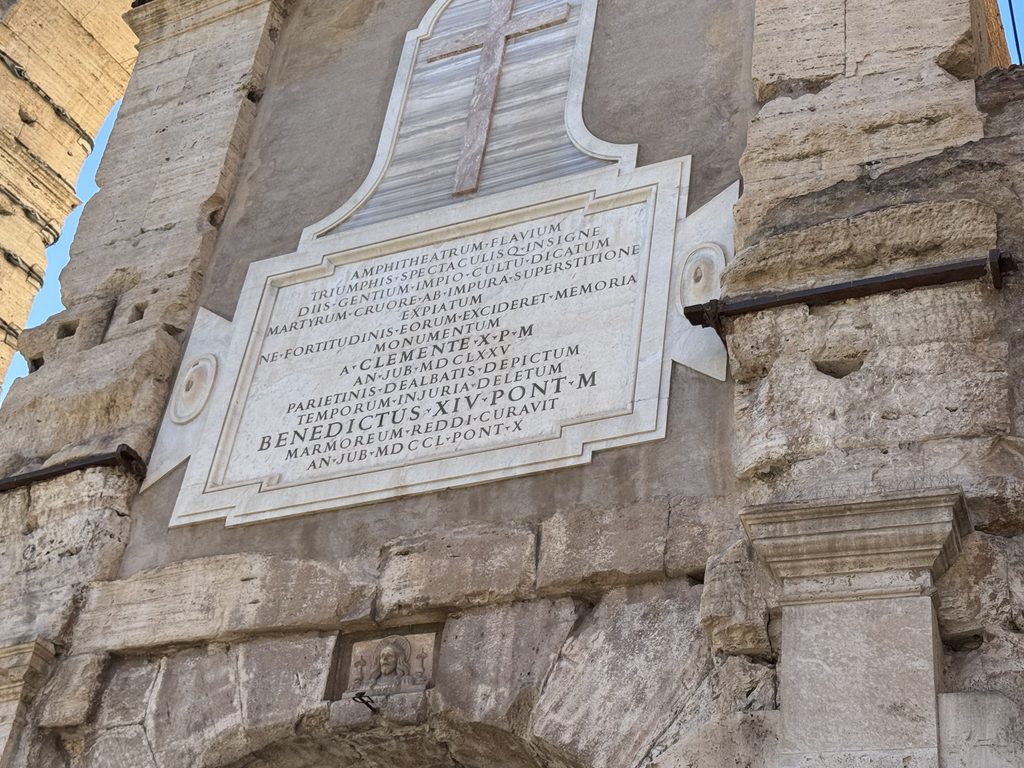
I could have spent all day in the Colosseum. The only issue is that doing so would be a disservice to all of the other things to see in Rome, some of which were just out the window from here.
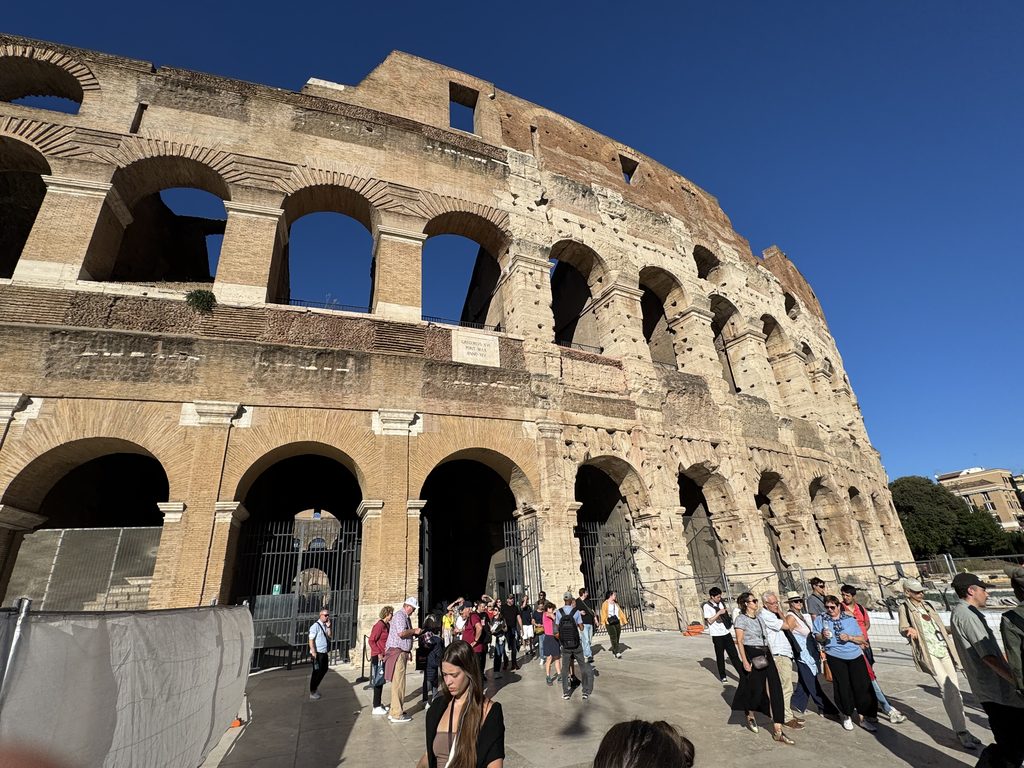
Lucky for me, our tour had a second half. And what a second half it was: a walking tour of the Forum Romanum, the most famous meeting place in all of history. The two are separated by no more than a few hundred meters of beautifully maintained Italian lawn, though one does have to pass by the famous Arch of Constantine:
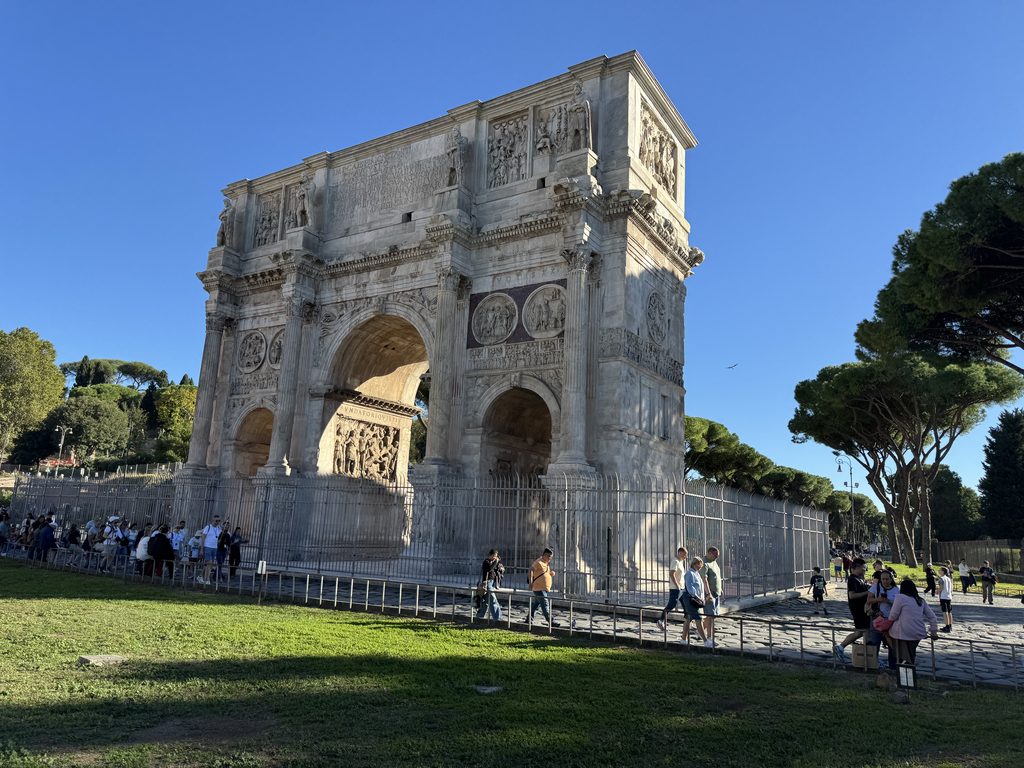
There’s another arch that we passed right by – the Arch of Titus. Our tour guide was quick to point out that the Arch of Titus was another public works project brought to you by the Flavian Dynasty who had also built the Colosseum. I’m not an expert in the Flavian era by any means, but by racking my brains I realized that this arch must have been to celebrate the ultimate squashing of the Jewish rebellion in the 70s. Sure enough, there were images carved into the arch that appeared to depict a triumphal procession over a conquered people. But when I asked, the tour guide looked at me blankly. “No, this arch celebrates the building of the Colosseum.”
Now it was my turn to feel blank. A public works project to celebrate… the completion of a public works project? Something didn’t add up here. I’m far to well-raised to challenge an expert in the field openly, though. Instead, I waited until the tour guide had dropped the three of us off at a cafe for some post-tour coffees, grabbed Elizabeth’s phone, and immediately went on Wikipedia to search why Titus’s Arch exists. Spoiler: it’s to commemorate the subjugation of the Jewish rebellion. And just like that, all of the questions I had asked this supposedly knowledgable tour guide and all of her entertaining anecdotes went swirling around the drain.
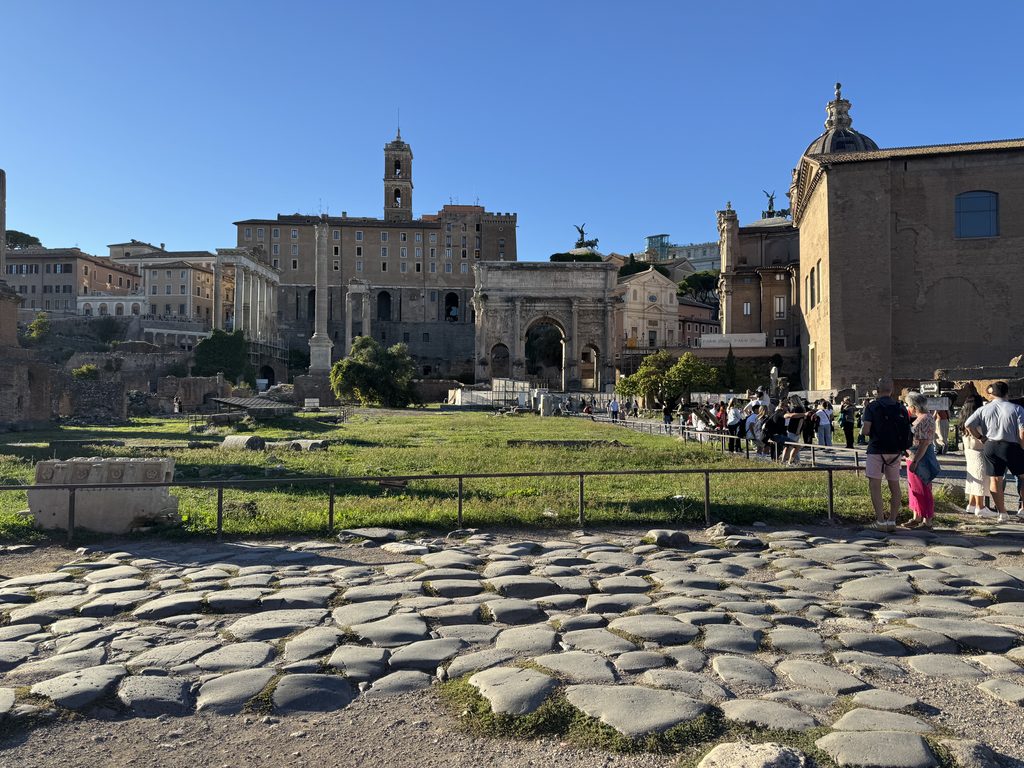
But that was a suspicion that would only be confirmed later. For now, all I could do was take everything she said with a grain of salt and try to shake the negativity out of my mind. Because why in the world would you get go to Forum Romanum if you’re going to have negative thoughts? This spot was the center of the known universe for hundreds of years, then buried for hundreds upon hundreds more, until the Italians (under Mussolini) began carefully excavating their past. They found all sorts of exciting things, such as the original pavement of the Via Sacra (literal translation: the Sacred Road, Rome’s original Main Street). You can see it on the right side of this shot looking down the length of the Forum:
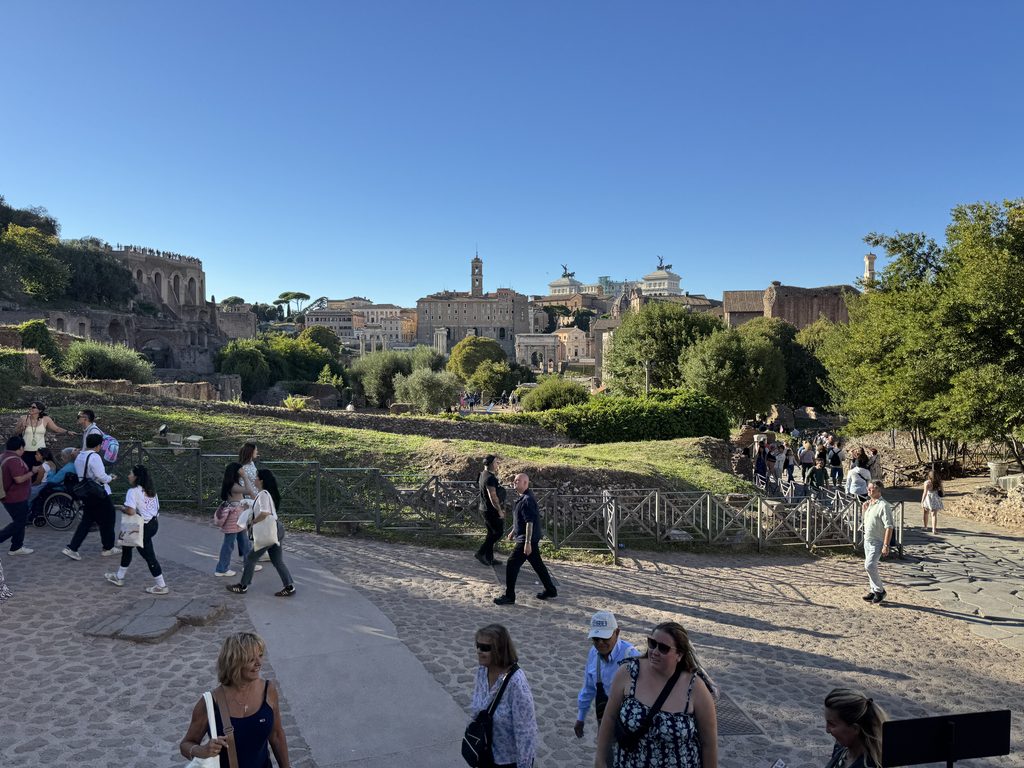
What remains intact is just awe-inspiring to see. The classic Greco-Roman columns, the inscriptions, the knowledge that you were standing right where the crowds would have been addressed by Cato the Elder, the Gracchi, Cicero, and any other number of Roman orators. This was where the Vestal Virgins’ sacred flame, the Temple of Jupiter, the Senate House, and any number of other famous landmarks that I grew up reading about were actually located!
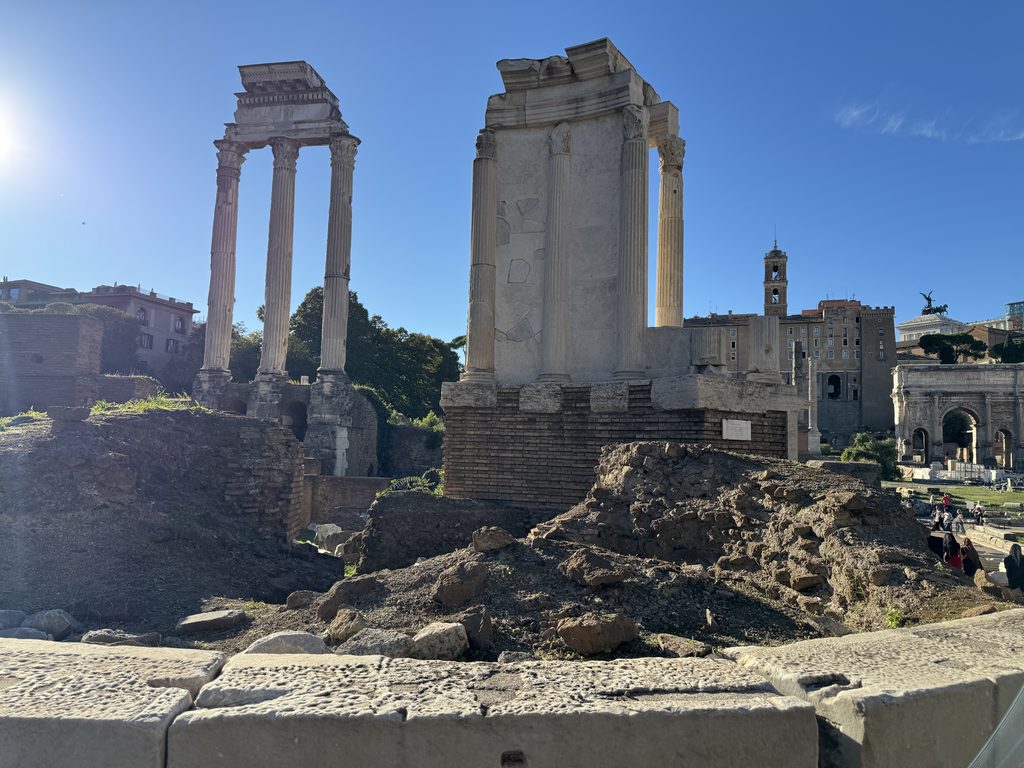
Some of the ruins were in a more serious state of “ruin” than others, which had been excavated semi-intact. It gave the impression of tombstones in a cemetery for giants. And maybe that’s what it was:
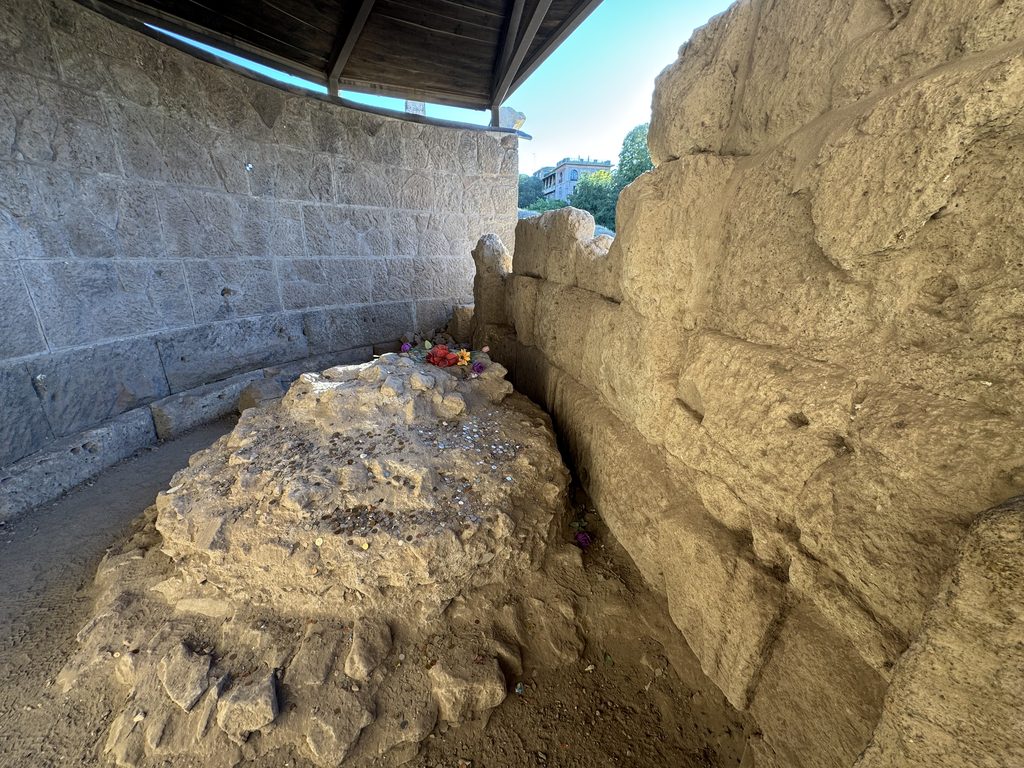
One marker in particular stood out: the Temple of Divine Julius, dedicated by Augustus to his adopted father after those pesky senators stabbed him to death on the Ides of March. Not much remains of the interior, but that doesn’t stop people from coming by daily and leaving flowers in memory of history’s most famous dictator.
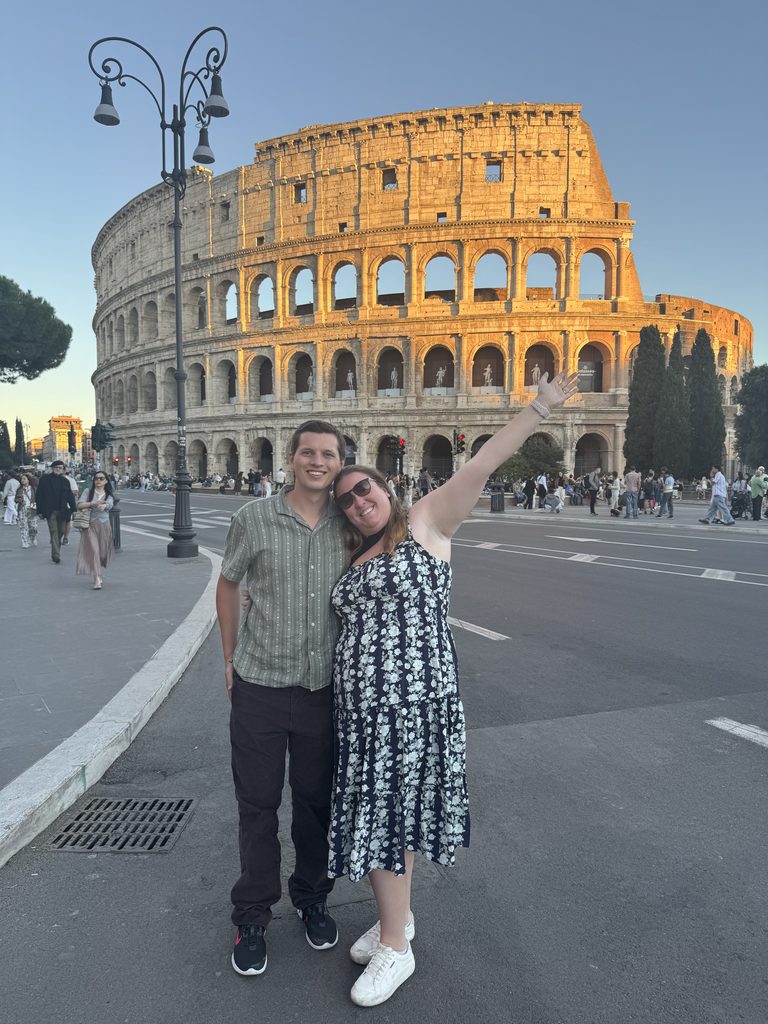
In truth, I could have stayed and enjoyed exploring the ruins for hours on end. That might have prompted a mutiny with Pam and Elizabeth, though Elizabeth has since said that she enjoyed the historic tours in Rome far more than she ever imagined. Fortunately for the two of them, there was no need to contemplate a fully uninhibited Nolan. The sun was sinking lower into the early-October sky, a reminder that our tour guide was a busy person with a busy life of her own. It had already been over 3 hours since we first walked up to the Colosseum, and unfortunately our guided tour was done for the day. The tour guide dropped us off at the aforementioned outdoor cafe (the three of us starting talking shit about the Arch of Titus controversy immediately) and headed on her way. As for myself, Elizabeth, and Pam: well, it was golden hour. Why waste one of your only two golden hours in Rome with anything less than a delicious espresso and a chance to get a beautiful backlit photo with your spouse in front of the Colosseum?
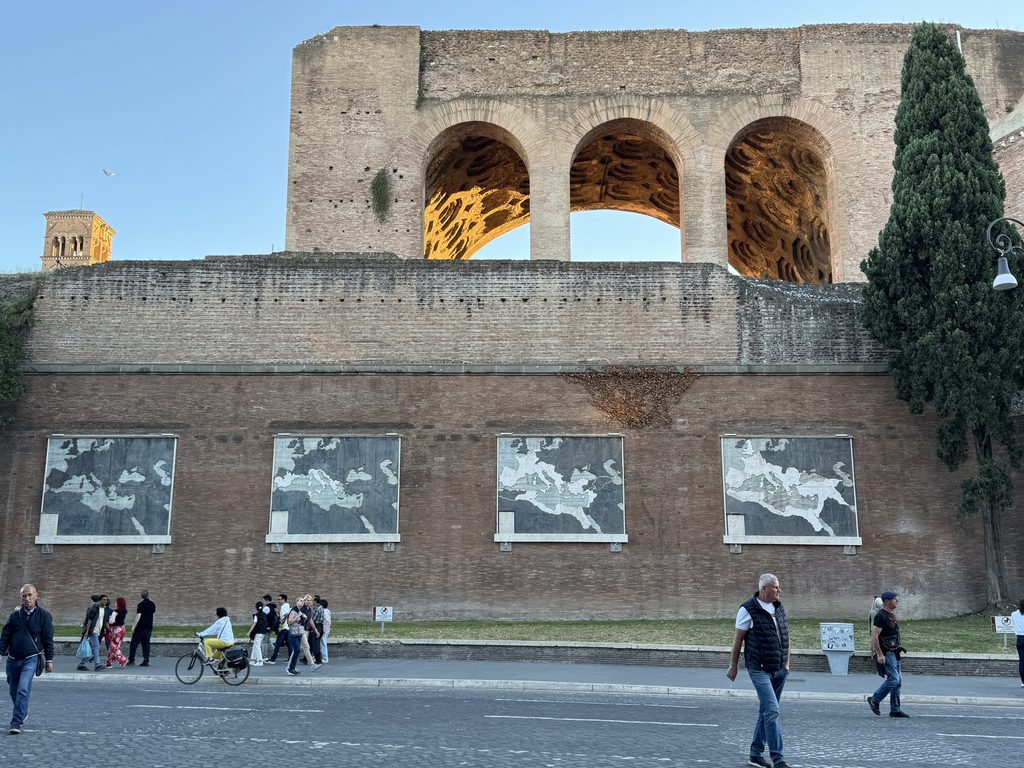
There was even a series of maps on a nearby wall that showed the rise of Rome from a minor regional power to the most dominant empire in world history.
What an absolute dream come true of a day. There were about to be – hell, in Sorrento there already had been – a lot of “dream come true” days, but don’t mistake me here: this was an absolute dream come true.
