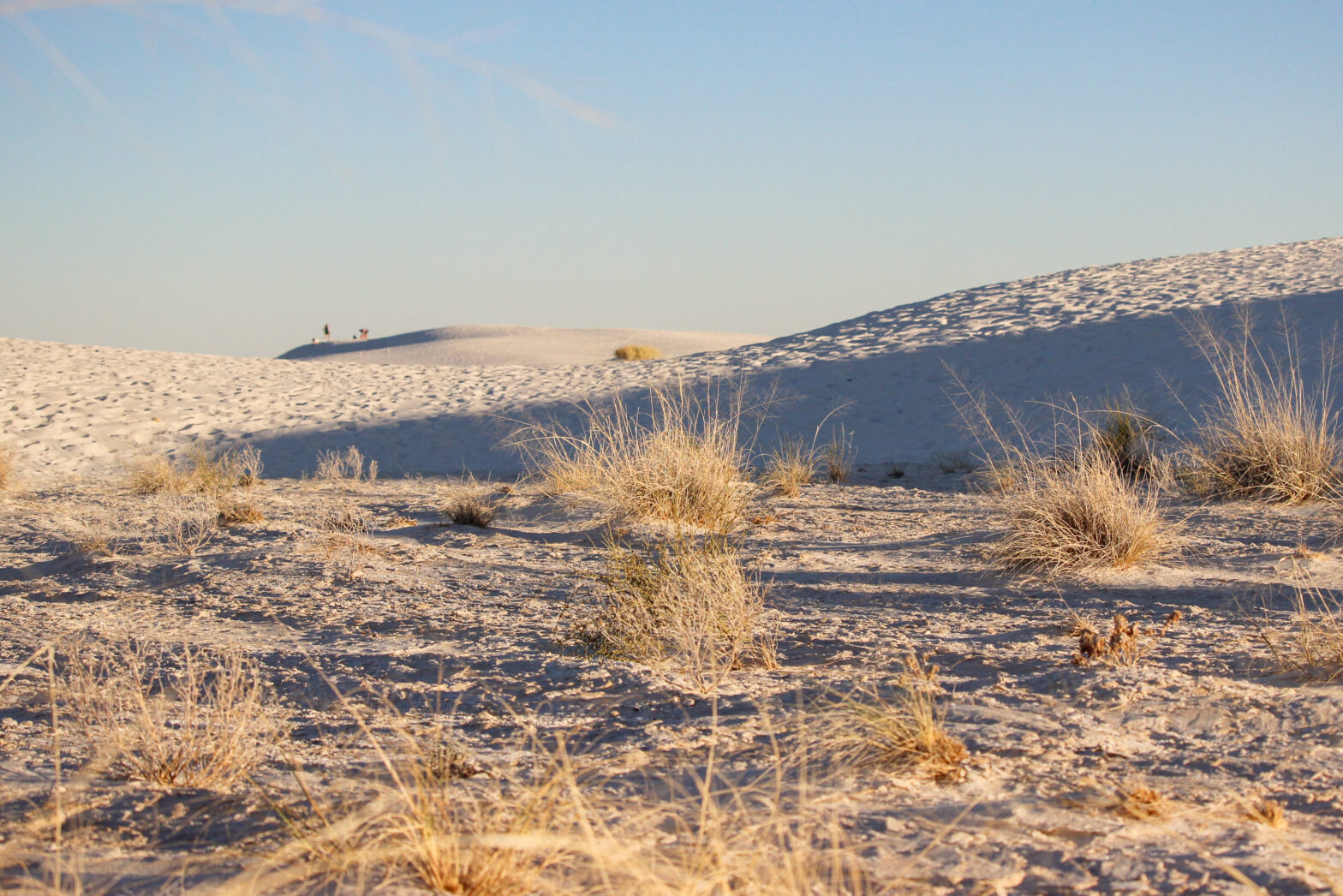
I saved this post from our March trip for last for two reasons. First of all, this is the only national park on the trip that Elizabeth and I visited for the first time. Anytime you visit a new national park, you deserve a longform blog post. The second reason is that – as you will see – I had a grand old time with my camera on March 21, 2026 in White Sands National Park. Get ready for lots and lots of pictures!
Let’s run it all the way back to the start, shall we? Our journey on the first full day of spring began in the town of Roswell, New Mexico a little before sunrise. My parents and I are all early risers, which was good in this case; it’s a little over 3 hours from Roswell to El Paso, where Elizabeth would be flying in by late morning. The sunrise threw a beautiful golden light on the cattle, the hundreds of square miles of empty rangeland, and the Sierra Blanca Mountains 70 miles to our west. The great flat expanse grew more rugged with each westbound mile, so that by the time we reached the first post office my dad could find to mail Wyatt some postcards (the booming town of Picacho), we were in a desert canyon. I stared out the window all morning as the bare rock turned to scrubland, the scrubland to stubby junipers, and as we approached the town of Ruidoso, the mountains were dotted with Ponderosa pines and Douglas firs. I’ve heard of the “sky island” ecosystems of the West, but this was a shocking thing to see.
The descent down from Ruidoso was even more stunning in a way, if for no other reason than it was much less gradual on the western slopes. My parents’ car seemed to pitch forward down the 2,500 foot descent into Tularosa at the opening of a massive desert valley. At times, you could see a glittering white expanse in the middle of the valley – our destination today, White Sands National Park.
After a brief stop in Tularosa for Mexican breakfast pastries (not at all the kind of place I would expect my parents to stop at, to be honest. Apparently breakfast pastries were a big part of their 2025 trip out west, and so my dad made the spur-of-the moment decision to stop when he saw the bakery. I am not complaining – concha is a great way to start the day), we made the final, much-less-exciting stretch of the drive through and already-heating-up morning to get to El Paso. A few wrong turns were made in the city, but we did pull up to the airport before Elizabeth had been waiting for too long. After 48 hours of travel without her, Elizabeth was in for the next 48 hours of New Mexican adventure.
We couldn’t go straight back to the national park, though. You see, White Sands isn’t quite in the middle of nowhere – Alamogordo is a short-ish drive to the northeast, and Las Cruces isn’t far to the southwest. However, it is a literal desert with nothing immediately around, so if you’re going to stay at the park through sunset, you’ll want to pack in your own dinner. Therefore, we took I-10 northward into Las Cruces to make a quick stop at Wal-Mart for some absolutely delicious pre-packaged subs. At least what our dinner lacked in terms of flavor, lunch at Blake’s Lotaburger absolutely did not:
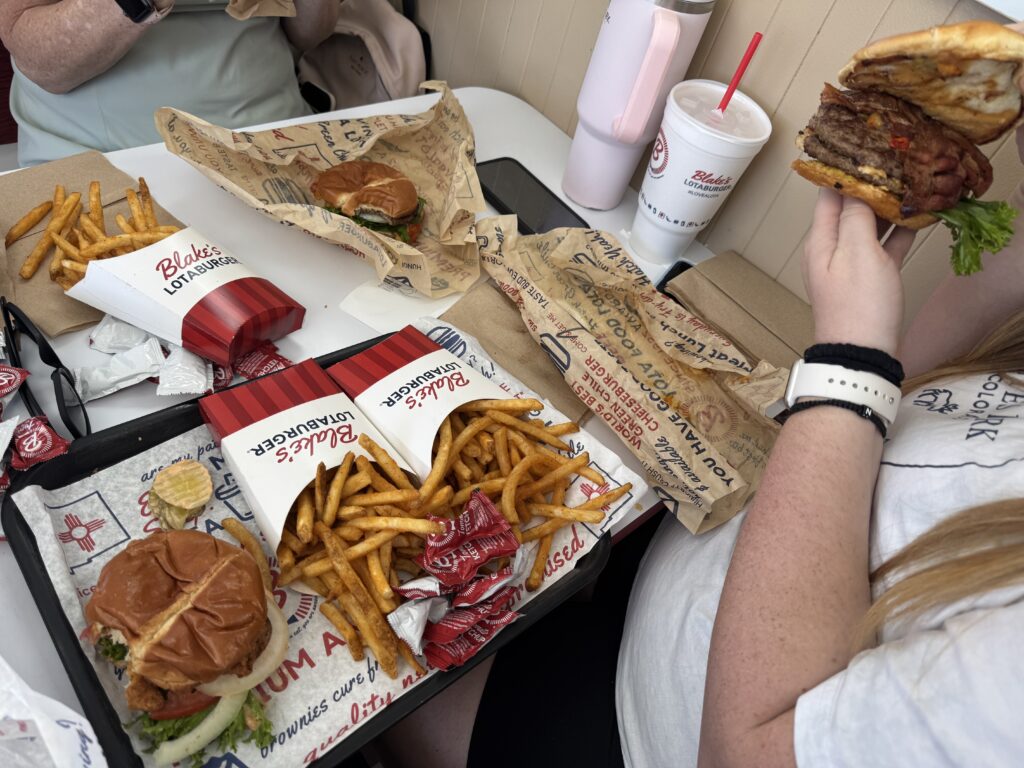
That right there is a capital-M Meal. Their use of green chiles was masterful, their portions on the fries were lovely, and all four of us left in a greasy, happy haze.
Ok, now we can get to the good stuff. Up and over San Augustin Pass between the Organ Mountains (please see my post about our hike there two days later) and the San Andres. Past the missile testing range, which was not-at-all-suspiciously blocked off by a giant vehicle with lights flashing. Northeastward past a Border Patrol checkpoint, where presumably everything we said in the car could be heard by some cutting-edge military technology. Now there were little glistening piles of white just beyond the trash-strewn roadside fence. On the other side of that fence: my 26th national park.
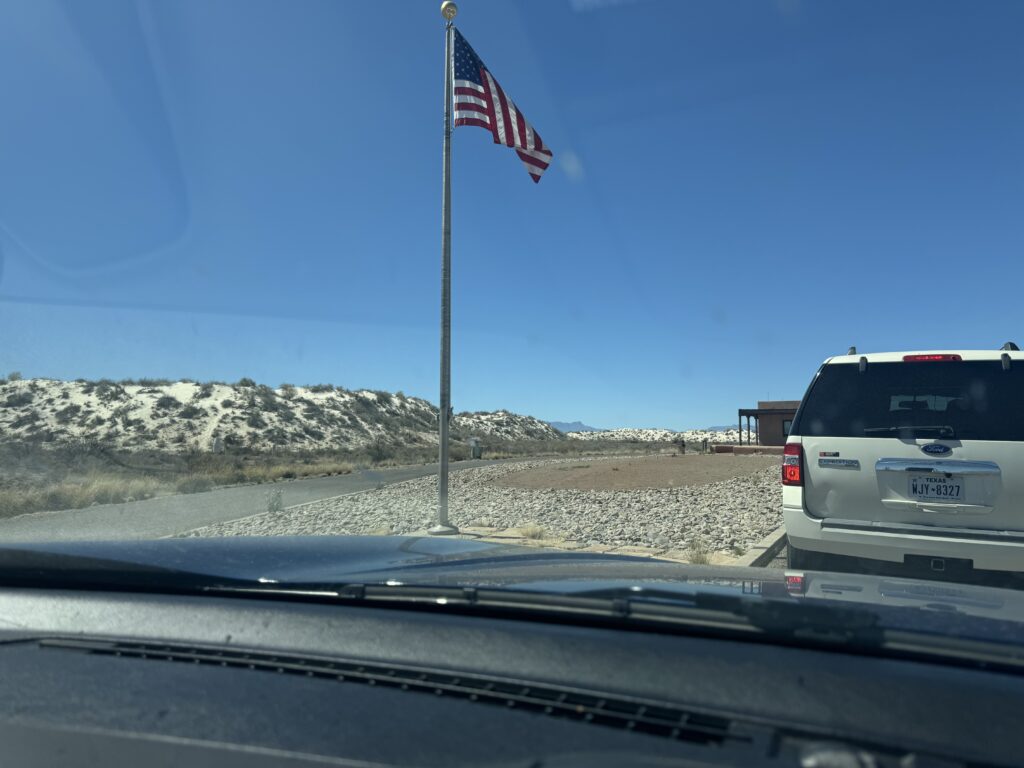
Entrance into the park was a surprisingly long affair. One wouldn’t think that White Sands National Park would be super-crowded in late March, but I talked with an elderly employee later that day and he told me that Spring Break is the absolute peak of visitation here. I guess that makes sense. Not many people are itching to go to far southern New Mexico in the dead of July for obvious reasons. Regardless, it ended up taking about 5 minutes to find a parking spot in front of the combined visitor’s center and store. That was in and of itself a bit of a dog and pony show with a whole bunch of people milling around and not a bunch of space. Unfortunately for me, I was in the presence of the three people in the world who buy more souvenirs in the national parks than anyone else. It took a little while to get into the actual park.
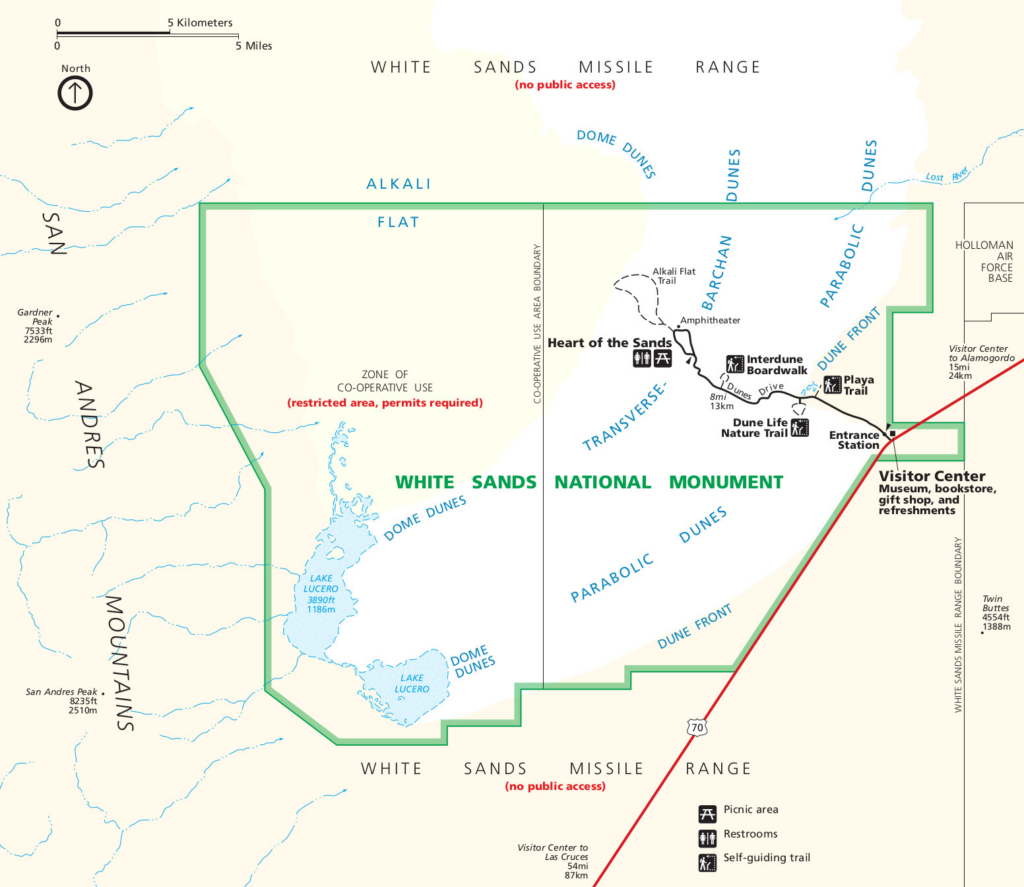
As you can see from this map, White Sands is not all that complex of a spot. There’s an entrance, and there’s a road of hard-packed gypsum that winds through the dunes, and then there are miles and miles of open white expanse. And that’s it!
And so we drove out into the dunefield. The road had frequent pull-off spots for people to find their own spot to explore (as long as you don’t wander off into the missile range, I guess). A lot of those pull-offs were already full up with cars, so we probably drove 2/3 of the way clockwise around the loop before pulling off on the inside of the “road”. Thanks to a sled Rich had purchased at the gift shop, we had our entertainment lined up for the midafternoon period.
Some first impressions upon stepping out of the car: my goodness, it was warm. I know there was a heat wave across the Southwest, but if this was possible in March, then get me the hell out of here before summer arrived. With a scorching afternoon, any person who has been to the beach knows one thing: you don’t want your bare feet touching the sand. Except: because the dunes at White Sands are actually formed by gypsum instead of your normal silica/quartz sand, the pure-white crystals reflect most of the incoming sunlight and stays comfortable even on the warmest of days. I would never have believed it if I hadn’t taken my shoes to test the waters myself, so to speak. That was a trippy feeling, standing in lukewarm sand even though the day was hot. And finally, thank goodness I had sunglasses. That was a hell of a lot of reflection.
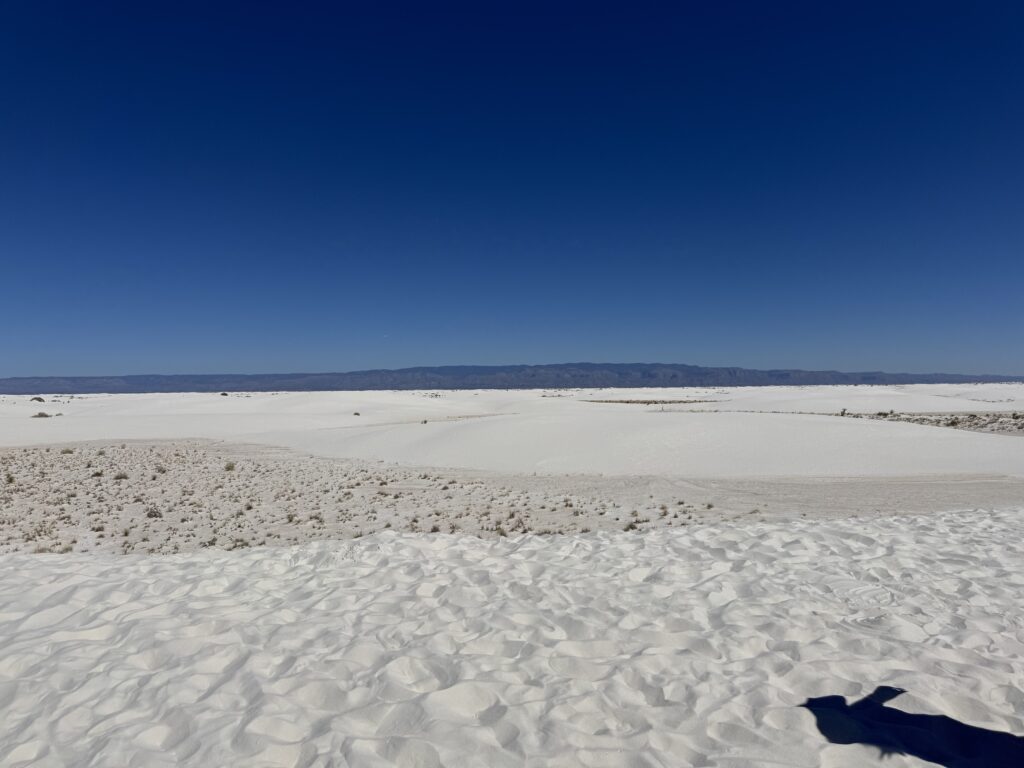
If you trudged out a way to get away from the road and the footsteps, the sand itself took on a serene sort of beauty only occasionally broken up by the tracks of a snake or a mouse.
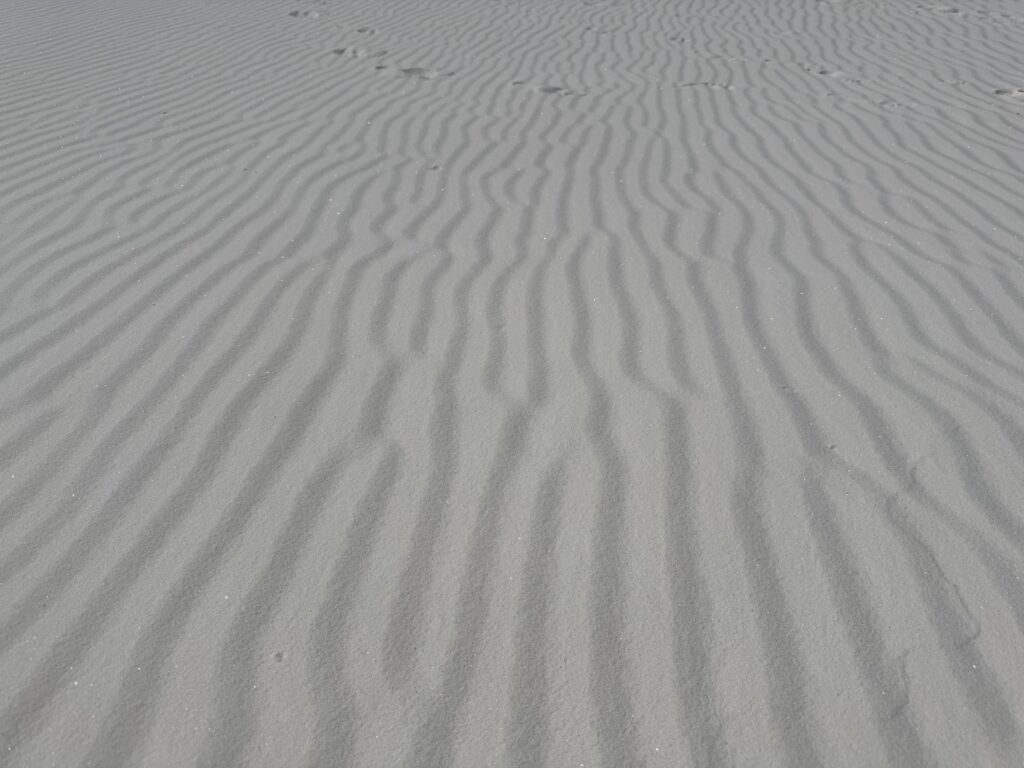
Elizabeth and I wandered away from the road for about 10 or 15 minutes before coming back. It was peaceful further away, but also would have been very, very easy to get lost. My parents insisted we not go more than two dunes away. I rolled my eyes at that until I got two dunes away, then saw the wisdom in it.
But it would have been nice to get further away, because as it turns out, when you live in the barren Tularosa Valley of southern New Mexico, going to White Sands is sort of like your “going to the lake”. Many of the pulled-off vehicles around didn’t appear to be your standard NPS recreation enthusiasts, but were rather just random locals. They came equipped with tailgate tents, picnic tables, speakers. Hell, one group had a kickball game going with a dune as their outfield wall (I took a guest kick and managed to put it about halfway up the dune). I guess it looked like great fun, but it wasn’t exactly how I expected a national park visit to go.
Not trying to rush to judgment, though. Because we found out pretty quickly that once you’re in the park and you’ve walked around a few dunes, there isn’t much else to do other than treat it like a beach day? We had time to experience this in its fullest because sunset wouldn’t arrive for another 3-4 hours. There was a guided ranger walk in the hour before sunset that my parents wanted to attend, so we were locked in until then (and I was itching for sunset photography anyway). So yeah. The sun beat down on our shoulders as we huddled in the meager shade of the car. Now the people with the big tailgate tents didn’t seem so clownish, did they?
That did leave out at least one thing that you can do: dune sledding. I’ve been dune sledding before on a trip to Coral Pink Sand Dunes State Park in Kanab, Utah with my parents way back in 2016. For Elizabeth, this was a first. And… it was fine. It was fine! The real problem with sledding at White Sands is that the park is famous for the white-gypsum sand dunes. It’s not famous for the gigantic white-gypsum sand dunes. So while dune sledding at Great Sand Dunes NP might be real fun, here you sort of feel like you’re winter-sledding in the flat no-man’s land known as Norman, Oklahoma.
Elizabeth did her best to make it look cool, though.
Her best was pretty good. She was better at it than me.
Otherwise, we enjoyed our own pseudo beach-day by playing some Bananagrams on a blanket (a Meister classic), drinking plenty of fluids and testing my mom’s battery-powered neck fan, and overall enjoying not being in a festering cloudy hellhole of lake effect snow like the last four months (this last part may have been more a reflection of my parents than myself).
A little before 5:00, as the sun was beginning to set toward the rugged wall of mountains in the west, we headed back to the Visitor’s Center. Now that the crowd had cleared out a little bit, we could do some of the more tourist-y things one does when they’re at an NPS entrance – watch the dramatic video narrating the formation of the gypsum dunes, play with the (relatively meager) interactive exhibits, and take pictures with the NPS signs. The official “White Sands National Park” sign is kind of an underwhelming artistic effort.
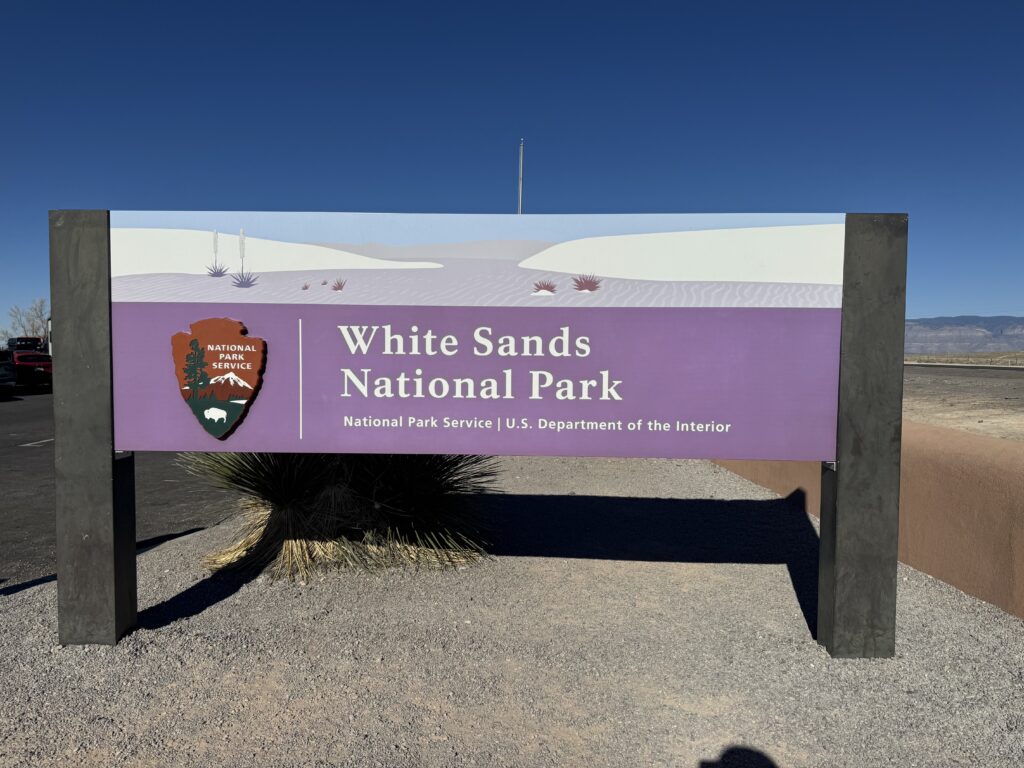
There’s some history behind this. After decades of failed efforts at protection, White Sands was made a national monument by Herbert Hoover in 1933, but various issues (the nearby military base, local opposition) made it so that the area didn’t receive full national park status until it became our 62nd national park in late 2019. So that sign is a piece of crappy 2020s architecture, which makes a lot of sense. In the old days, we would have gotten something much more rustic and cool. Such as:
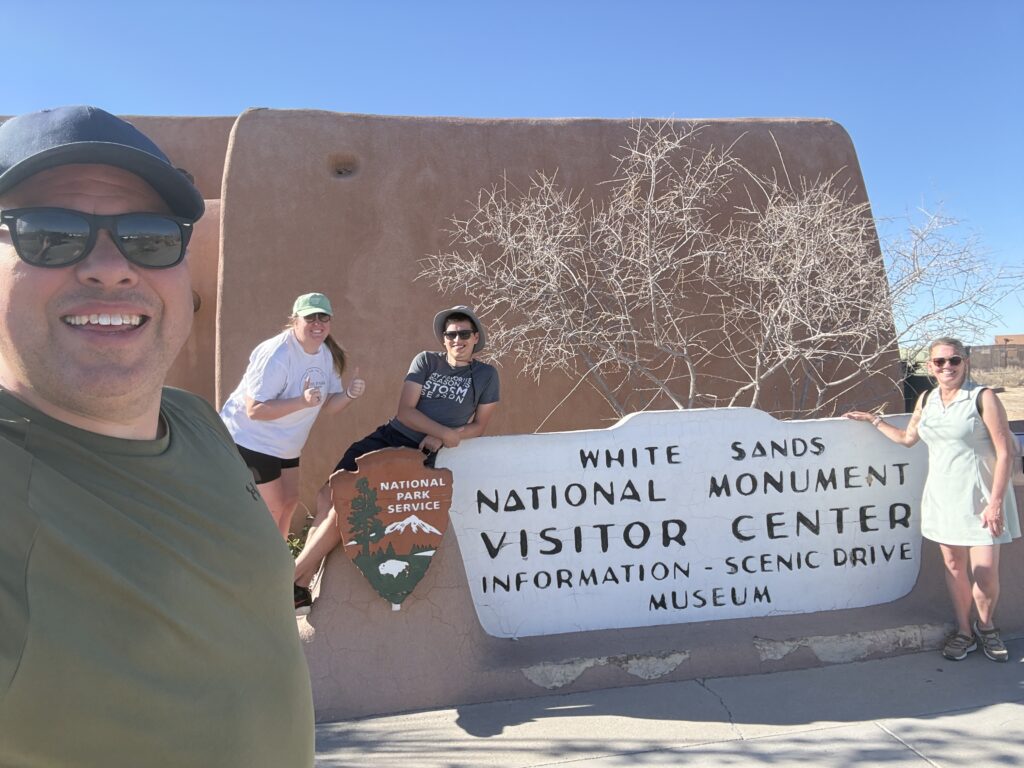
Way better.
By now I was hungry enough to make even something like a Wal-Mart ham and cheese sub sound good. We headed back out into the beginning of the dunefield to a spot where a few shelters houses picnic tables. It turned out that the principle of “everything tastes better in a national park” does require you to work for those calories a bit more than I had done so far in White Sands, but my parents are also the undisputed champions of packing snacks for picnics. Nobody could starve with all of the different types of Pringles, pretzels, fruit, and even some leftover Blake’s Lotaburger fries that Elizabeth had stashed. We all fueled the fire to keep going through the evening.
At about 6:00, our car was one of the first to pull into the largest parking area in the dunefield. An interpretive ranger gathered people around them like a sort of khaki-clad Pied Piper. By the time they started speaking, there were probably 100 little piggies all around, listening intently. That included people of every age and fitness category, since this interpretive walk would be less than a mile. It even included multiple dogs (some of them pretty reactive. Scipio would have had a field day at White Sands).
It didn’t include me, though. The problem with following a shepherd around is that I’m kind of a poor sheep. The daylight was fading into the perfect golden sunset that was everything a photographer could ever want and then some. It was time to go hunting for some foregrounds. My dad briefly tried to get me to fall into line with everyone else, but my mom and Elizabeth were right: just let me cook.
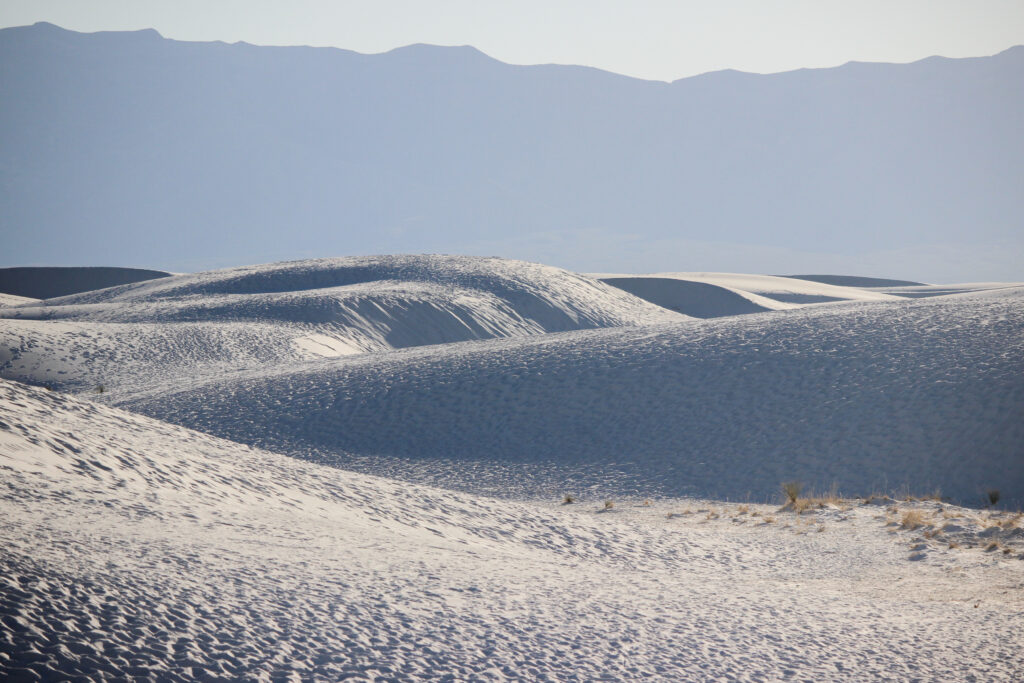
I drifted in and out of the group often enough to hear what the ranger had to say. Some of the adaptation that plants animals make to survive in this hyper-specific environment is really mind-boggling. Dune grasses and yuccas can dig their roots deeper and deeper as the gypsum sands propagate northeastward over time. Tadpoles sit in the playas for ages, frozen and immobile until water appears. Everywhere underneath us, a sturdy water table helped hold the dunes in place, as the guide showed by having a small child draw up a glass of water through a hole drilled in the sand.
And then in between, it was back to work. Especially as the sun sank lower and the light became more golden.
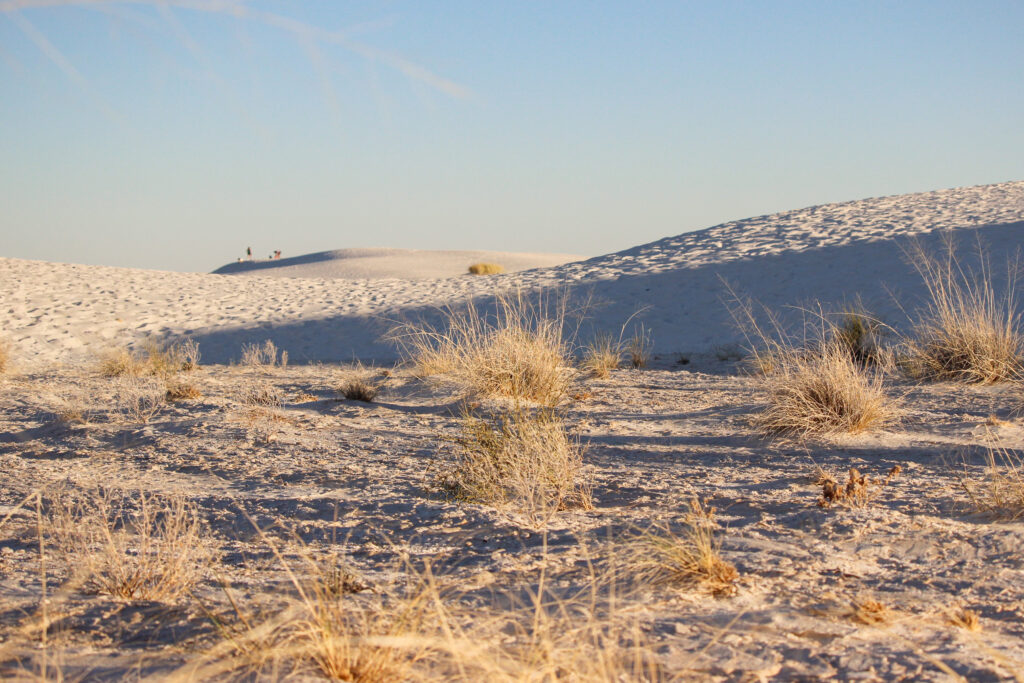
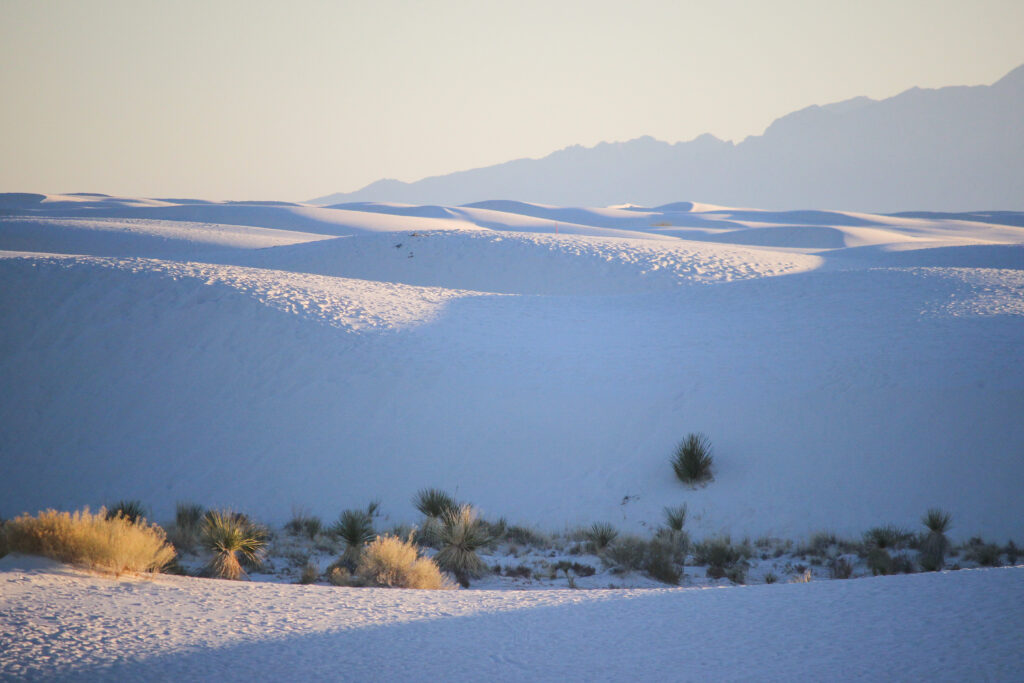
The guided walked ended around 7:00. The sun still hadn’t set over the San Andres in the distance. Here and there, as far as you could see, groups of people dotted the high ground, looking toward the west. Children ran around and played. People laughed. But mostly, they took pictures. Some were like me with cameras, but most were getting set up and posing dramatically for Instagram. It was kind of depressing. What ever happened to just enjoying a sunset?
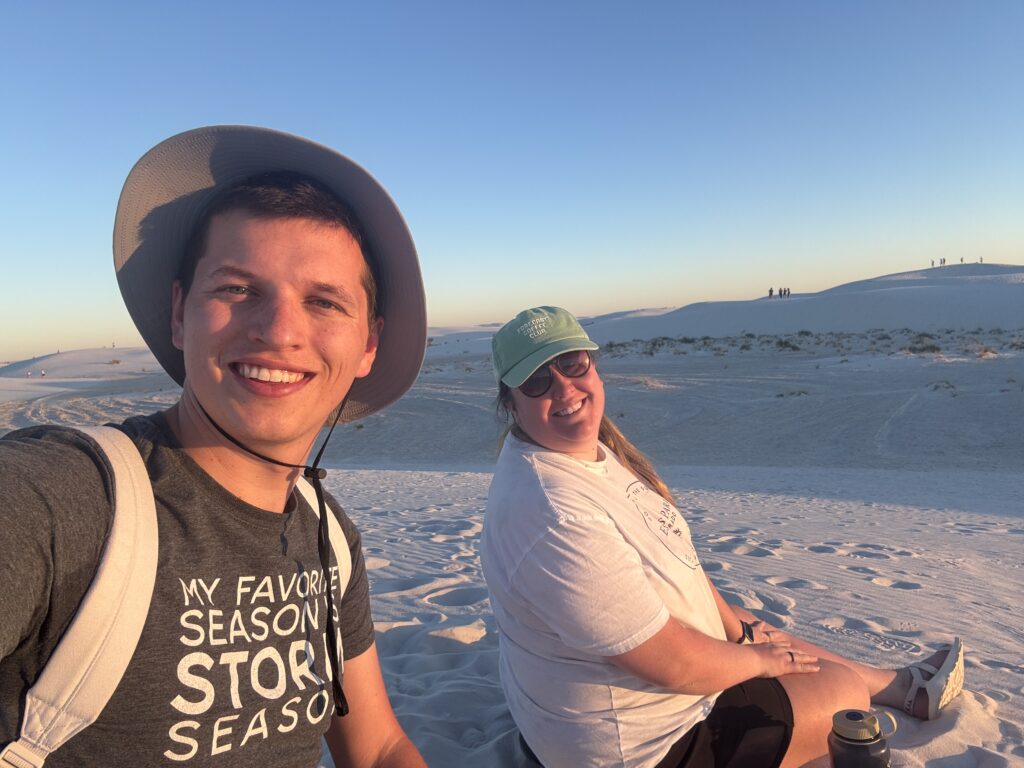
Anyways, here’s a picture I took of Elizabeth and me. It’s much different when I do it, you see.
The sun dipped behind the mountains, leaving a brilliant red alpenglow back in the Sacramentos off to the east.
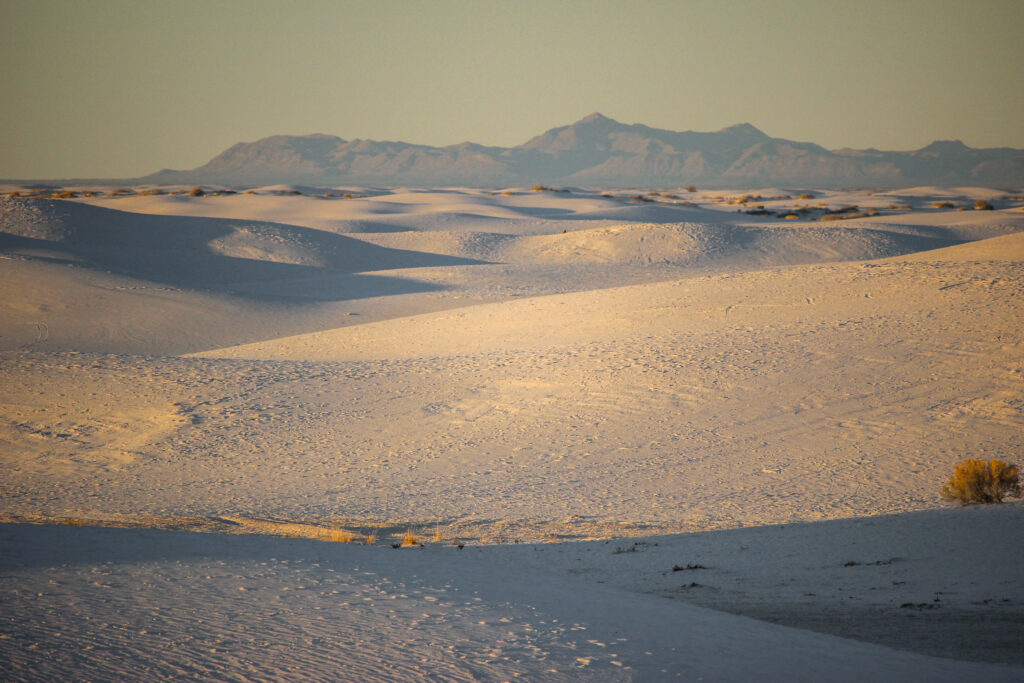
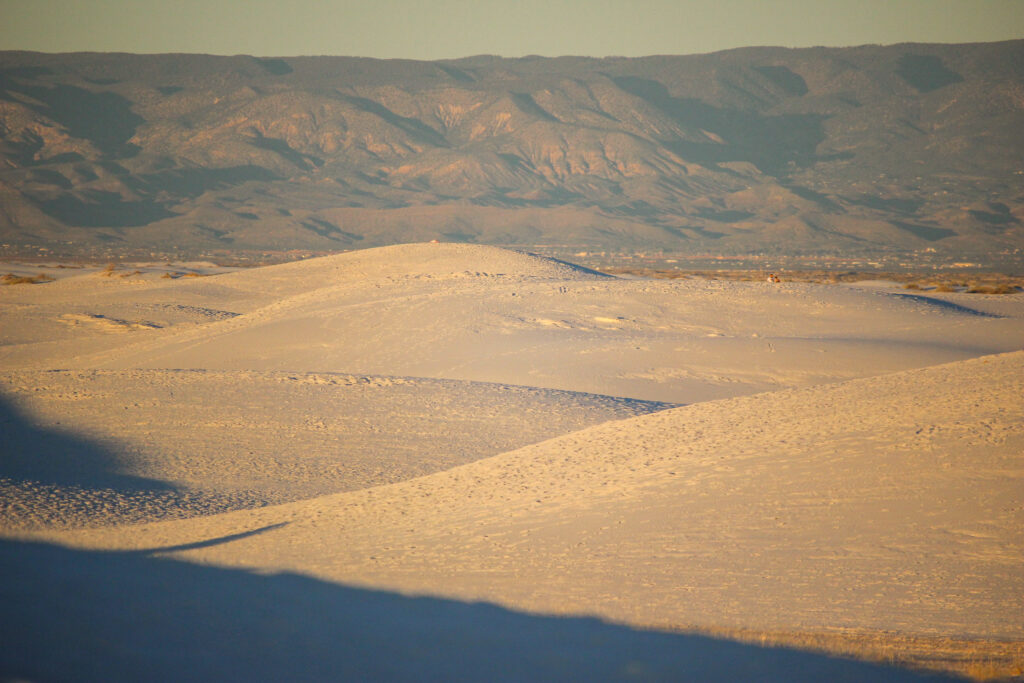
But the star of the show was the western sky, which turned ablaze around 7:30.
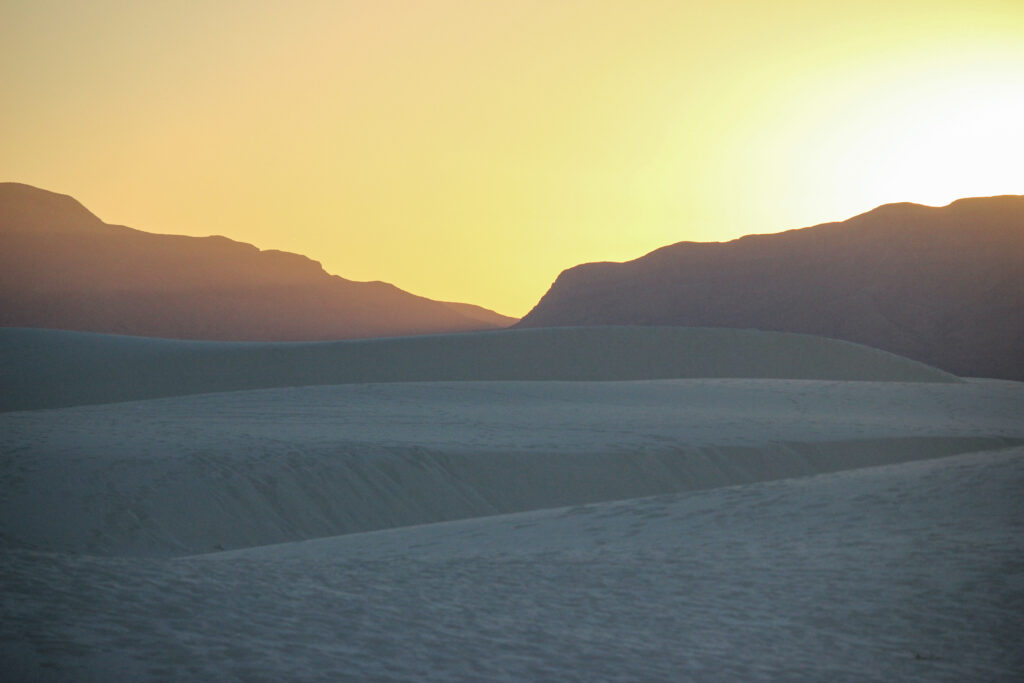
And finally, as hundreds of onlookers (or at least photo-seekers) started to file back toward the parking area, the light faded away.
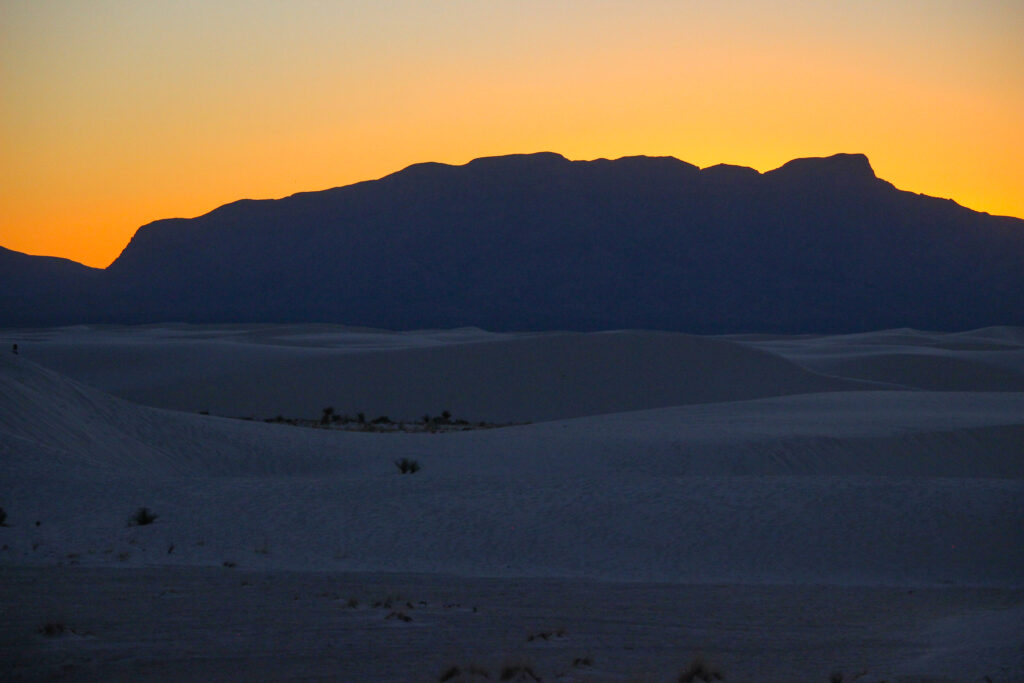
I don’t know if it was the most magical sunset of my life, but it certainly takes the cake in 2026 halfway through the year.
Elizabeth and I joined the exodus of humanity walking through the still evening air. At some point, it had begun to cool off. As hot as those desert days were, the late evenings and early mornings from this trip were a real treat. We joined my parents and trekked back to the car. You don’t want to get left behind after sunset – White Sands is one of the rare national parks that closes the gates a half hour after sunset, so everyone (with the exception of the few people who get backcountry camping permits) has to be out of there pretty quickly.
As we walked down the final dune, I took a look behind me. The moon was already visible in the ink-blue sky with the last vestiges of twilight still visible over the mountains.
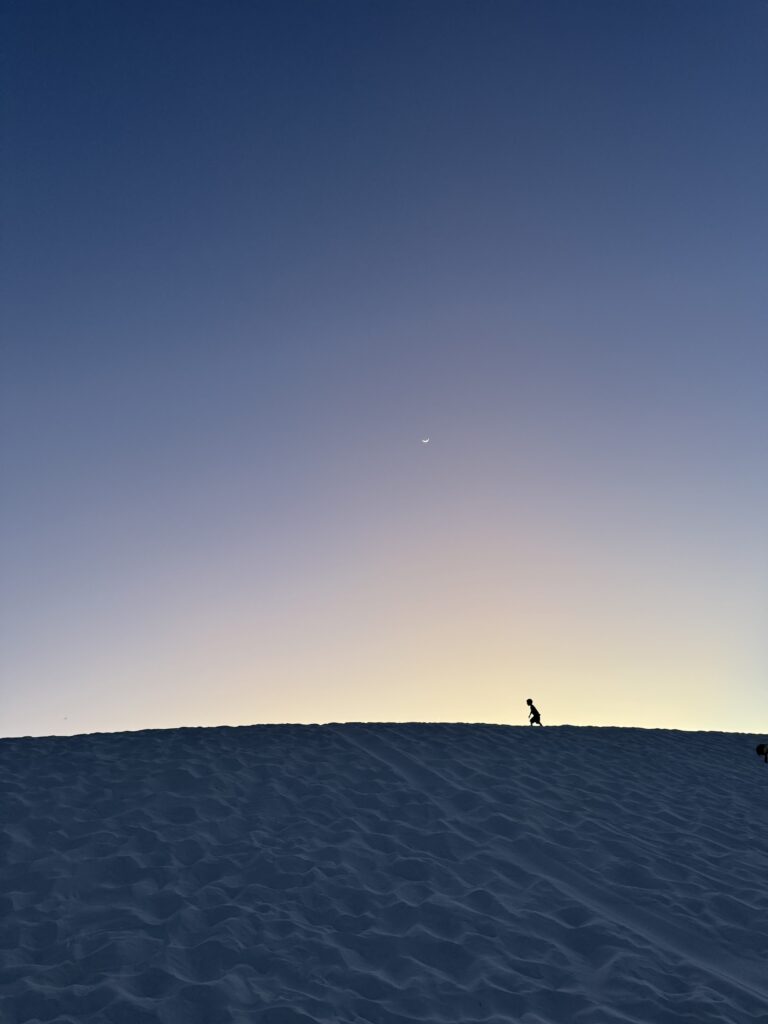
White Sands isn’t your typical national park. It’s probably not one where you keep exploring for days or weeks on end. But it’s also not the NPS Redneck Yacht Club that I originally thought when we parked by the tailgate tents and speakers earlier, either.
Go to White Sands in the evening. See how the colors change, the shadows dance, and the breeze becomes completely still. And you’ll understand why it’s our 62nd national park.
