But if you close your eyes
Does it almost feel like nothing changed at all?
And if you close your eyes
Does it almost feel like you’ve been here before?
Pompeii by Bastille – 2013
I don’t know why I included the Bastille lyrics. The song is just stuck in my head as I start writing this. Hopefully it doesn’t get stuck in your head. Anyways! On to our first European adventure.
It would be a little hard to explain just how rapid the transition was from “travel mode” to “hey, we’re doing something” mode at the start of this vacation. One minute, I’m waking up on a Lufthansa flight that’s descending into Naples without a clue in the world what time it is. The next, we’re on the the ground and waiting for checked bags to arrive at the weirdly rundown Naples airport. The next after that, all three of us are waiting outside the airport for our driver to come pick us up because there’s no customs in the Schengen Area. And a few minutes after that, I’m sitting in the backseat of a giant van, looking up at the slopes of Mount Vesuvius and hoping that our driver doesn’t kill us en route to Pompeii.
To give you a sense of how stunned my senses were by this rapid shift in surroundings, I still have no idea where exactly the driver dropped us off. Or to whom. Or anything else. What I remember is that the roads started to narrow, and then there were massive puddles from all of the rain (do Campanians deal with flooding often?), and then the van had pulled off in front of a big covered patio. The driver was opening the doors and introducing us to our Pompeii tour guide, who was promising to meet up with us as soon as we were done with lunch. Lunch… right. I guess we should be hungry, since it was 2:30 local time in Italy.
Gradually my wits returned to me as Elizabeth, Pam, and I sat down at… some restaurant. I’m planning a whole food post for each region, so don’t go looking for any pictures of my pizza in this article. With that said, it’s still worth mentioning the restaurant because it was my introduction to the idea that Europeans can charge you to use a bathroom. As an American, I bristle at the very idea.
Our tour guide was waiting patiently outside the restaurant with an umbrella in hand. I will sincerely apologize up-front for not remembering her name, because she was awesome. It wasn’t until our guide (should I just call her Guide for short?) brought the three of us across the street that I realized just how close the ruins of Pompeii were. In that, I of course mean that the entrance to Pompeii was literally across the street. To be fair, the park entrance is well outside the excavation zone, so how could you really know if you weren’t paying much attention?
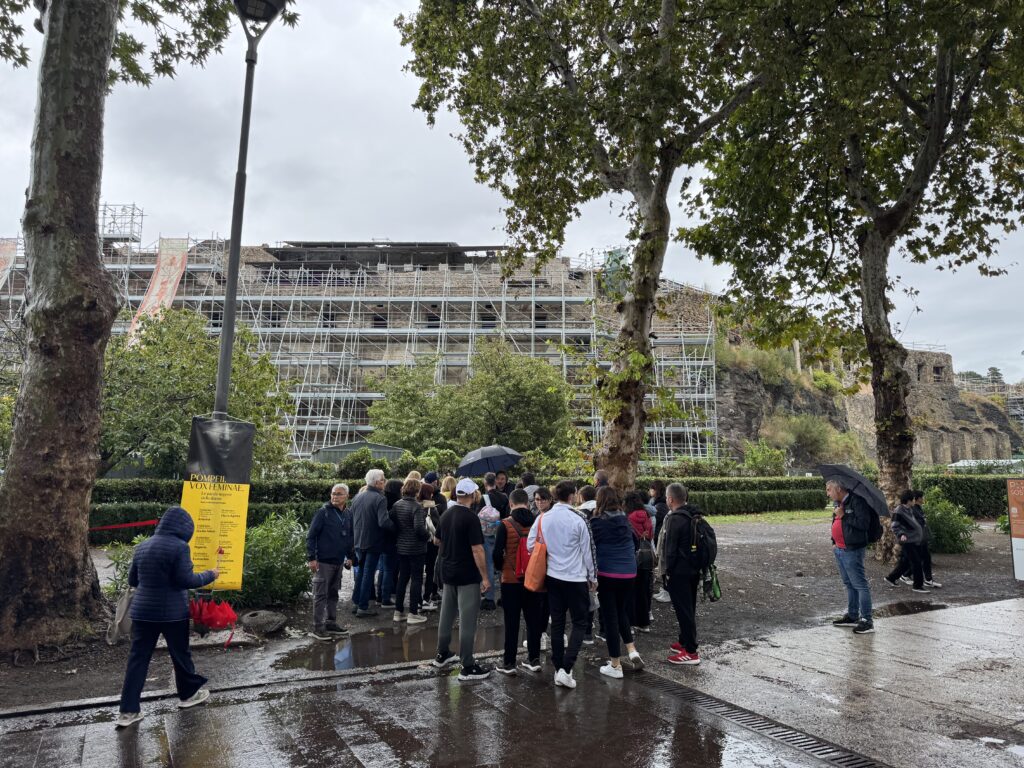
There was a brief queue and security zone to pass through, but it turned out to be a breeze as long as we were with Guide. This was a thing that happened consistently on guided tours here and in Rome – there would be a long line, and we would just… skip it. It’s probably not the egalitarian thing to say, but it’s pretty cool to be a VIP on a tour like that.
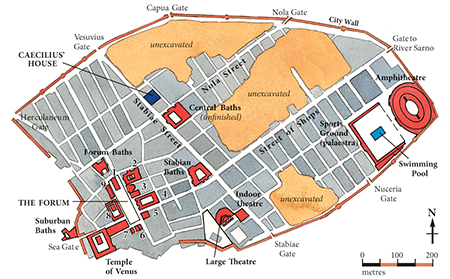
It has taken me an embarrassingly long time to even begin retracing footsteps from this tour. For one thing, all of the maps are in Italian. For another, I have already gone on about my complete lack of spatial awareness. And for a third, posting that map above has finally made me realize that it would be very simple for a tour guide to hear that I am a Roman history junkie and to take us to some of the places on the map (House of Sallust!) and say “Here is where so-and-so lived”. It’s a very common thing when you’re giving historical tours. People want to see the spot where the historical event they read about occurred; when you go to Gettysburg, you stand along the stone wall and look out at the valley across which Pickett’s Charge occurred. But instead of yielding to that temptation (as at least one guide in Rome was to do), Guide took us around Pompeii to the ruins to look at architecture, artwork, and get a glimpse into daily life of the Pompeiians as best we understand it. And in the end, that was way more historically and culturally enriching than yielding to the tour guide version of Great Man Theory.
Anyways: fortunately for me, iPhones do track the location in which you took a photo. So for someone like me who desperately tries not to take 1 trillion pictures and instead live in the moment, but then fails and takes 100 pictures anyway, it’s like having a little trail of bread crumbs to follow later on. Based on that, I am 99% certain we entered the Pompeii excavation zone at the the Stabiae Gate.
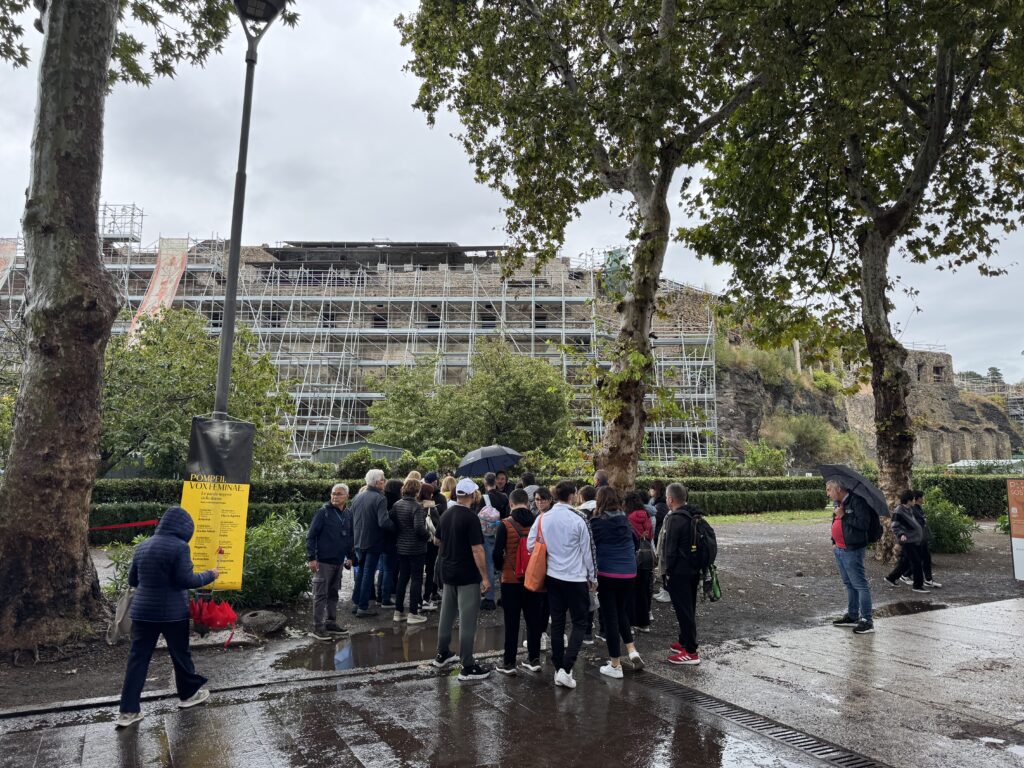
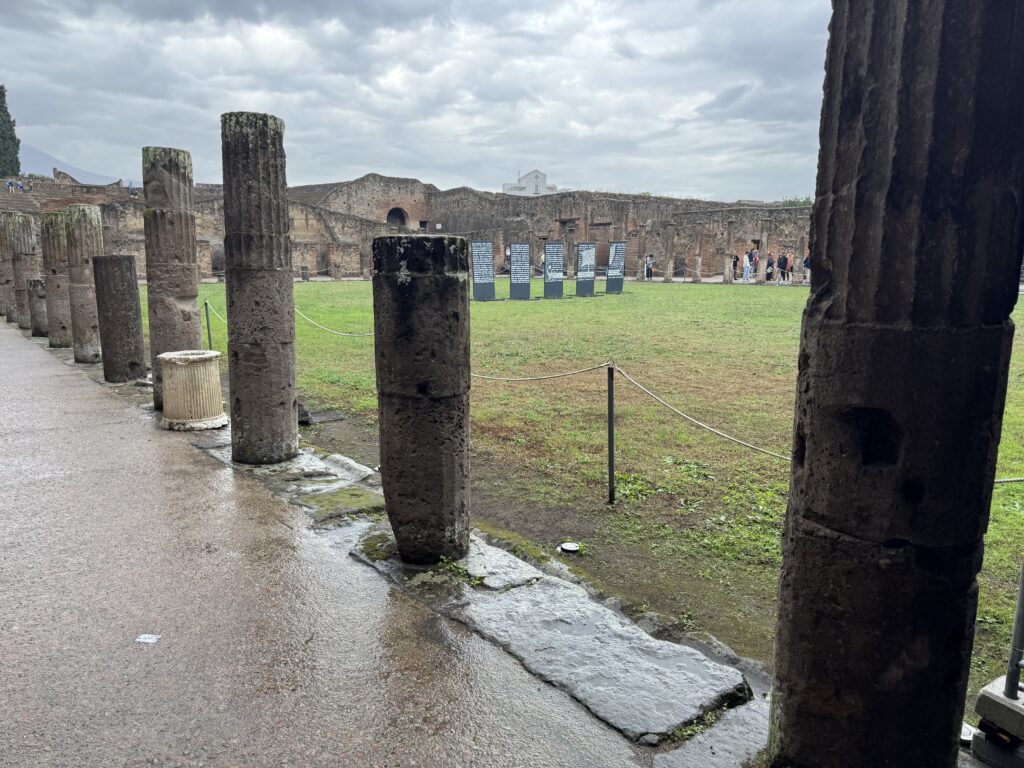
Again: still trying to figure out just what the hell was going on. All of a sudden, we were inside Pompeii itself and surrounded by ruins. Maybe I should have read up a little more on what Pompeii was actually going to be, because I assumed there would be a museum full of artifacts, stories, the preserved mummies of people buried in volcanic ash, etc. Instead, Pompeii looks like what it is: a town that was buried suddenly and unearthed only slowly over many decades by a group of people dedicated to interfering with the memories in the place as little as possible. If the best they could do was unearth a group of broken columns near a courtyard, that’s what the researchers did.
But in other places, there were entire buildings and arches intact, some of them with the inscriptions still showing 2,000 years after some Pompeiian (or Roman, if it was written in Latin) had carved the letters out.
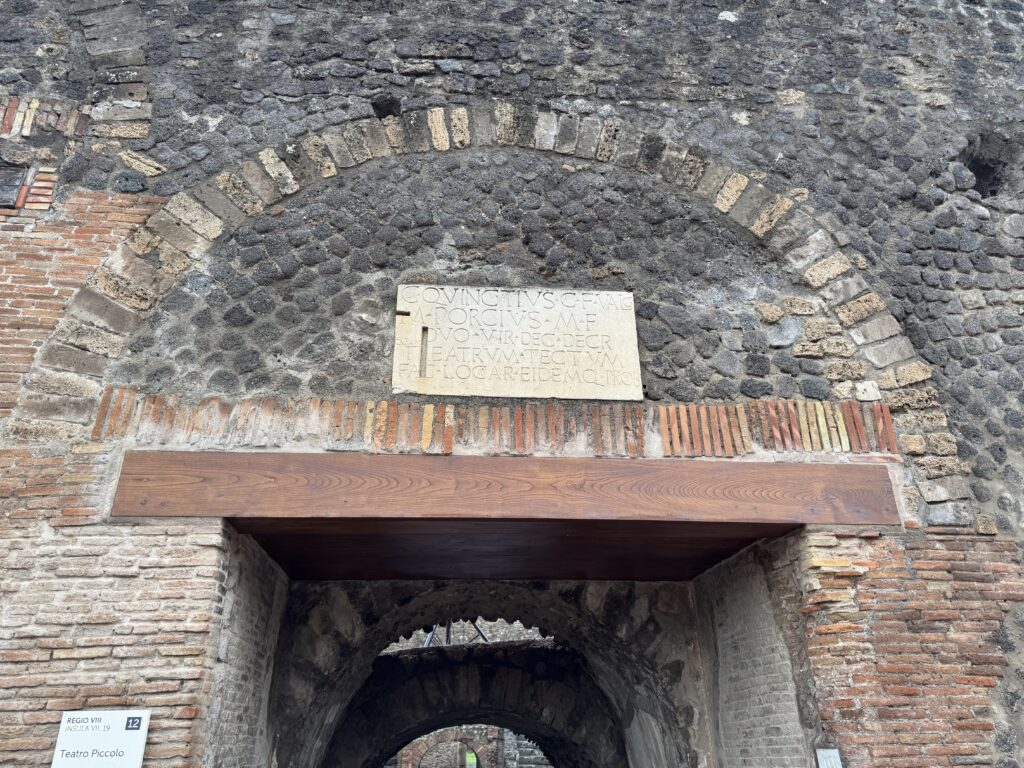
You could take the entire span of my life and go back in time to the beginning of it. Then you could repeat that process another 50 times. And if you used that time machine and went back those 1,400 or so years, you’d still be at a period where you were further away from that inscription being made than we are now from when the Pilgrims landed at Plymouth Rock. THAT is wild to me.
Even though I didn’t know what way was up, down, east, west, left, or right, our Guide did. She was wonderful at navigating the puddly, tourist-infested streets of Pompeii to take us to see as much as we could. Speaking of streets… look at how impressive ancient Roman streets were!
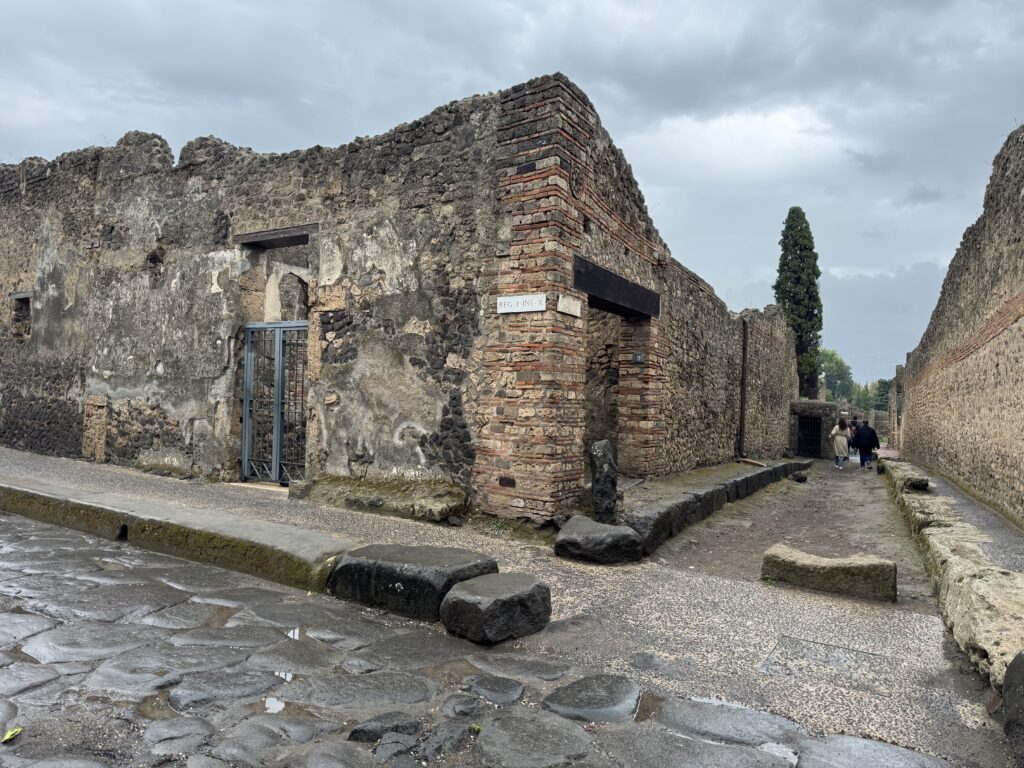
There are even stepping stones in the street that Pompeii put in so people wouldn’t have to step in horse doo doo.
As the map above shows, not all of Pompeii is excavated. Teams are still digging in active, taped-off zones that crisscross the town. Our guide took us up a ramp somewhere near the back that crossed through the excavation zone and back into something closer to terra norma. It’s a reminder that while Pompeii was situated on a hill, meaning the outer scaffolding towered above the park entrance, the ruins are also buried under feet of volcanic ash and other accumulated sediment. This ramp was taking us through that layer of rich-black volcanic ash to be able to see the action.
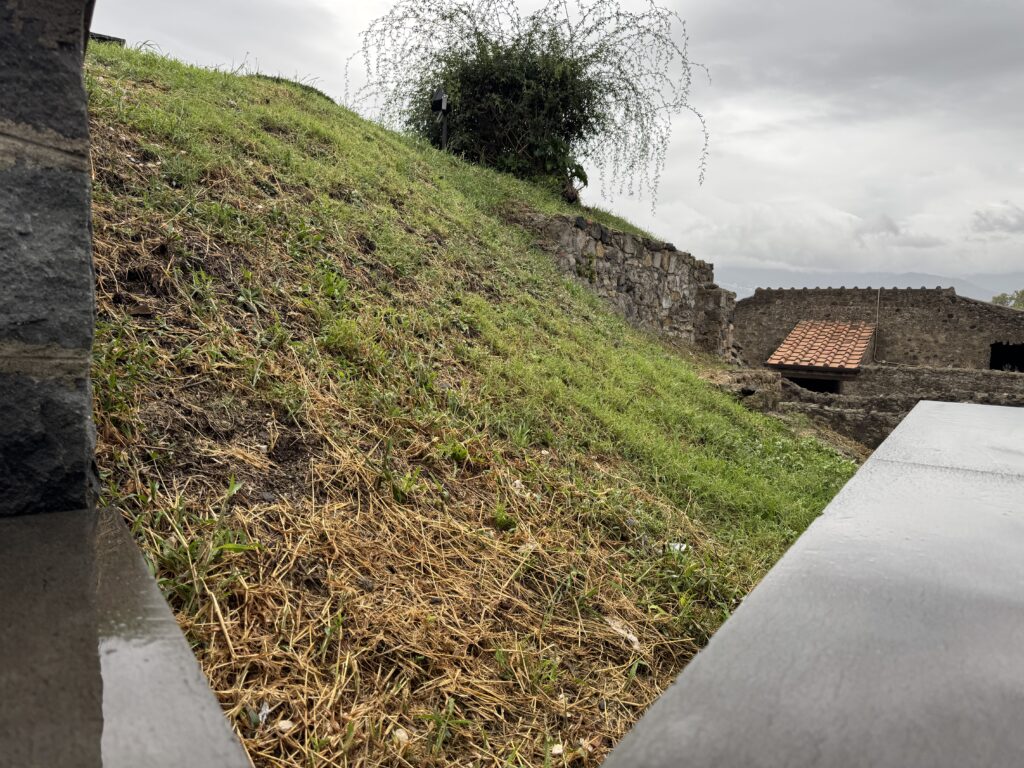
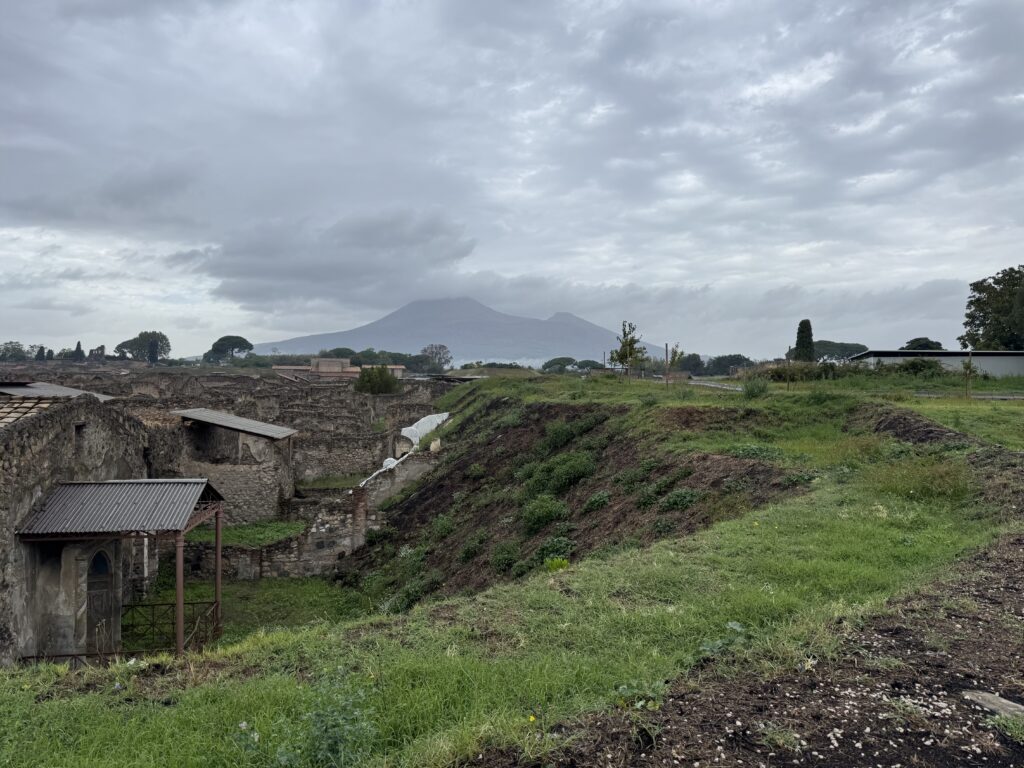
Up on top, we got a slightly more panoramic look at the town below.
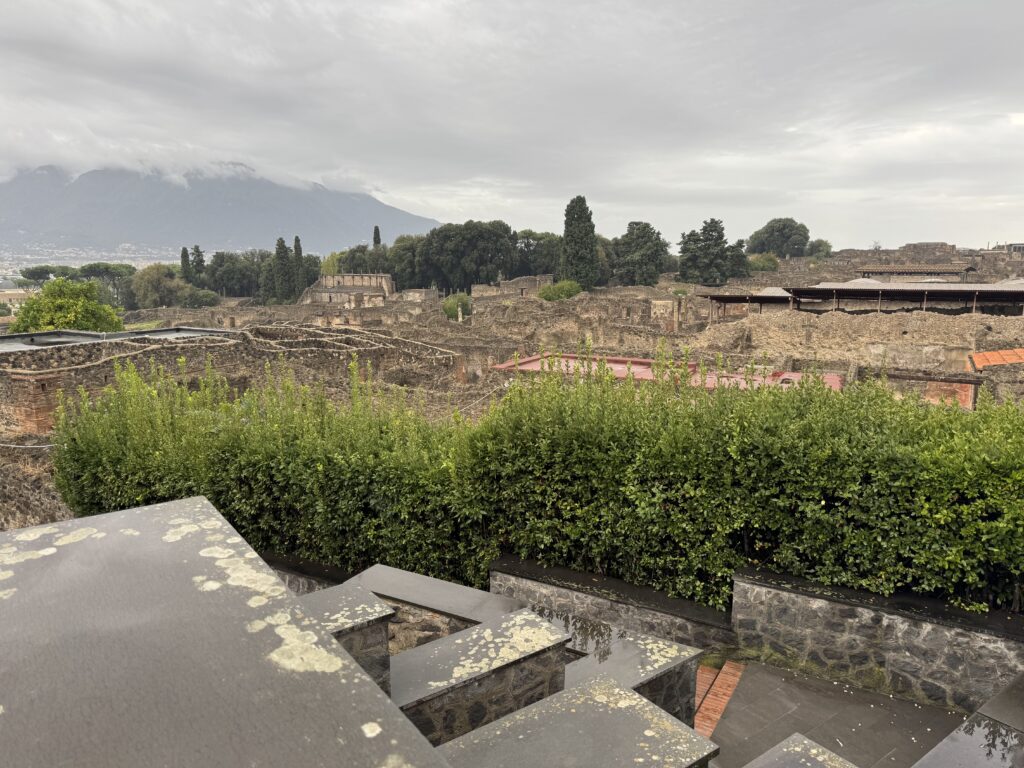
In fact, it was a great place to get a family picture.
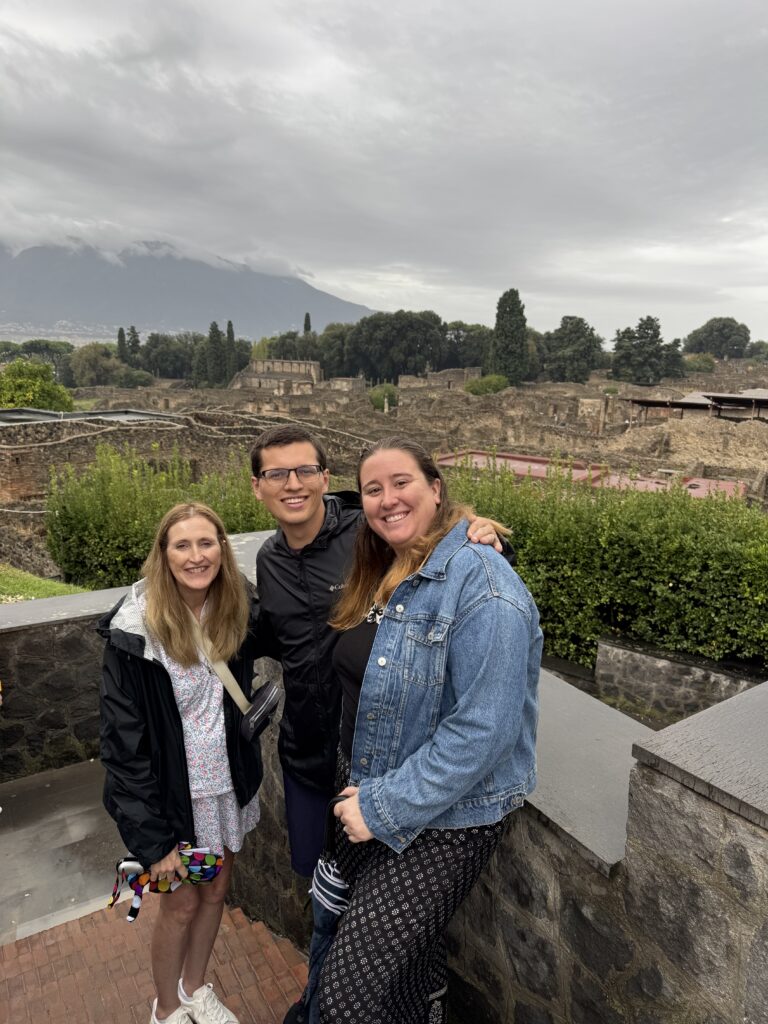
If only Winston were there to enjoy it with us!
I really can’t emphasize enough how enraptured I was. What surprised me was how enraptured Elizabeth was. Turns out when she was younger, she had a bizarre fascination with Pompeii of her own. So we sort of had both types of people in our group – the over-the-top Rome history nut, who was going crazy over things like “street layout” and “stormwater drainage” and “oh my god look at that inscription”, as well as the Magic Treehouse fan who was skeptical but intrigued to visit here because she thought she was going to see some mummified volcano victims. (We really never stopped to see anything like that. I believe there is a museum where you can go and see stuff about the volcanic eruption and the final moments of Pompeii, complete with plaster casts of people being buried in ash, but I really think the better way to visit is to stroll the streets and admire the pristinely preserved village).
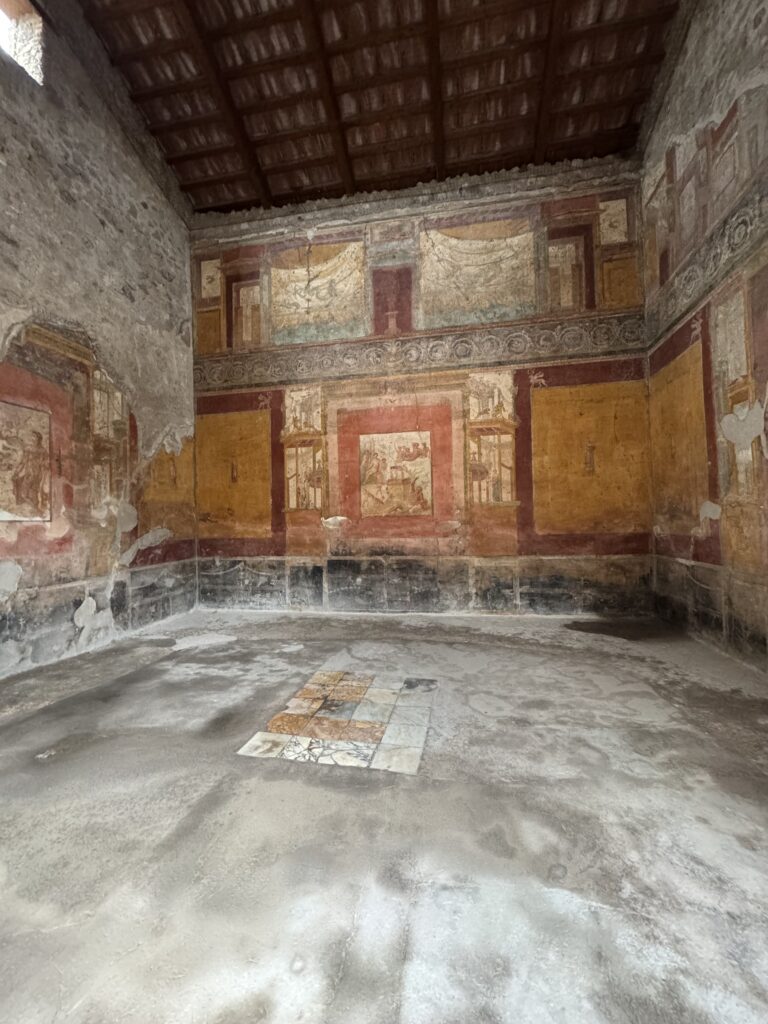
When we descended back into town, our guide took us down a few streets where we could get a good look at some of the living standards that Pompeiians would have experienced. There were homes that had servant’s quarters in the back and big, open-air living rooms where rainwater collected into shallow pools. There were homes where you could still see the frescoes and artwork remarkably intact after all this time.
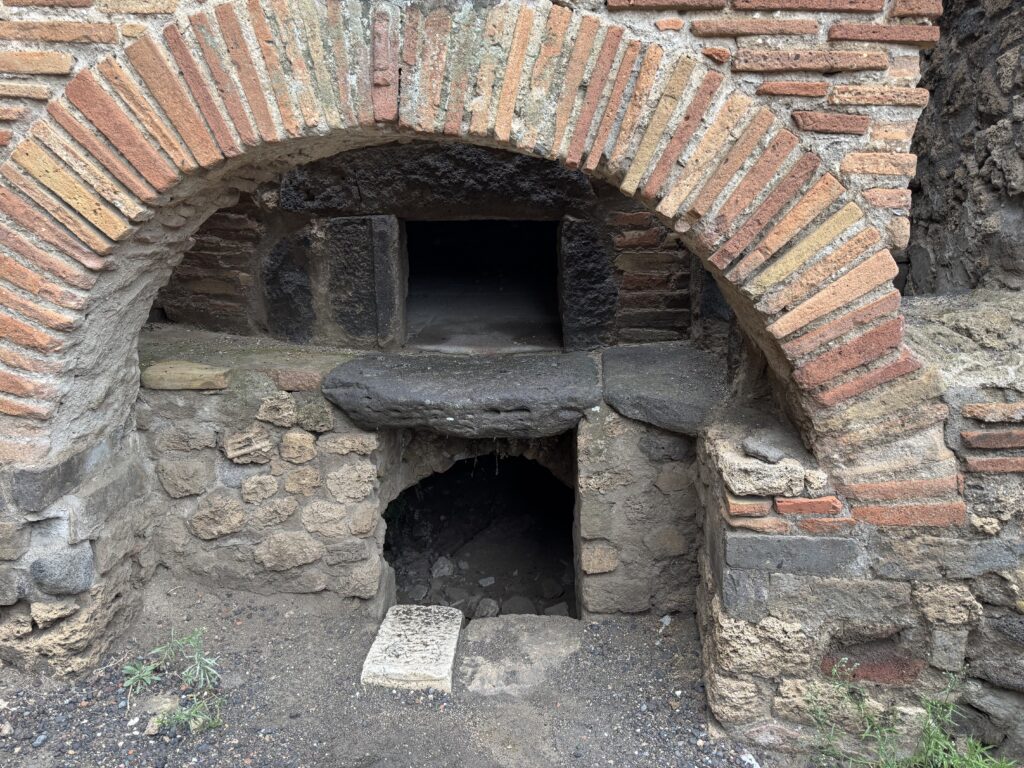
There were bakeries with still-intact ovens where you could just imagine some sweaty Italian baker putting in loaves of bread any moment now.
There were even signs pointing you to the redlight district in town (the phalluses on the signs are very helpful, ancient Italians. I think I know where I’m going now). But to me, the coolest part of the whole day was seeing the Stabian Baths, a large and luxurious bathhouse. In some places you walk through the town and you think “my goodness, these buildings look barely nicer than something you’d see in the Stone Age”. Then you go to the bathhouse and realize that the Romans rigged up and underground heating system stoked by a furnace so they could have their baths turned into a sauna, and you realize that what we see today are a mere scratch compared to the sophistication of a classical town. Sure, some people probably did live in extremely rudimentary squalor. But ignore the incredible achievements of the civilization at large at your own peril.
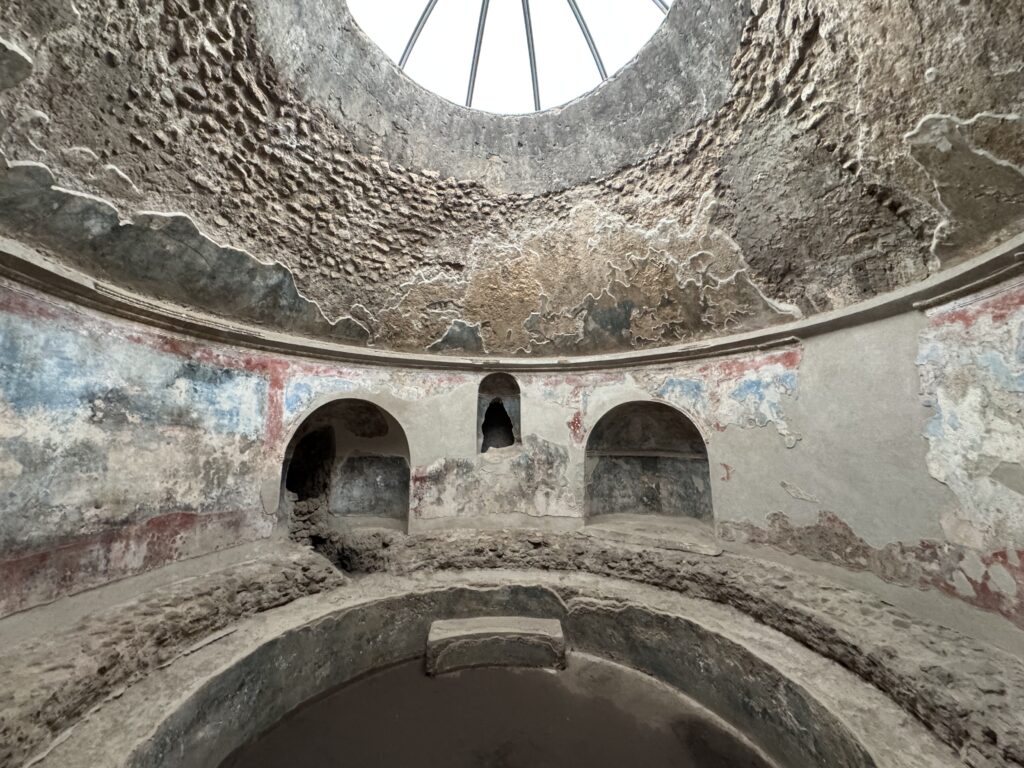
With that said, I am opting out of the historical hypothetical where I would use these bathhouses in the first century AD. Way too many Romans who didn’t wash their hands after pooping before getting into the pool. It’s no wonder the average life expectancy in that period was something right around my age right now.
In the blink of an eye, it was close to 5:00 and we had been wandering around Pompeii for an hour and a half. The three of us had to continue our ride down the coast to Sorrento at some point, while our guide presumably wanted to go home soon. She took us to the final stop on our journey. And man, what a final stop: it was the ruins of the Pompeii forum. Before, the hints of the Roman past in town were subtle – the style of reconstructed columns, the antique-font inscriptions, or the tight-packed brick roads. But here in the forum, it was obvious we were in a land that had once gleamed in white marble. All of the renderings and the movies sprang to life in my mind. You could almost convince me it was a gloomy afternoon in 78 AD, and the residents of Pompeii were out and about at the forum, selling this and that and listening to local politicians…
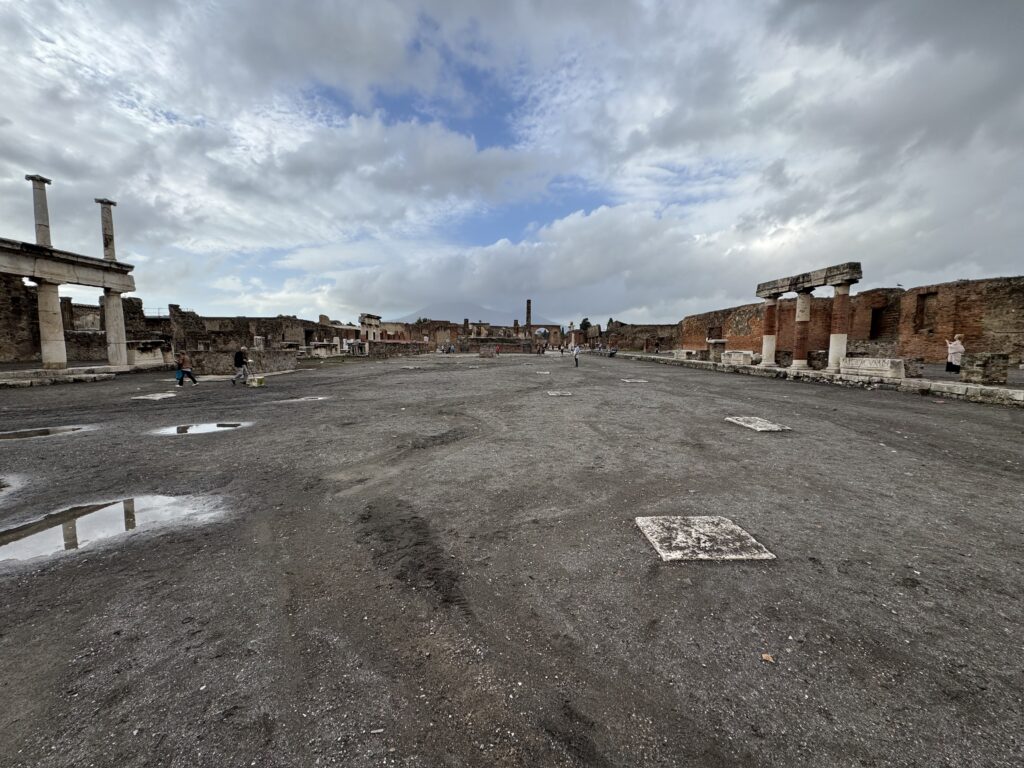
I just kept exclaiming how cool this was. Elizabeth (who again, had been skeptical) agreed with enthusiasm. So did Pam. We had 2 whole weeks in Europe and were starting with what might end up being the best part of the whole trip? (It wasn’t. Not to take away from Pompeii, which really was incredible, but there is sooooo much more to dive into from that trip). A lot of the shine of the experience came from our tour guide, who was the absolute best. She was knowledgable, in a hurry, and seemed to know exactly what I was looking for in the tour. I really wish I had remembered her name, because she ruled.
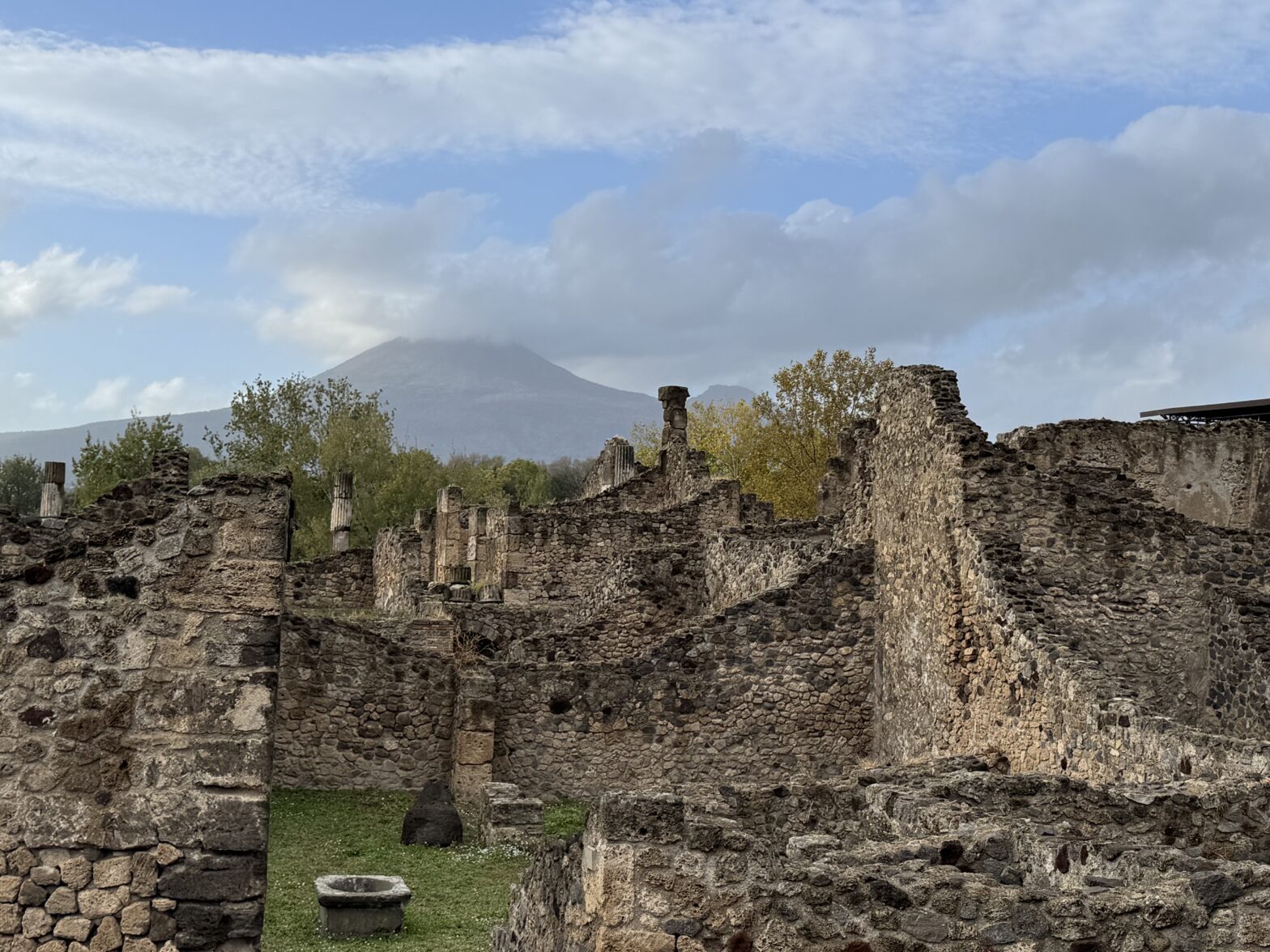
As we left the excavation area, the post-rain cloud cover finally started to break. For the rest of our time in Europe, we wouldn’t see any more precipitation. The sun shone weakly on the western horizon just in time to illuminate the emerging slope of Mount Vesuvius. Now that is a volcano, for sure.
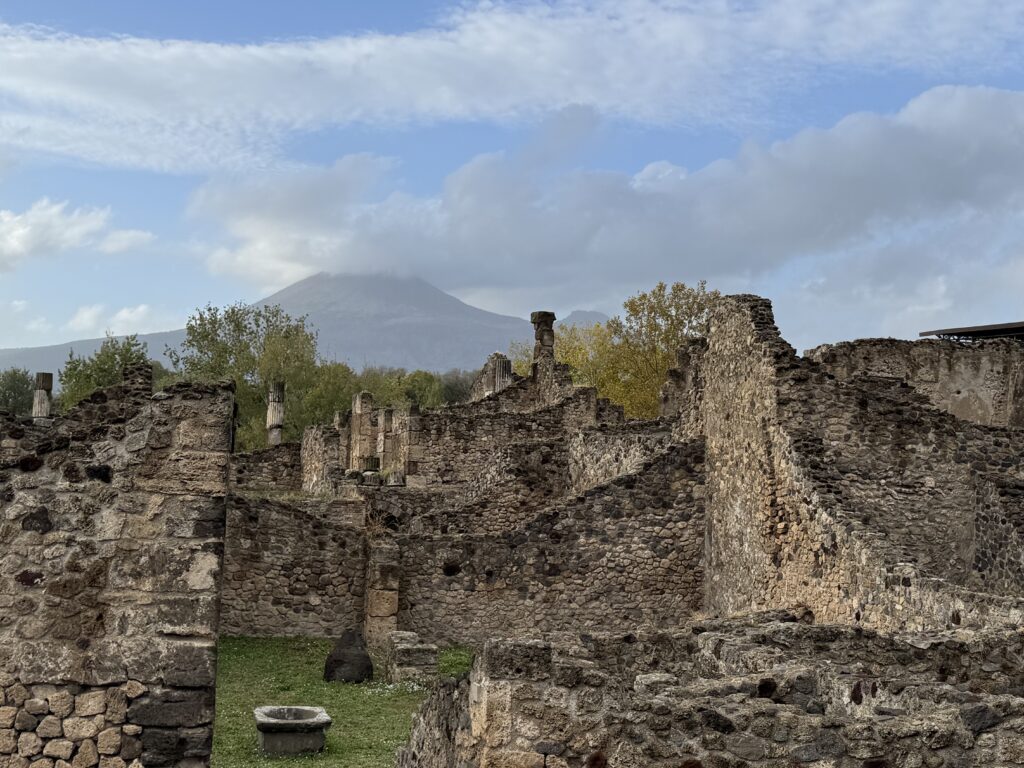
A perfect end to a perfect start.
