The first national park I ever visited was Mammoth Cave. It was part of a Spring Break way back in the day – like, I must have been 6 years old or something. As Elizabeth and I prepared to visit Mammoth Cave for her first time 20+ years later, I wondered: would any long-buried memories from the cave return? It’s the kind of question that can rattle around your brain all day.
Not that we had all day on November 15, 2025. This is the Meisters we’re talking about, and this was a national park we’re talking about. We slept in a little late – understandable after an incredibly early flight into Louisville on Friday and the hellish traffic nightmare after the football game that night – but got downstairs in the Marriott just in time to eat breakfast before they closed the buffet. It only took a couple of minutes to pack up our overnight bags and check out of the hotel. Nolan and Elizabeth were national-park-bound for the final time in 2025.
It’s about an hour and a half from the southern suburbs of Louisville to the entrance to the national park. Most of that is on I-65. As I pointed out to Elizabeth, you basically take 2/3 of the entire length of I-65 in Kentucky to get there. It’s such a short state north-south. Anyway, the drive wasn’t too bad. Elizabeth found this really nice little coffee place in Shepherdsville called Cedar Grove Coffee House. They had an interesting backwoods decor, one of those industrial espresso bean grinding centrifuges, and a delicious strawberry-banana smoothie for me. To make matters even better, the radio was playing nothing but bangers all the way down the interstate.
The immediate concern for the two of us was making sure we were inside Mammoth Cave’s grounds and at the visitor’s center in time for our 3:15 Mammoth Cave Historic Tour. Elizabeth and I had booked our tours just in the last couple of days as the late-2025 government shutdown came to an abrupt end at a perfect time. Booking those tours (one Saturday, one midday Sunday) helped us get our bearings straight and start planning how to attack the rest of our time in Mammoth Cave. This is an opportune time to break out the map:
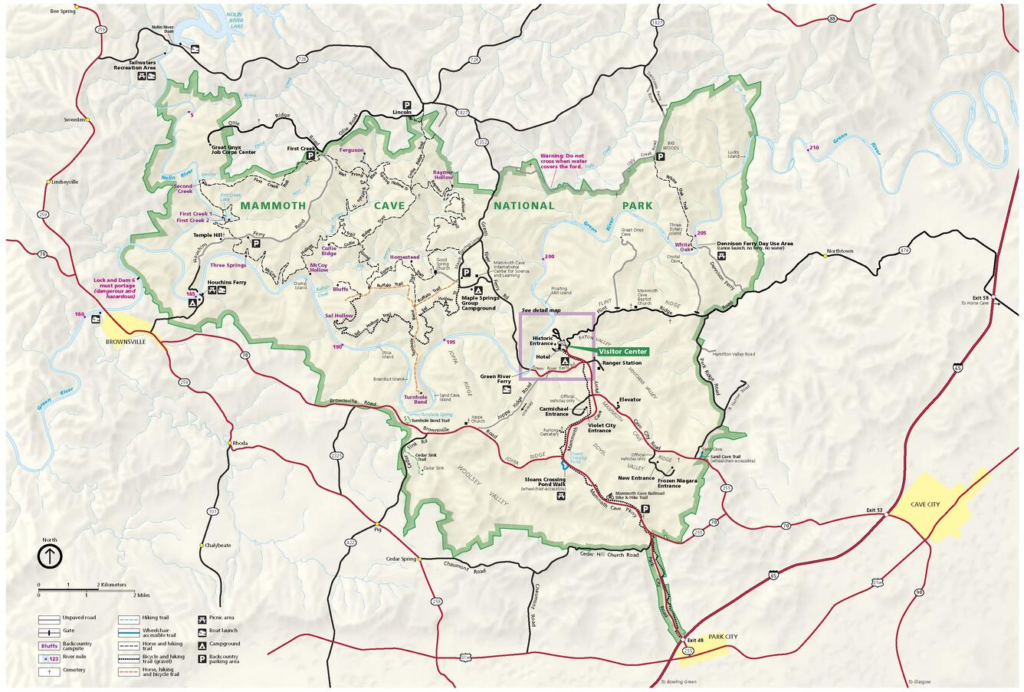
You tend to think of Mammoth Cave for its underground elements, which is completely fair. With that said, there’s a whole above-ground element as well, with over 50,000 acres of pristine Kentucky plateau landscape, sinkholes, and the broad sweep of the Green River gorge. Elizabeth and I only visited the southeast (main) area of the park in part because the Green River Ferry was closed after being extensively damaged during April 2025 floods. There was plenty to see regardless over the next 24 hours.
We first reached the park boundary via Cave City around 11:00 am. It was a beautiful fall morning – not to chilly, a little breezy, and with a hint of the fall foliage that must have been stunning in these tall forests a couple of weeks prior. The drive in had been impressive too, with vast views off of ridgelines and the inevitable tourist traps that surround national parks. I would around one more corner, and here was the entrance sign.
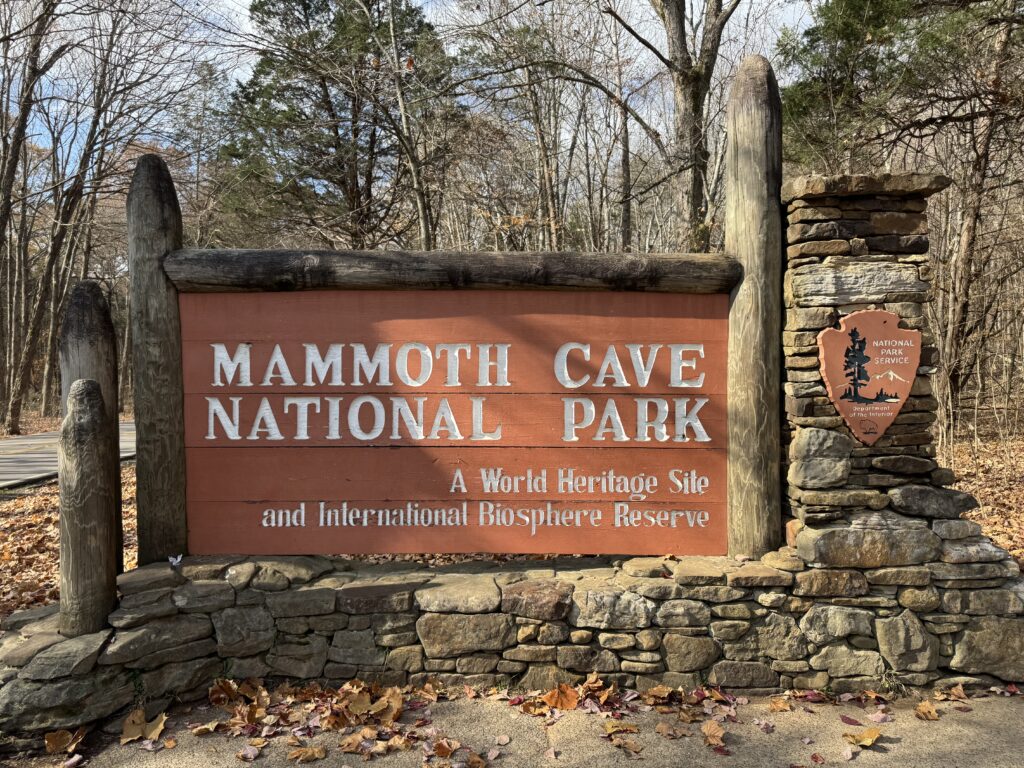
It was another new national park for my lovely wife!
Right at the entrance to the national park is a little path known as the Sand Cave Trail. It’s only one third of a mile round-trip and flat. Elizabeth and I made the spur-of-the-moment decision to see where it led (spoiler: Sand Cave) before heading to the visitor’s center. I’m glad we did if for no other reason than a chance to admire the trees, since this was the most residual fall color of any spot in the park.
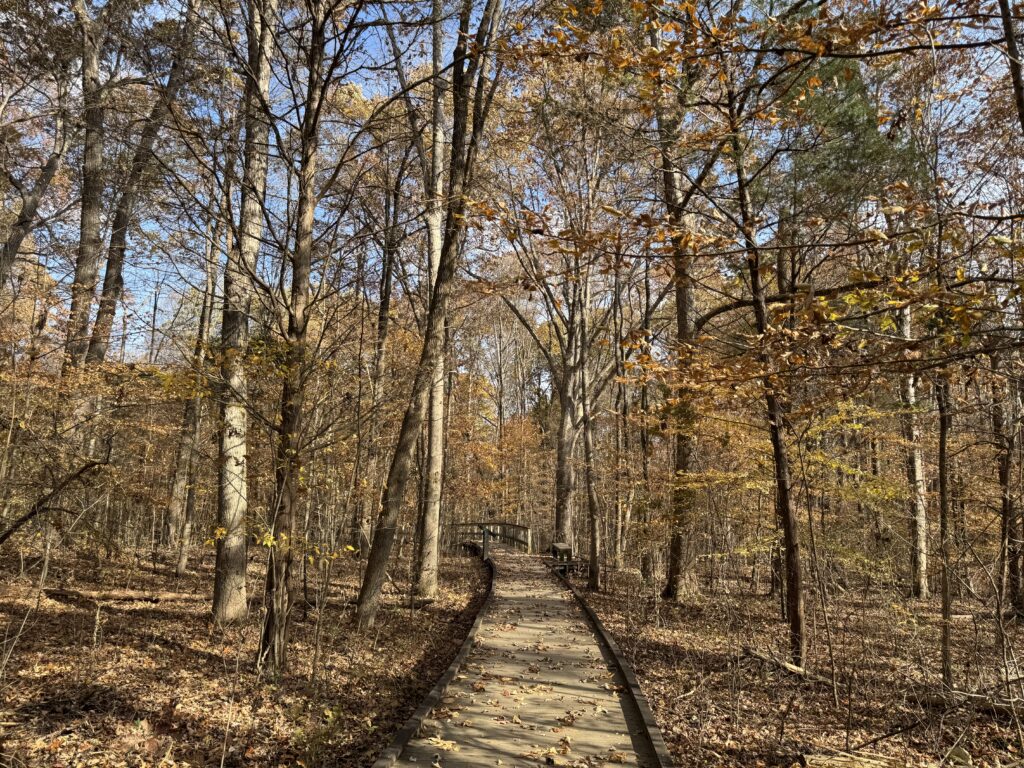
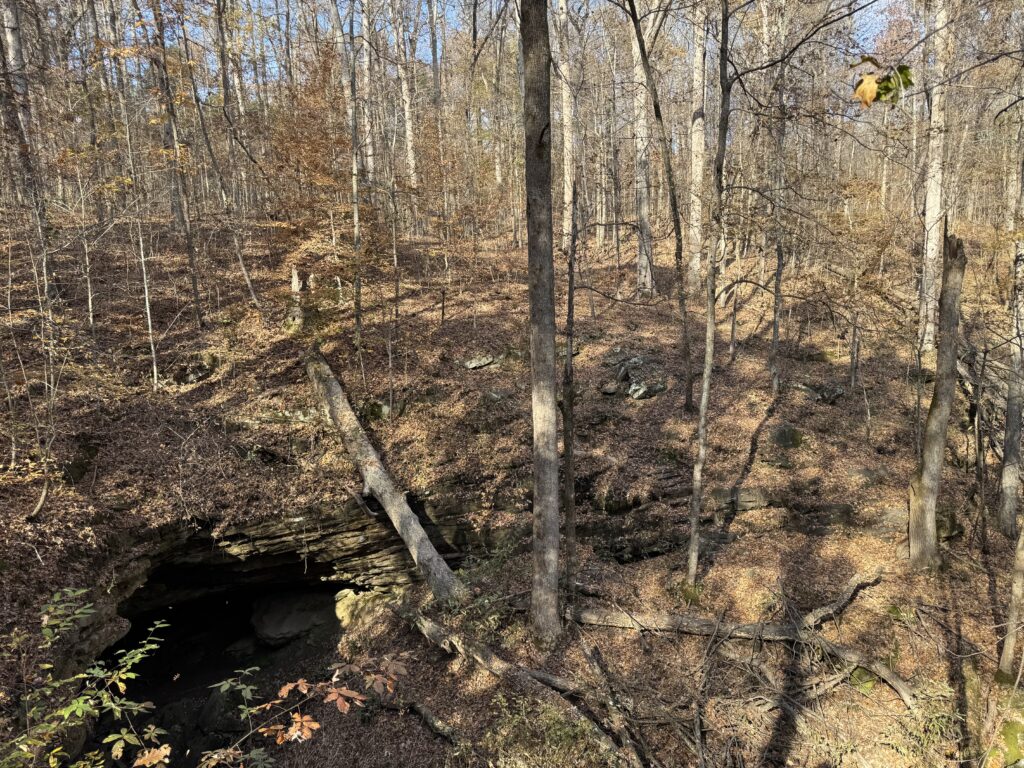
A short minute or three later (literally; my picture from the NPS sign and my picture from the cave are four minutes apart), the trail terminated on a small wooden deck. Historical signposts at the end of the deck told the story of Sand Cave. And what a story it is: at this exact spot 100 years and a few months prior in 1925, Floyd Collins had been enlarging a small passageway to try to commercialize it when the cave collapsed on him. A multiple-week rescue effort seized the attention of the entire country, which was probably small consolation for Collins – he was buried alive and eventually starved to death before rescuers could save him. But on the plus side, his cave was a really neat looking feature.
After this unexpectedly morbid welcome to the national park, Elizabeth and I drove further down the Mammoth Cave Parkway toward the Visitor Center. As paranoid as Elizabeth always is about missing rendezvous times and points, she wanted to make sure everything was extra squared away before our 3:15 Historic Tour. The parking lot was active and cars lined every row, but it felt like it was a long way away from being “crowded”. November might be a pretty good time to visit Mammoth Cave to avoid crowds. I wracked my brain trying to come up with any vestige of this Visitor Center from my kindergarten-age brain and couldn’t manage it. This might as well be my first visit to the park, too.
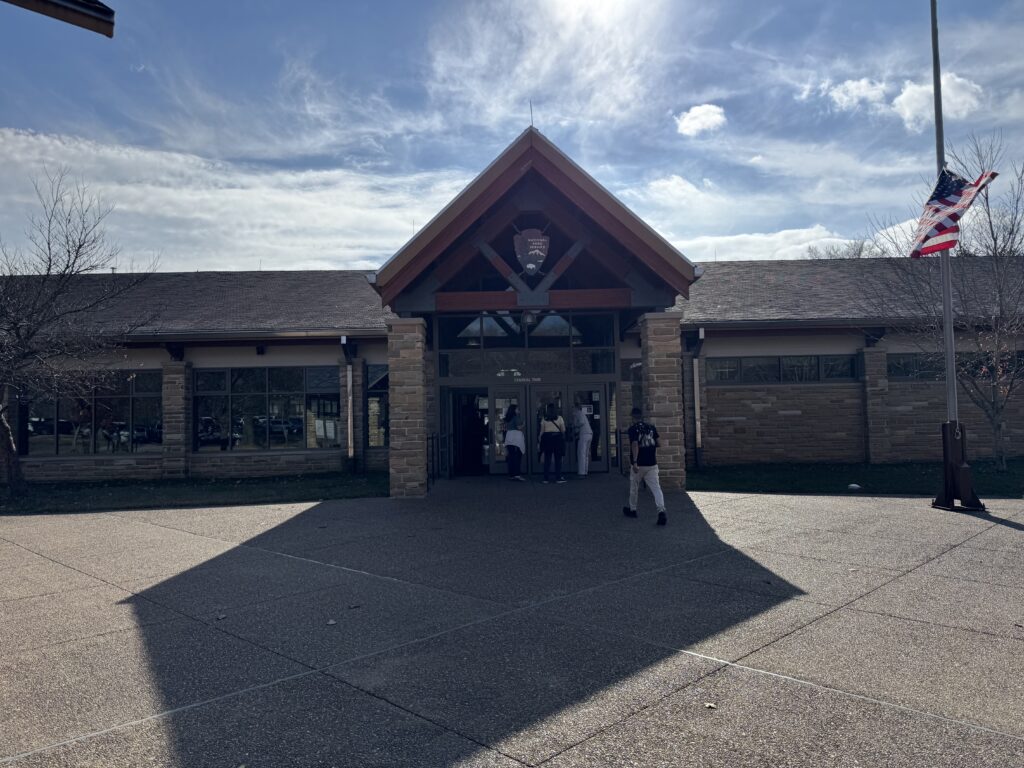
NPS Visitor Centers are always so nicely laid out and this one was no exception. Because so much of visiting Mammoth Cave boils down to what you can do underground, a big part of the center was a reservation desk for cave tours – kind of reminiscent of Carlsbad Caverns. There was a circular desk for rangers to handle any other sort of questions that dumb little piggies might have (Me: how would you suggest spending the next 3 hours before we have to be back here for our tour?). And there was a self-guided interactive exhibit walking through the geography, geology, and human history of the national park. But for the fact that these were caves instead of horses, the exhibit could have come straight from the Kentucky Derby Museum the day before.
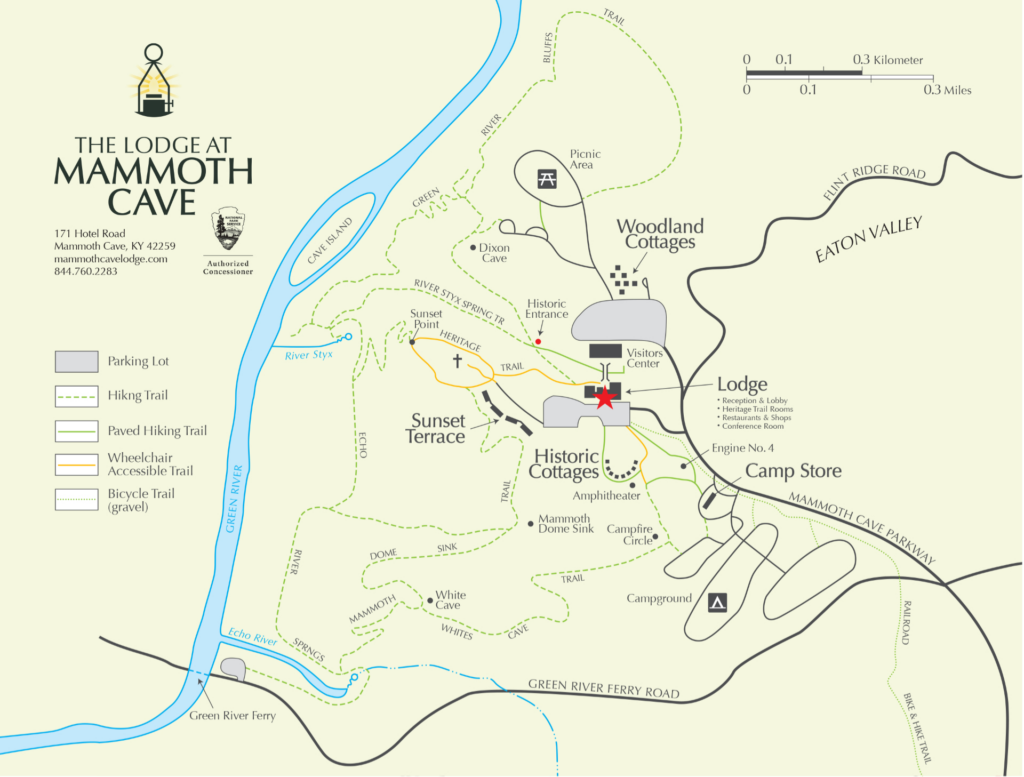
Our lodging for that night was at one of the historic cottages owned by the Mammoth Cave Lodge. We figured it couldn’t hurt to try to check in early, especially when the lodge was a 3-minute walk across a swale away from the Visitor Center anyway. Unfortunately, the humorous man at the desk (potentially the same guy I had talked to on the phone a week or two prior when switching the night we stayed in the park?) was unable to accommodate us. Disappointing but understandable, given how busy the national parks are. You have to figure the lodge staff is turning around and cleaning/re-checking people in constantly. The good news is that the lodge held a restaurant called The Green River Grill. Elizabeth and I must have missed the lunch rush, because it was pretty much empty in there when we sat down. The food was functional if not incredible and the service was excellent. Inside a national park, you can’t ask for much more.
So now it was close to 1:00. We still had two hours to kill before the Historic Tour (a little less when you consider that the official guidance on our reservation suggested getting there early, and Elizabeth would literally rather die than look irresponsible in front of an NPS ranger). The ranger at the counter had made a strong case for taking the Cedar Sink trail, a 1.6-mile out-and-back that makes a loop around one of the biggest sinkholes in the park. Into the rental car we went for a drive across the huge plateau to the southern side of the park.
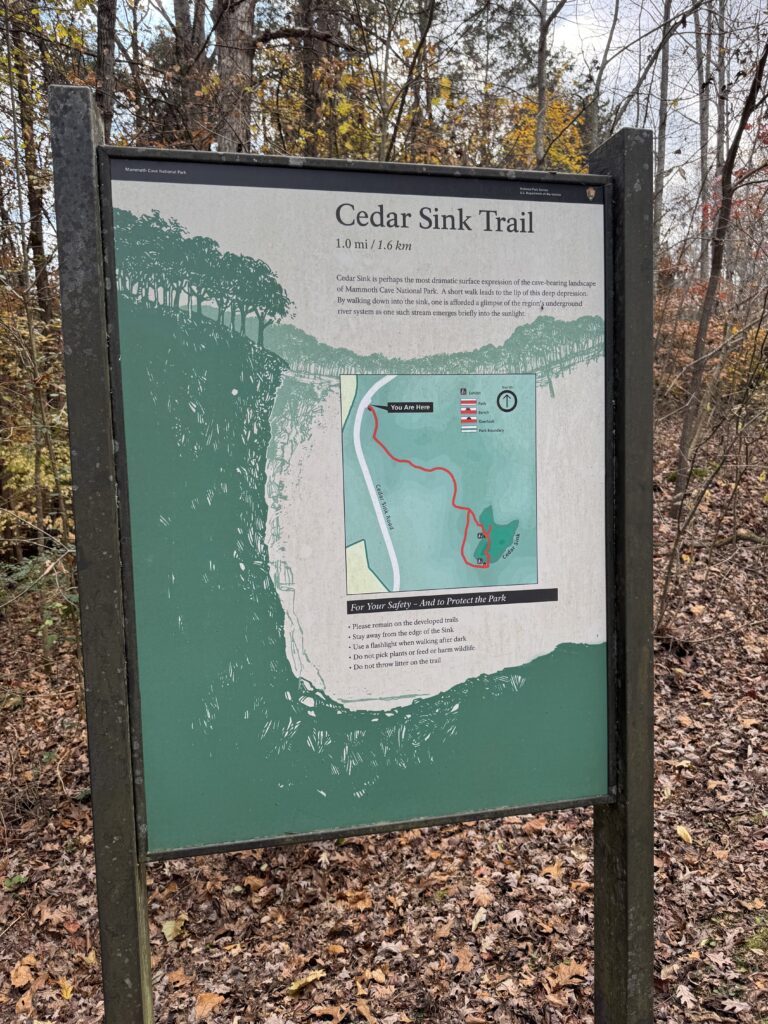
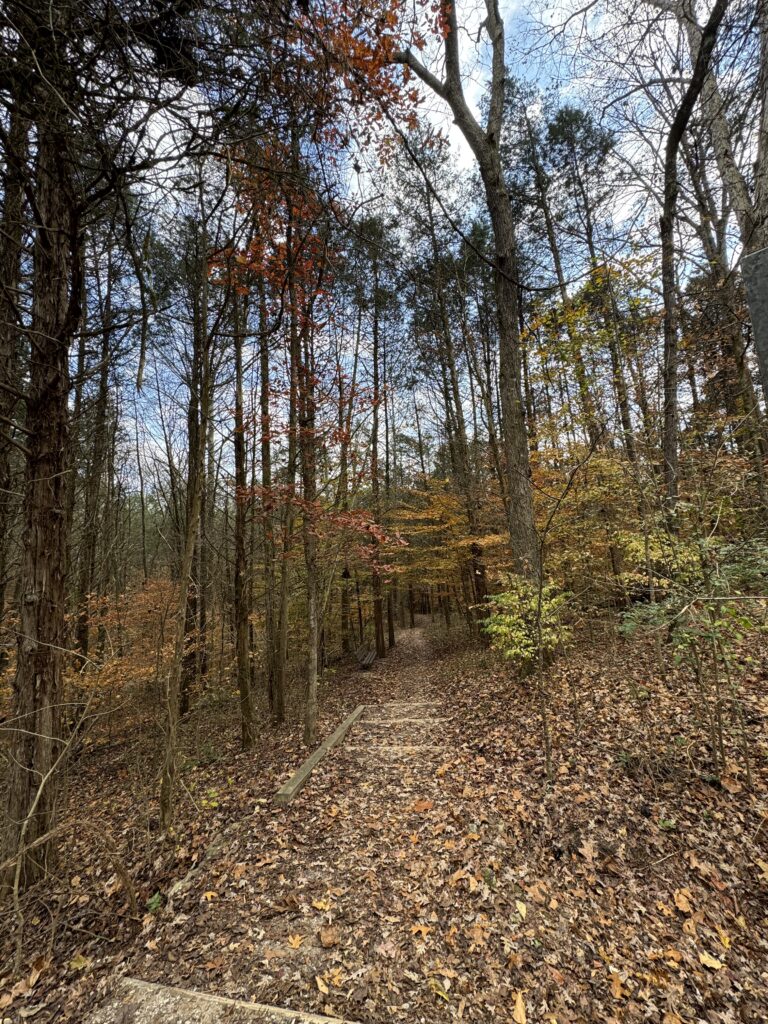
The trailhead wasn’t terribly crowded – a good thing, because it only had a few parking spots. Elizabeth and I set out on our second above-ground hike at Mammoth Cave, this time to see some of the sinks. It was a peaceful 15 or so minutes out to the sinkhole itself. Outside of the crunching of leaves under our feet and the occasional whisper of the wind through the remaining foliage on the trees, nature was plotting out a silent Saturday here.
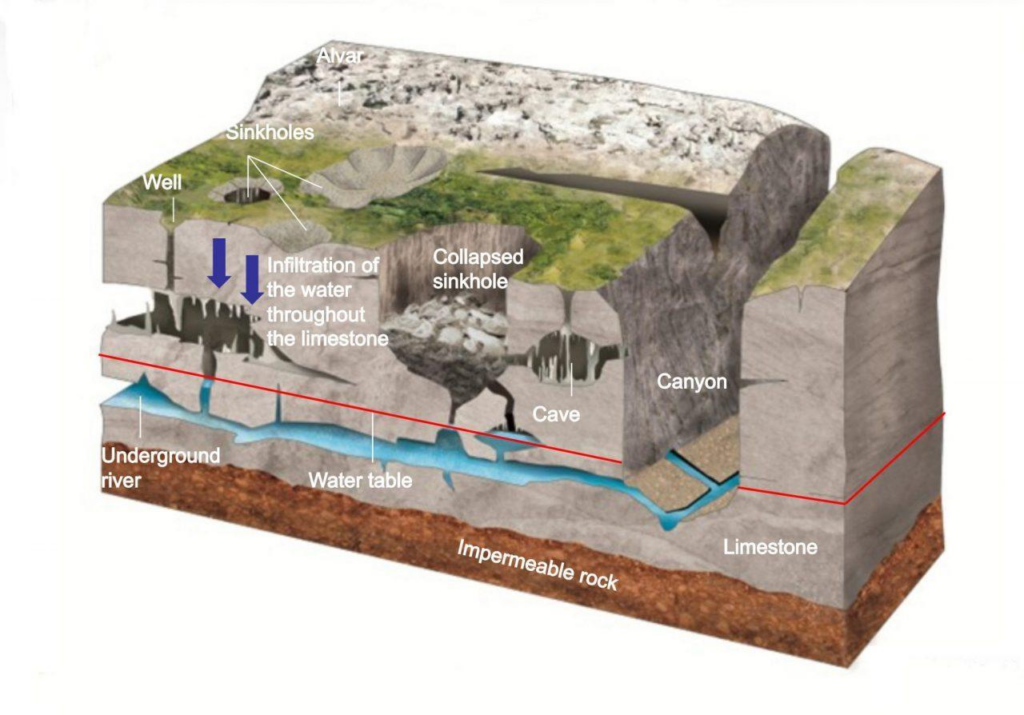
Now seems like a good time to talk about some of the geology of the national park. You see, Mammoth Cave gets its origin in the highlands immediately south of the national park boundary. Here, the karst limestone is pocketed with sinkholes. Those sinkholes act as a great source of seepage for runoff, which then bleeds into an underground network of streams and rivers that eventually form the cave system. Eventually all of the water makes it into the Green River at the bottom of the park, but the routes to get there can be exceedingly complex. Cedar Sink, a giant sinkhole on the south side of the park, is a great example. We still aren’t entirely sure where all of the water inside of it funnels through Mammoth Cave before it reaches the river.
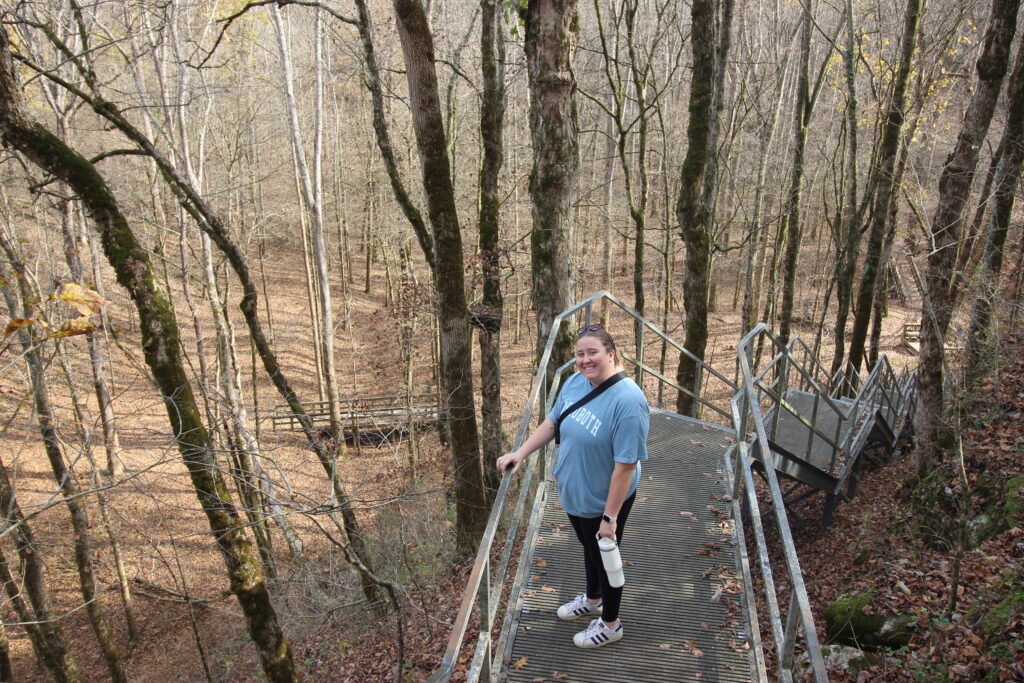
Something that became clear when Elizabeth and I reached the loop into the sinkhole: this thing wasn’t just a few feet across. It was a whole valley with a semi-submerged creek flowing through it. The NPS had to put in a full staircase just for people to be able to access the bottom!
Once you got toward the bottom of the trail, the geology of it started to make sense. There were some ledges of rimrock on either side of the valley with a lazy, brackish pool of water at the bottom.
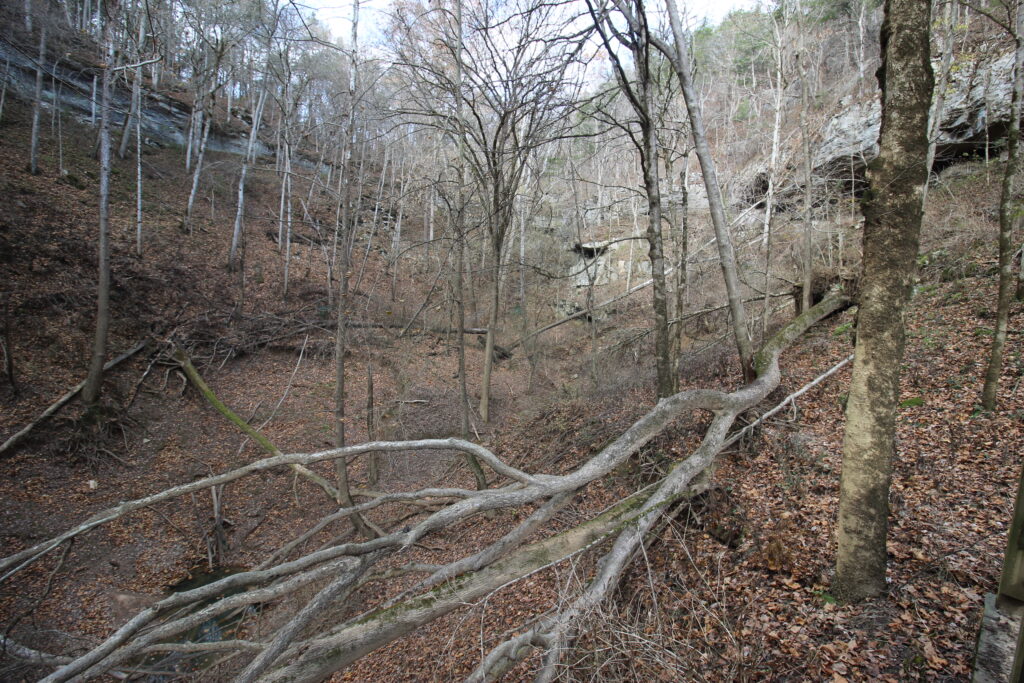
It was actually quite beautiful, especially when the sun managed to sneak out from behind the clouds and briefly illuminate the forest floor.
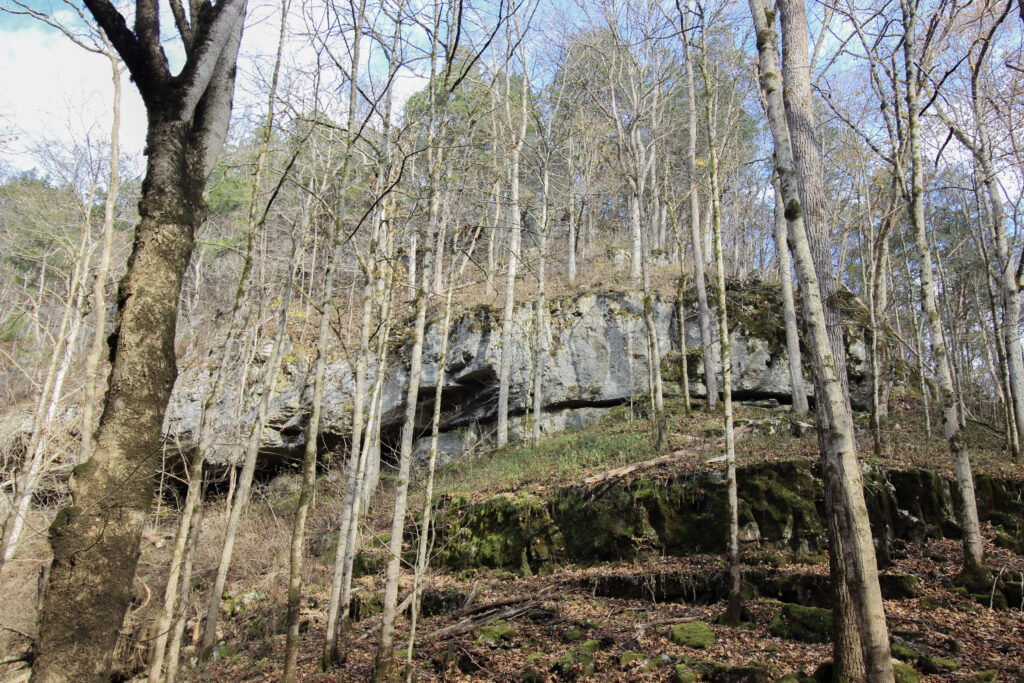
There’s a spot on the other side of the trail where you can actually see the underground river that is responsible for the sinkhole – because of the collapse, the stream is actually briefly visible aboveground, and you can see the spot where it descends back into the rimrock. Unfortunately, because of all of the leaves that had fallen in recent weeks, it was a little hard to even tell that such a process was occurring.
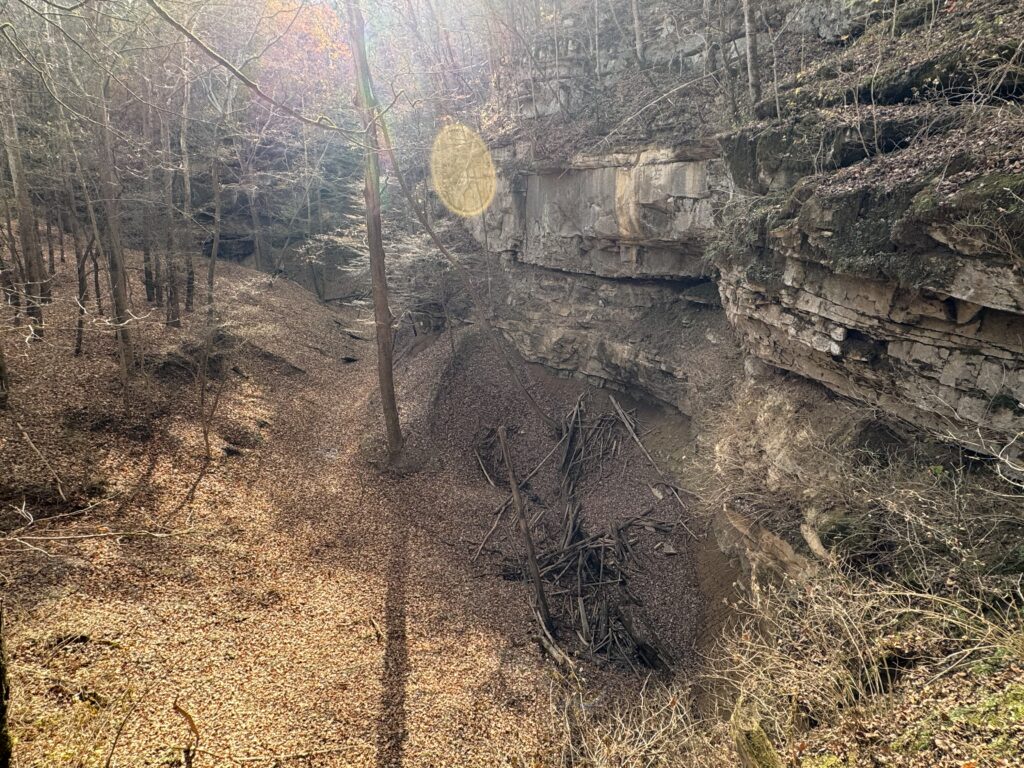
I swear, there’s a stream in there!
Continuing onward past the bottom of the sink, Elizabeth and I started ascending the opposite wall. Along the way there was a little rock overhang carved out that you could rest under. As I often am when I see features like that, I couldn’t help but wonder: was this very spot used as a shelter by pre-Columbian humans who lived here? There’s no proving one way or another (at least with my nonexistent anthropological knowledge), but a groundhog wandering by was enough to show that even in modern times, a little shelter goes a long way.
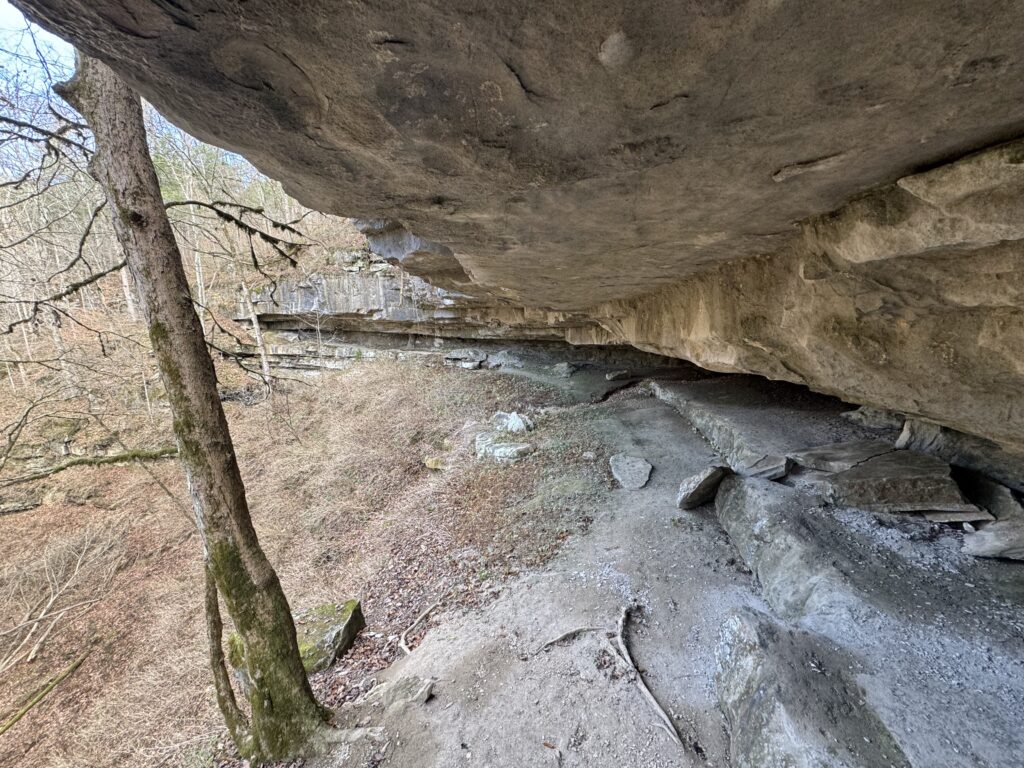
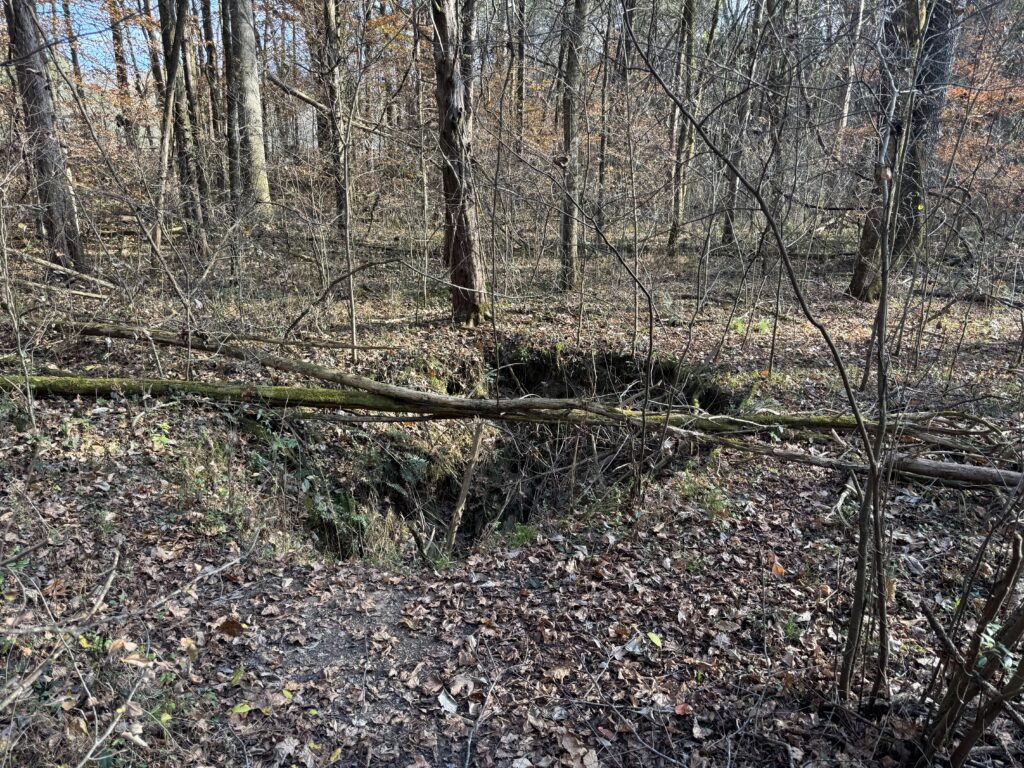
We made good time on the return trip back up from Cedar Sink to the road. If anything, the trail seemed even more lonely on the way back than it had on the way out. We had come out all this way to see the caves, but so far I was finding myself impressed with the raw natural beauty of Mammoth Cave’s forests and hills. As long as I didn’t step into anything that looked suspiciously like a newly-forming sinkhole.
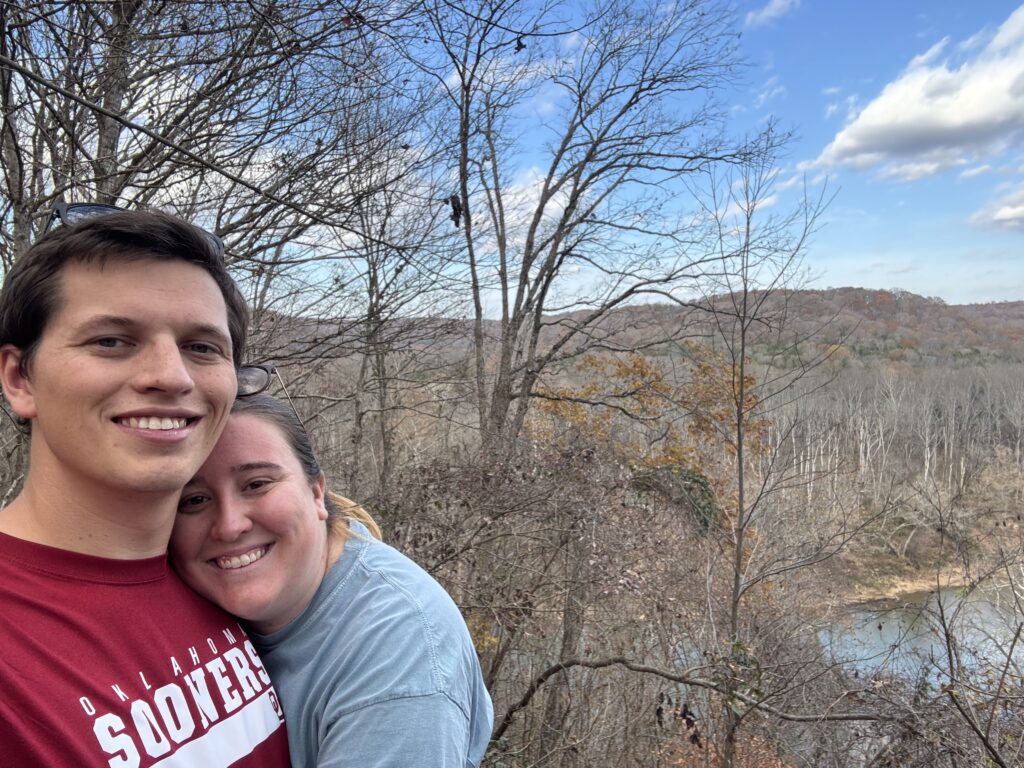
Now it was getting closer to 2:00 and the sun was starting to sink a little lower in the late-fall sky. We still had about an hour left before having to be back to the Visitor Center. It was just enough time to quickly walk the Turnhole Bend Trail, a 0.6 mile loop around a bluff overlooking a big horseshoe in the Green River. “Overlooking” might be overselling it; there are a lot of trees in the park.
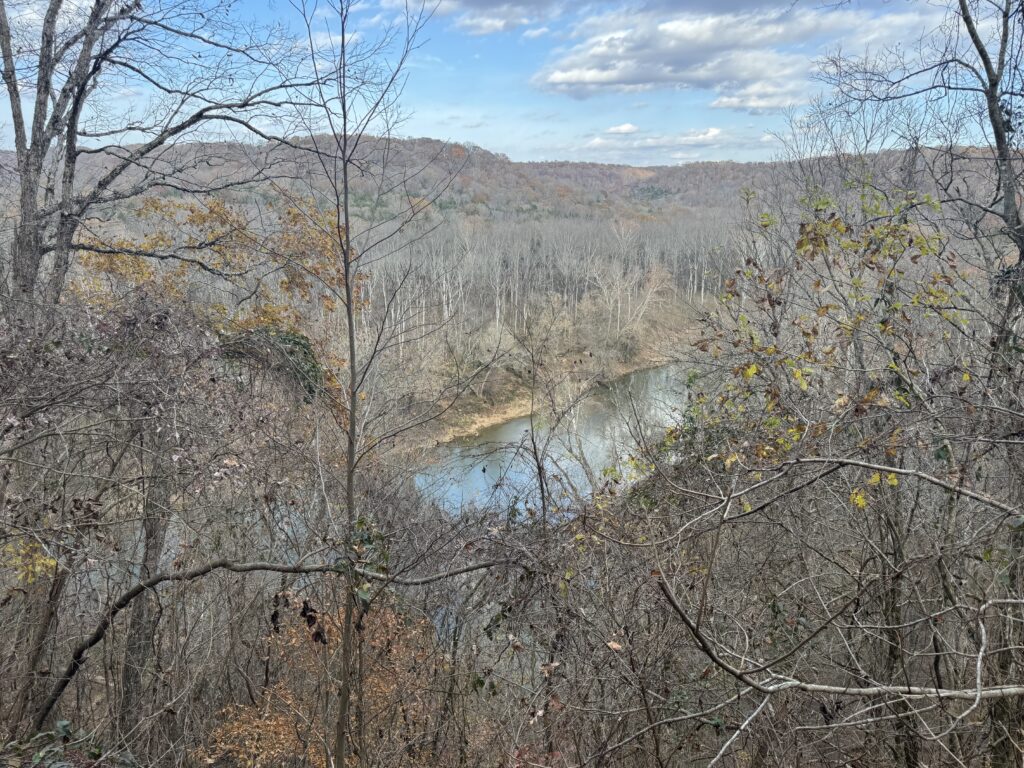
But look at us. Do we look like we care, or do we look like two people who are just having a great day in America’s national parks, with no other crowds around?
Plus this trail went right past another miniature sinkhole – nowhere near as big as mighty Cedar Sink, but much easier to see the impact on the local terrain.
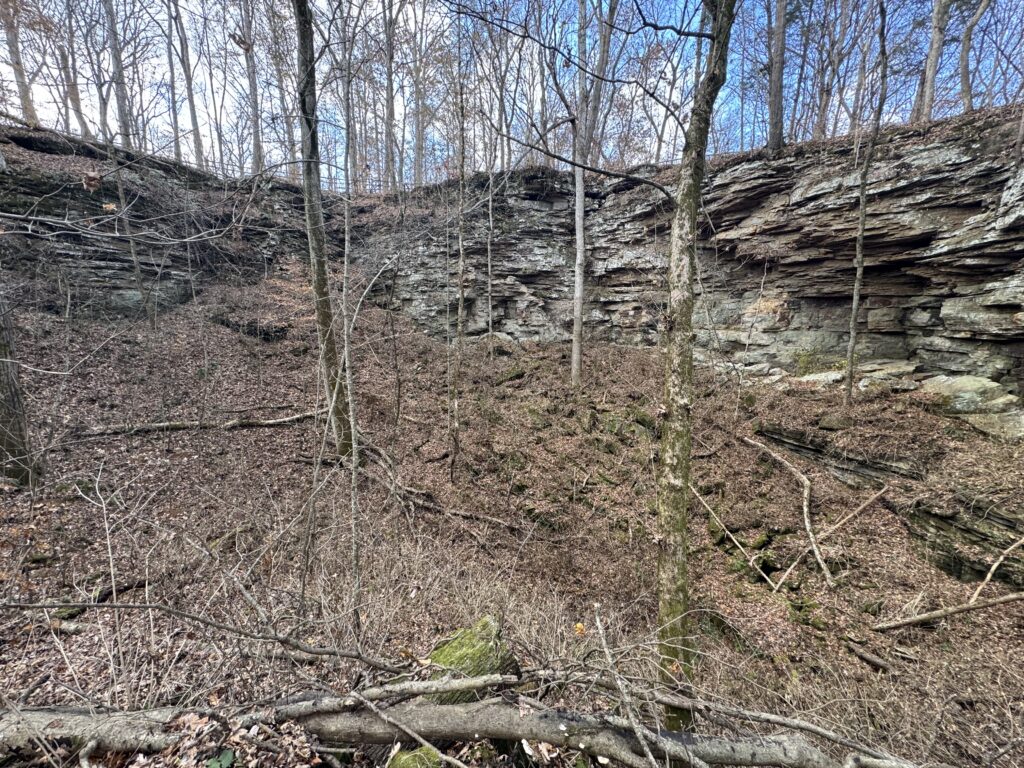
Since these sinkholes often tap into the cave system below them, there’s usually a release of much cooler air from underground. That means that the sinkholes have these microclimates that can be much, much different than everything else around. Take this one, for example. Even in late November, moss was showing a brilliant green on the trees!
That also served as a stark reminder that somewhere directly below us was a series of caves. That’s a pretty weird thing to think about. Way underground, there was just… no ground! Most park experts think the water from Cedar Sink oozes through an underground river that emerges in a little pool at Turnhole Bend. That’s actually where the name comes from – the pool was the hole that old-timey boats would turn around in in the otherwise narrow river. History and geography are sometimes intertwined in the most delightful ways.
Now it was getting closer to 3:15. The aboveground part of Mammoth Cave had soared far above my expectations for it. But Mammoth Cave National Park is not a place for soaring. It’s a place for sinking – deep, deep underground.
