I’ve often thought that National Park Service Rangers have some of the toughest public-facing jobs out there. To put it simply, the average American is an idiot. The average American in the great outdoors is an even bigger idiot. I often think of the off-duty rangers in Yellowstone who just wanted to go wolf-watching, only to have to help some morons tow their car because they drove over a rock marking a parking spot. Basically, being an NPS ranger (especially in a Visitor Center) sounds like you’re running the world’s lowest-funded daycare.
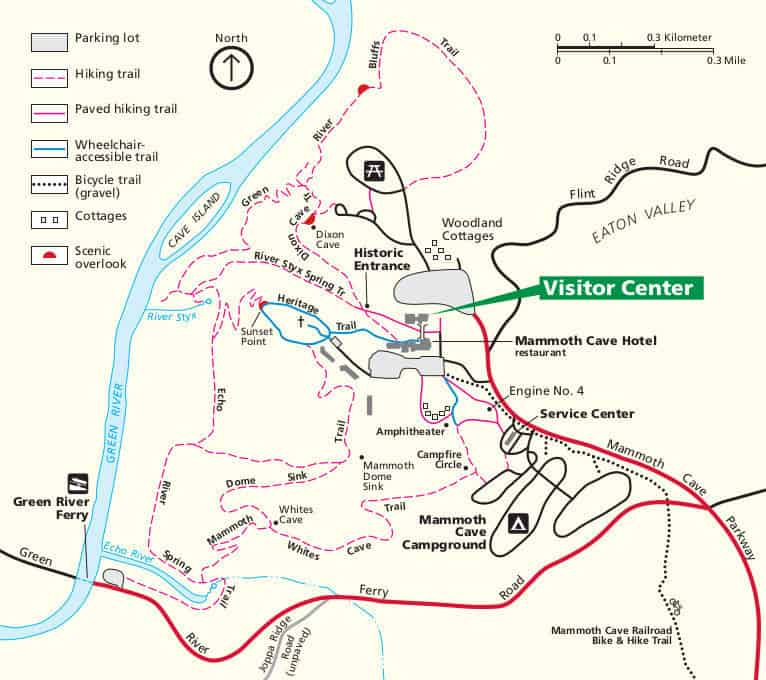
This is a long-winded way to apologize to the rangers at Mammoth Cave National Park. You see, I knew all along where we needed to gather for the Historic Tour. Elizabeth and I were already there. We’d just gotten there so early that nobody else had arrived yet, and Elizabeth was panicking as a result of her own over-preparedness. The ranger managed to not call me an idiot when pointing me right back where I came from – the pavilion just outside the Visitor Center, just as marked on the screen above his head.
The good news about being so early for the end of our tour was that there was almost a bar of 5G here, which was about the most signal you could find anywhere in the national park (understandably). It was a Saturday in the fall, and though I had bravely volunteered my weekend to spend below-ground with Elizabeth, out in the human world college football was still being played. I had just been able to track Michigan’s trip to Northwestern before and after descending into the Cedar Sink trail. Upon reaching the top of the plateau again outside the Visitor Center, it was a small shock to find out that Northwestern had managed to take the lead late in the 4th quarter. So while we waited for our tour, I managed to get a laggy feed of the FOX broadcast onto my phone; it was just good enough to watch Michigan drill the game-winning field goal to win 24-22. Oklahoma kicked off against Alabama next, but I didn’t push my luck with the nature gods by pulling up a feed of that one.
Over the next few minutes, people started gathering at the pavilion – first in trickles, then in droves. This tour is apparently a Mammoth Cave staple, because our group was getting well up towards 100 people. Imagine the pressure the rangers must feel when speaking to groups like that daily! You can make or break a lot of people’s impressions really quickly. With that said, our ranger, a lanky young man with a voice that carried nicely, didn’t seem all that worried about that. More than anything, he just sounded excited – and a little emotional – because the government shutdown had ended just in time for him to give one more tour before the end of the season, meaning this would be his last-ever. I guess the timing was even more perfect than Elizabeth and I even realized.
Our tour guide went through his standard disclaimers – if you don’t think you can handle 500+ stairs and 2 miles of walking, or if you don’t think you can handle the darkness, or if you don’t think you can squeeze through confined spaces (wait, what?), then maybe reconsider this tour. After the disclaimers, dozens of tourists arose from their little benches under the pavilion and we began an informal procession toward the underground. There’s a little valley in between the Mammoth Cave Hotel and the Visitor Center which the pavilion is perched at the end of; below the pavilion a short 1/4 mile trail led down to the Historic Entrance.
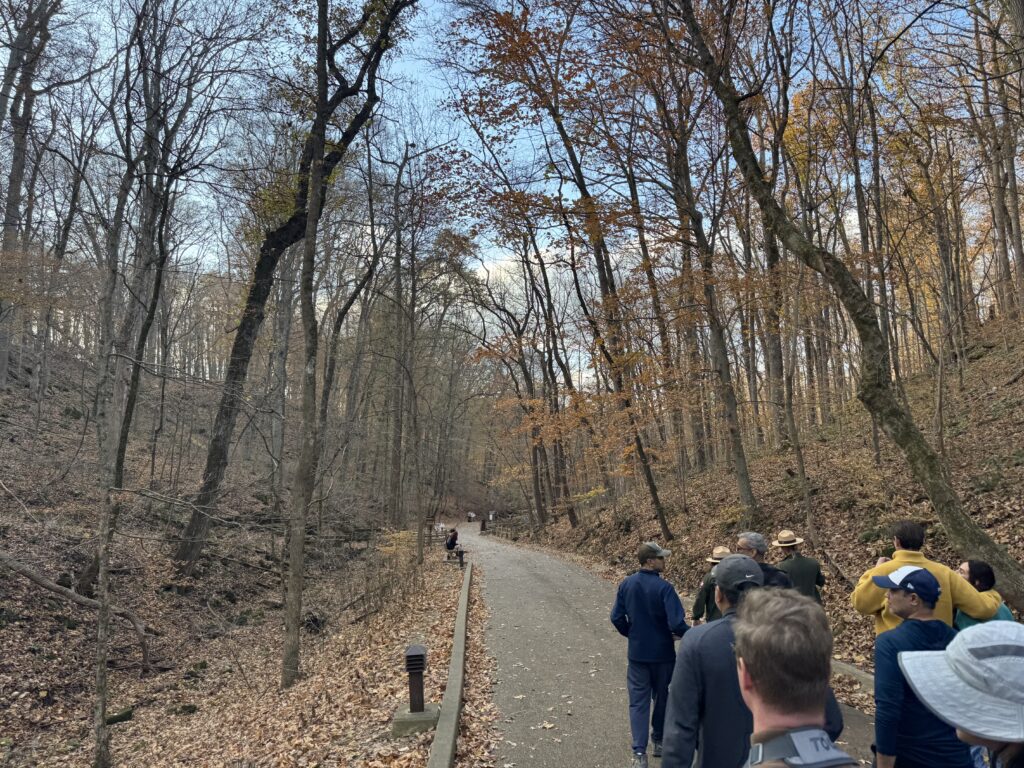
The Historic Entrance has some fun connotations to it, and the urban legend (that it was discovered by a frontiersman chasing after the bear he shot) is pretty damn good as well. Before we could go down into the cave, I expected that every tour participant would have to clean off our shoes to prevent the spread of White Nose Syndrome in bats. But nope, there was a just a gate where you showed the ranger your pass. When I asked our guide why we weren’t taking precautions before entering, he said “Because it’s already here. No point in preventing the spread at this point”. Brutal, but fair. He went on to inform me that some bat colonies in the park had lost 95% or more of their population while others had been relatively unaffected. It’s a brutal truth in the 2020s, but hopefully the initial shock at Mammoth Cave has gone by and the bat population gets time to recover.
And from there we were heading down, past the yawning entrance and into the darkness. The first feel of cooler air on my shorts/t-shirt combination left me thinking “You idiot, you’ve underdressed yet again”. In the end though, the temperature was passable if not downright comfortable.
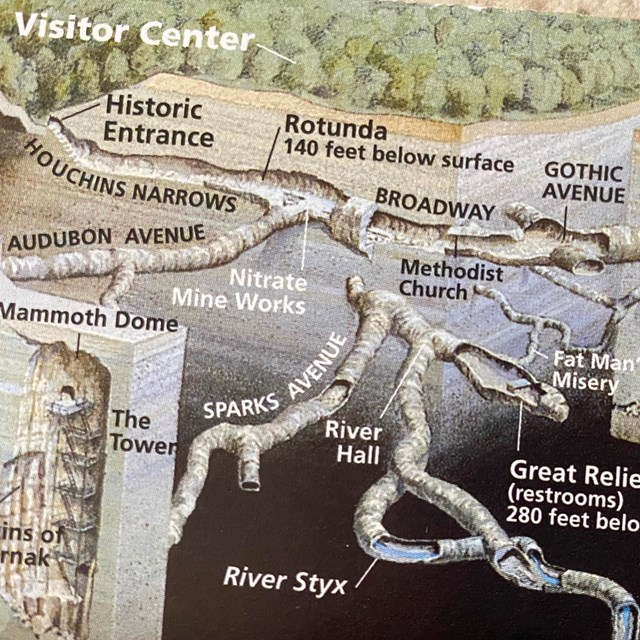
The first few minutes followed “Houchins Narrows” (named after that hunter who shot the bear). Unlike other cave tours, this was pretty well-lit and the path was paved. The one unique thing was the series of log flumes running along the side of the path.
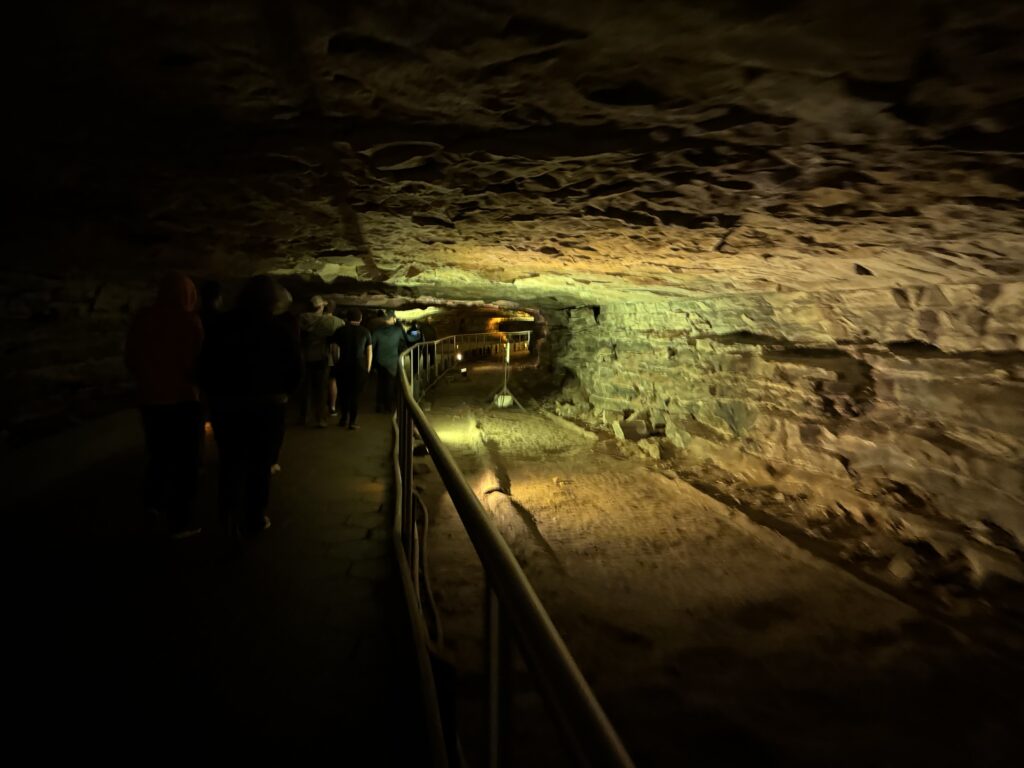
As we learned at our first stop, this log network was part of the surprisingly rich history of Mammoth Cave. The cave was well-known to frontiersman by the early 19th century, and like all 19th-century frontiersman, this was seen as an opportunity to mine some saltpeter. As it turned out, the mining era of Mammoth Cave perfectly coincided with the War of 1812. Remnants of the mining operation can still be seen in the upper part of the cave. Really puts the “historic” in the historic tour. One area that we would not see (because it is only accessible on the extended historic tour) dates back to a few decades later in the 1840s. Some brilliant doctor thought that the constant temperature and dampness inside Mammoth Cave would be perfect for tuberculosis patients. He brought a dozen consumptiuon patients down into the cave and set them up in little stone huts to await their miraculous cure. A few months later, most of them had died and the survivors had escaped. It’s a morbid piece of national park history, and unfortunately (or fortunately) not one that was a part of our tour.
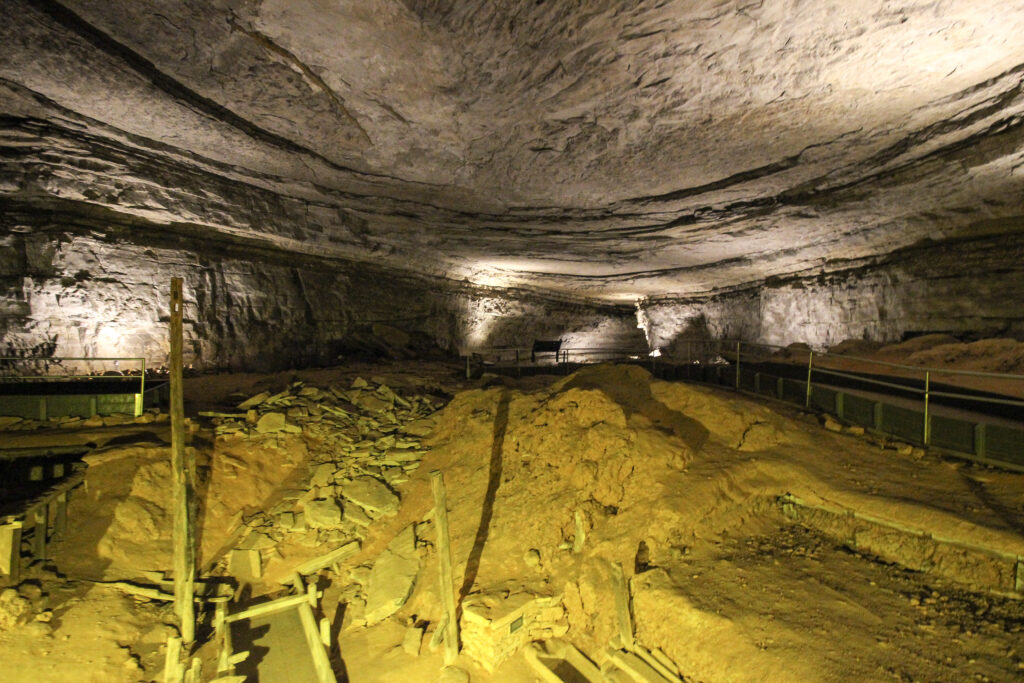
The above picture is one of the the only from my camera that wasn’t too blurry to include in here. It’s understandable – dim light + bustling crowds makes it tough to get an exposure that isn’t out of focus. The nice thing is that the path through the early part of the route was wide, allowing me to pull out of people’s way to try and take pictures, and that our tour guide was weirdly a stickler for not sharing pertinent information until all 100 or so tourists had arrived at the pre-arranged stops. That’s no mean feat given how much the crowd strung out!
In another wide part of the cave, our tour guide brought us to a halt to talk less about American history in Mammoth Cave, and more about what makes Mammoth Cave so special. It really is an incredible thing – the largest cave system in the world by far, with huge subway-tunnel-shaped passages that were carved before subterranean rivers found an even deeper passage to take and now sit as impenetrable reminders of the cave’s past. Our tour guide turned the lights all the way off, something that I have experienced on just about every cave tour I’ve ever been on. It never ceases to be just a little bit amazing, though. There’s something about sticking your hand right in front of your face and realizing there’s absolutely no way to know that it’s there. Then you realize that for this part of Mammoth Cave, this has been the standard for hundreds of thousands of years. Up until very, very recently, the rocks all around you hadn’t seen light since the dinosaurs roamed the earth. And now we’re down here with our little flashlights, trying to project confidence in the face of how insignificant human history is in comparison with the rest of the earth’s history. Then the tour guide turns the lights back on and 30 people immediately reach for their phones to take more pictures. Please enjoy me being one of those 30 people:
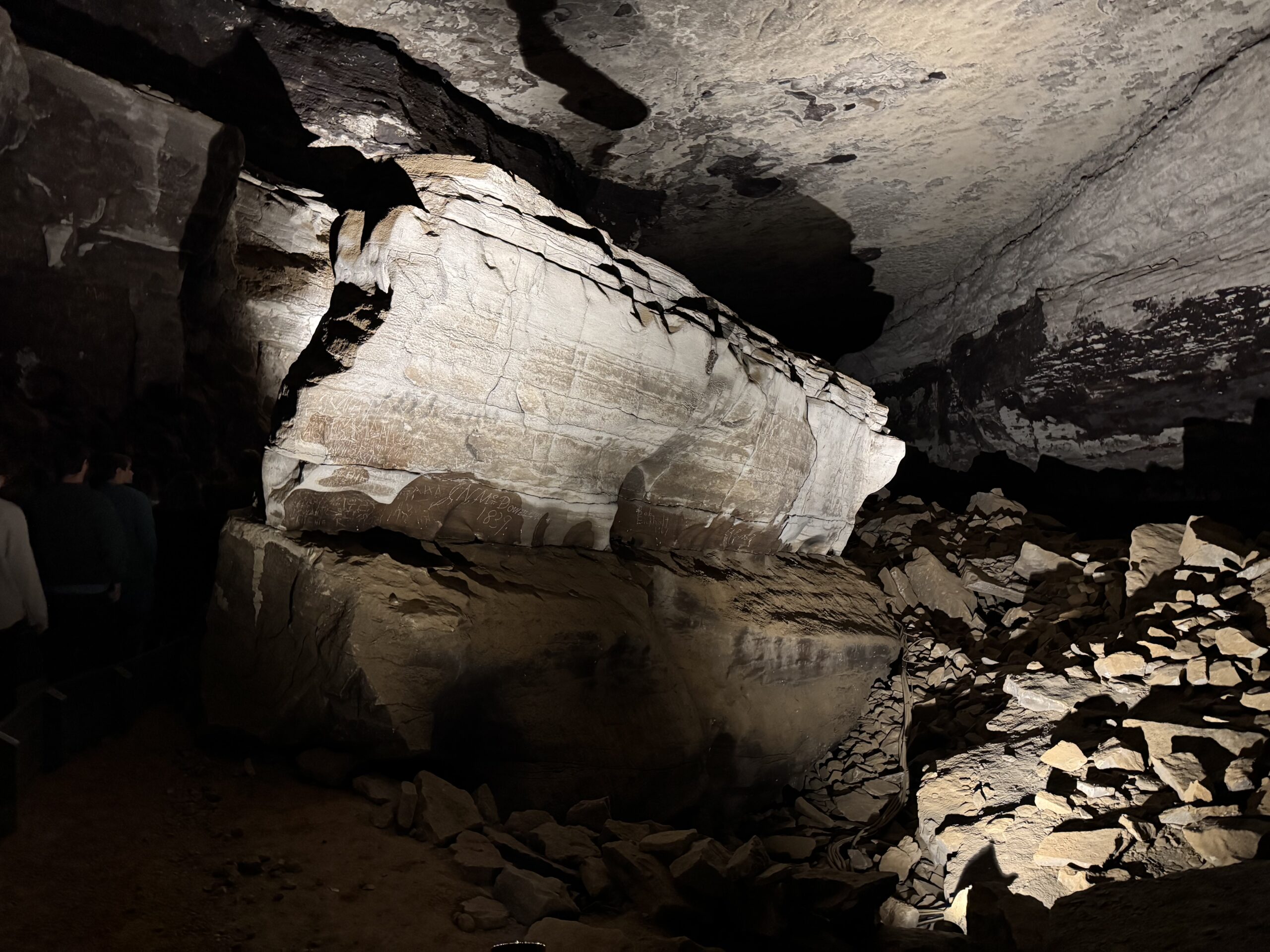
At least I’m not one of those people who goes through the entire spiel of thinking about the darkness, the immutability of Mammoth Cave, and then thinks “I should carve my initials into the rock”. As you can see in the picture above, plenty of people over the last two centuries do feel that way.
The next section of the tour was probably the longest in between guide monologues. It was also perhaps the most famous and memorable part of the tour. “Fat Man’s Misery”, as you may guess, is a rather narrow and winding passage further down into the cave that forces you to contort yourself if you have any sort of vertical or lateral extent to your body. As a camera-bag-wearer, I found it pretty difficult to keep myself from banging off of the walls. And as Mammoth Cave’s rangers will remind you, DO NOT TOUCH THE WALLS OF THE CAVE. YOUR SKIN HAS OILS THAT WILL BREAK DOWN THE ROCK. (I assume they don’t worry about it as much in the Fat Man’s Misery, because everybody is banging off of the walls in there).
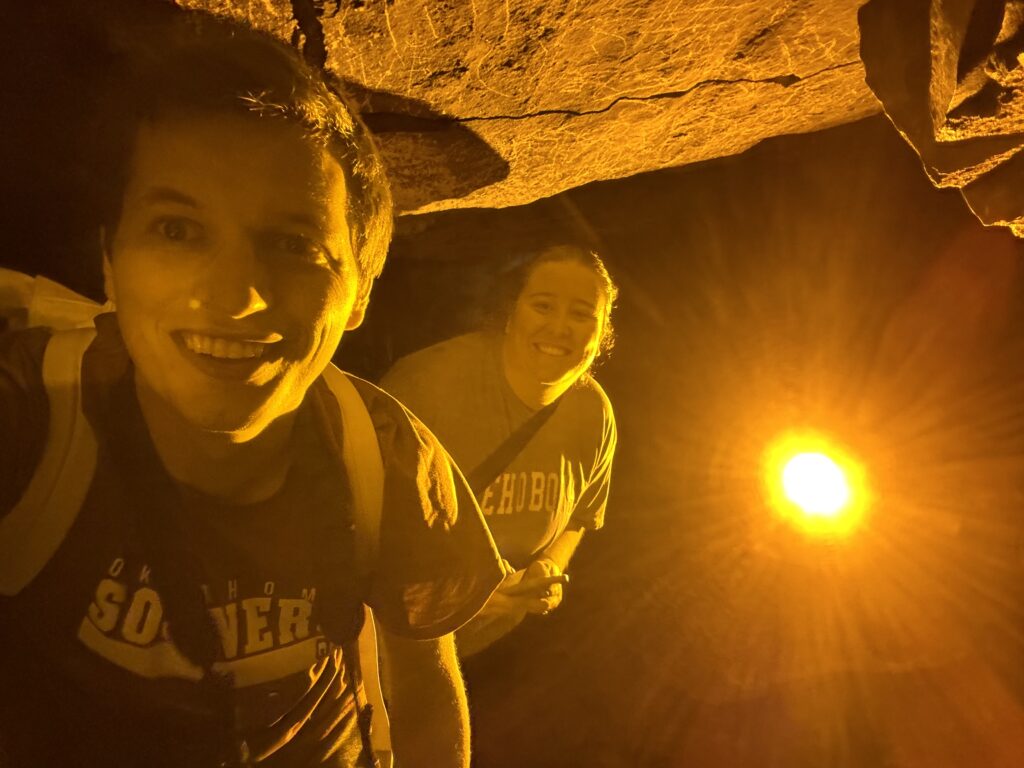
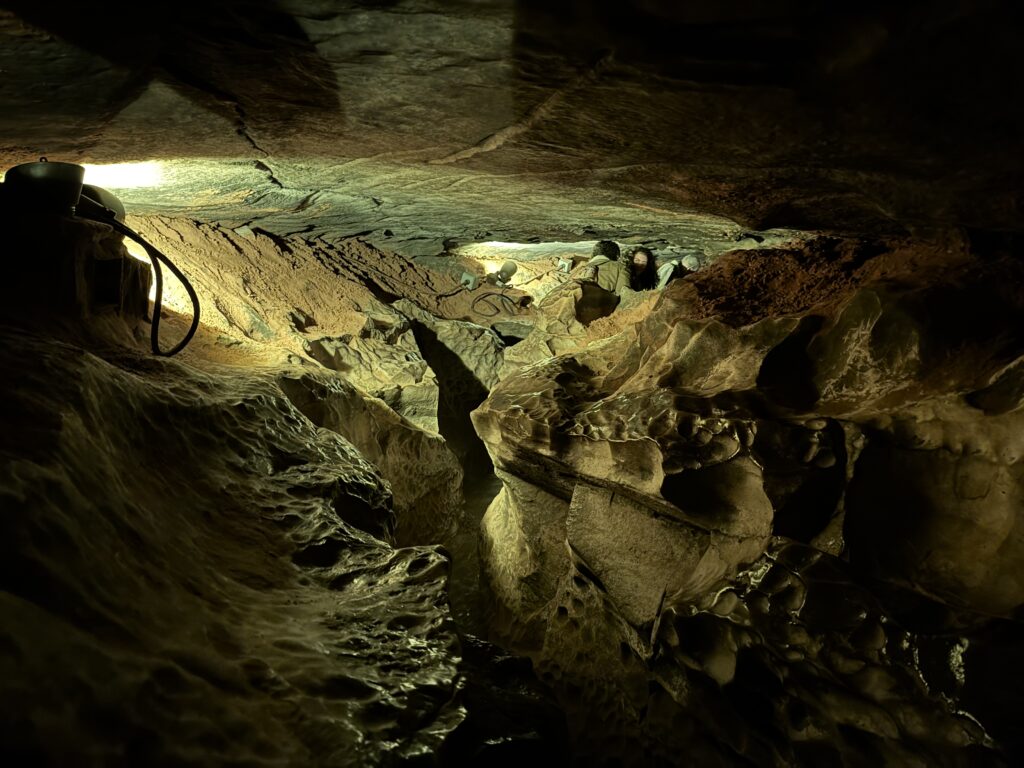
Elizabeth and I ended up in the very rear of the tour with about 10 other people who seemed more interested in enjoying the ride than hustling from one place to the next. Just given how strung out the line was here, I bet there was a 5-minute gap between the first people arriving at the bleachers below and when we got there. Personally, I wouldn’t have done it any other way – this section of the walk was the most fun.
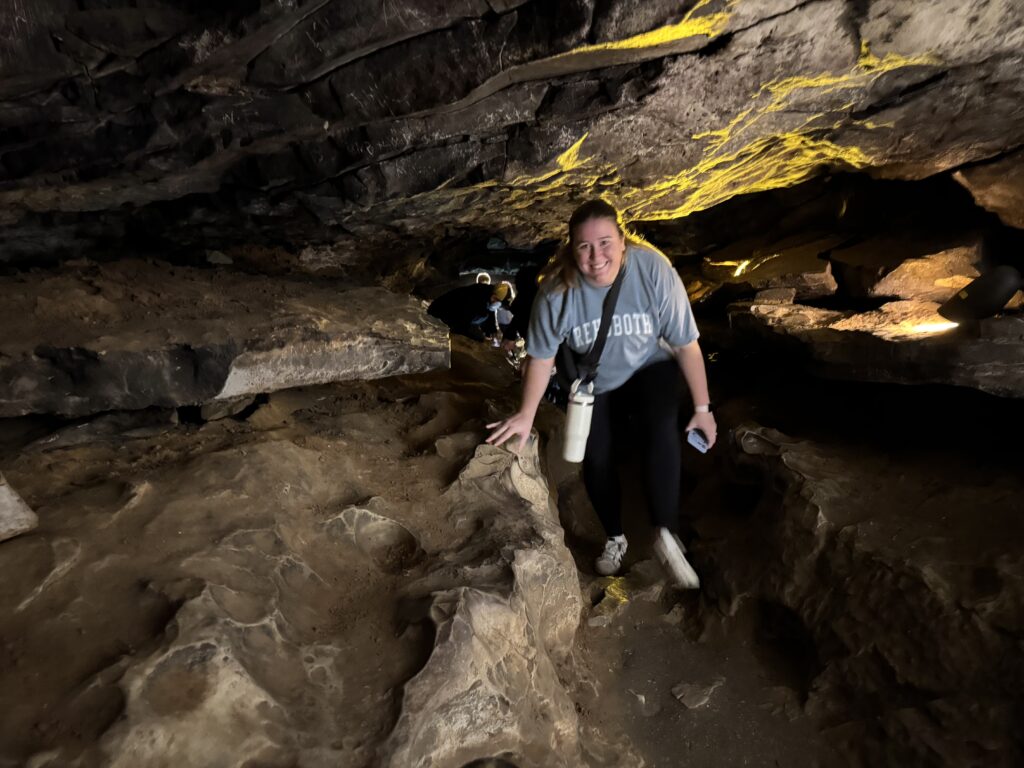
We have now brought you, dear reader, all the way to the bottom of Mammoth Cave. Just below these bleachers, the underground River Styx flowed through the floor of the cave, carving out new future channels and tunnels. Behind the tour guide, a set of stairs got ready to take people all the way back up – 540 stairs to go from here! Along the first several feet of the staircase, high-water marks showed where heavy rain/flooding had actually inundated this entire stretch of cave several times in recent years. It’s not clear whether the electronics down there are made to be okay if they’re submerged in raging underground floodwaters, or if the park employees have to go down there and move them when heavy rain arrives, but it does feel like one option maybe makes more sense than the other.
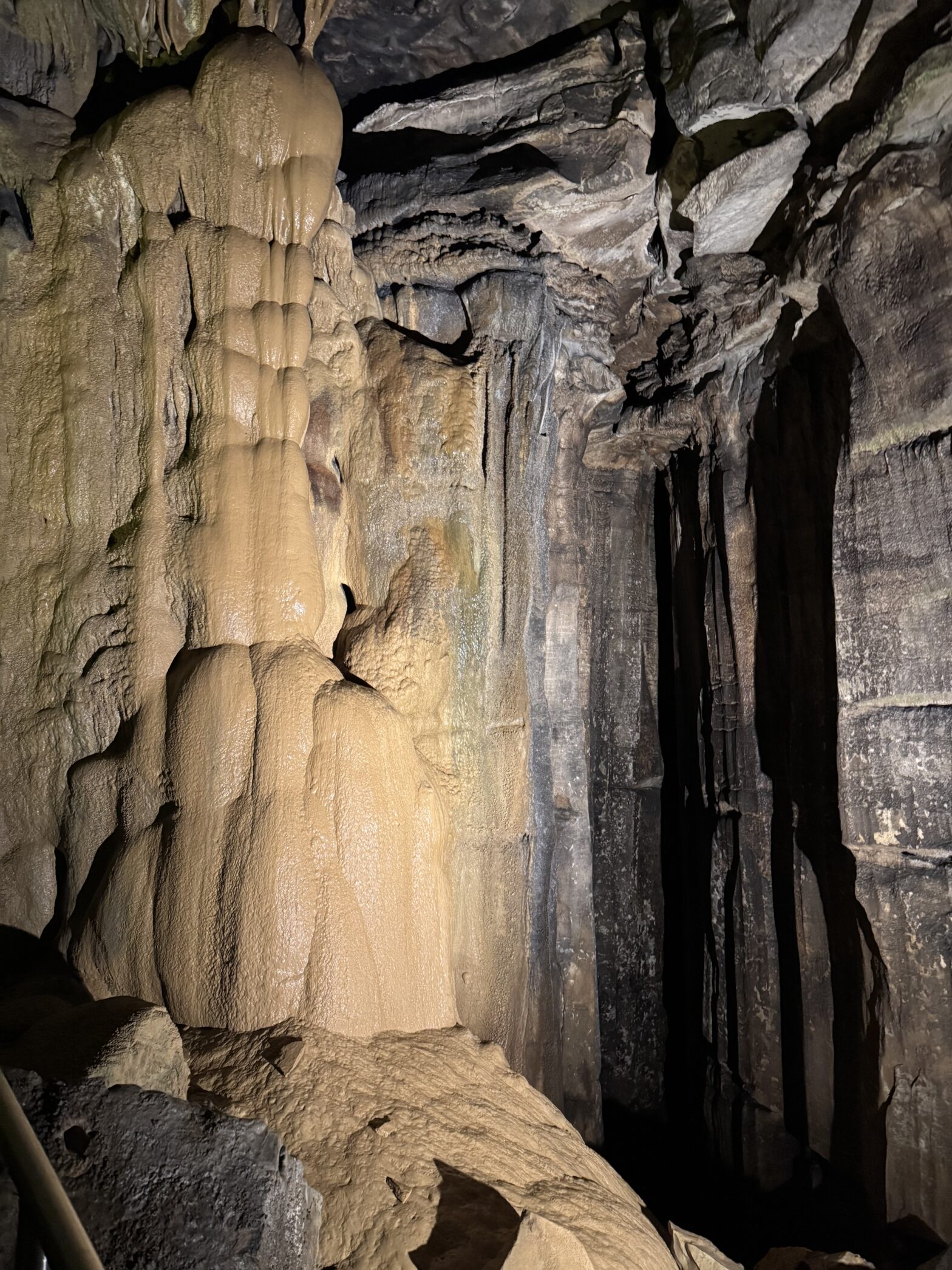
And then it was time to head up, up, up the stairs. It really wasn’t all that bad, mostly because of the slow pace of traffic, but no denying this part of the tour put a little bit of burn into the thighs. We were coming up toward the final attraction of the Historic Tour – Mammoth Dome. It’s a 200-foot-tall natural cathedral with the highest ceilings to be found anywhere all weekend. The footpath suddenly changed to a grated bridge, below which sat the “Bottomless Pit” (I don’t think it was that deep, but who knows, they didn’t light it up!). And then Elizabeth and I were in the group getting to take a lap up to Mammoth Dome istelf. Most of this tour (and most of the cave everywhere) lacked in the formations that you associate with caves (stalagmites, stalactites, etc). I’ll get into this more in our final Mammoth Cave blog post (probably coming out next month!), but that’s because most of the cave these days is dry without water flowing through it. Not here. Here, you get some of those classic dripstone features.
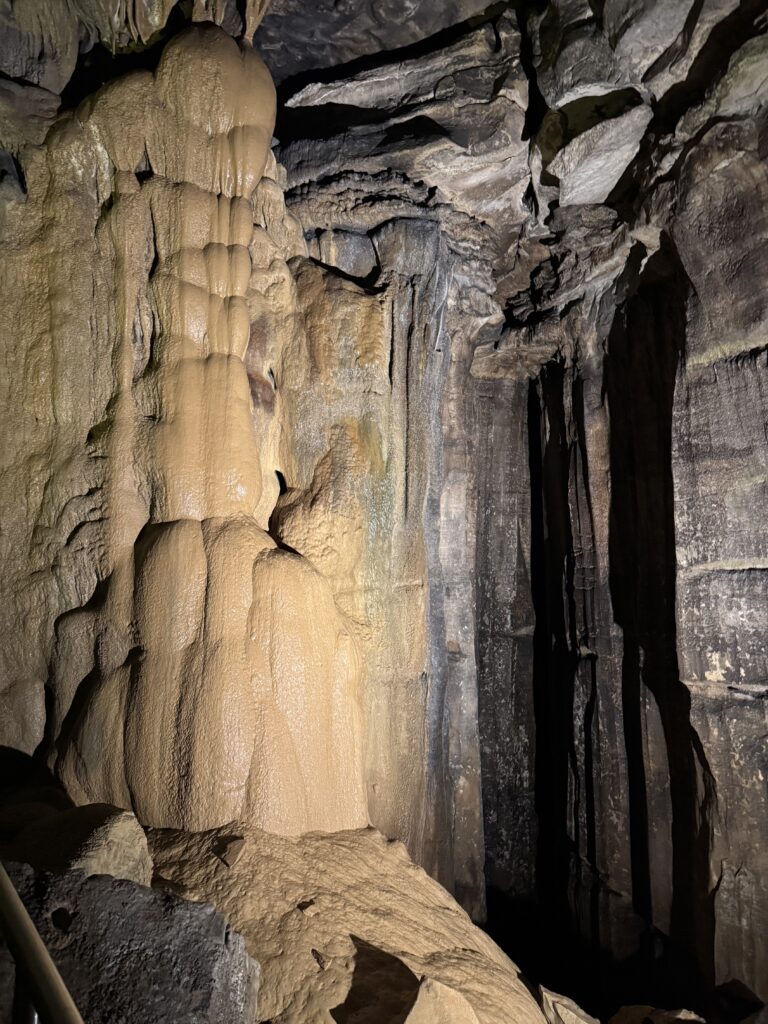
It’s funny the things that you associate with caves – it didn’t feel like something was missing from this tour until we saw this, but it was.
To get out of Mammoth Dome, some enterprising employees of the Park Service put in a fire tower. No, really.
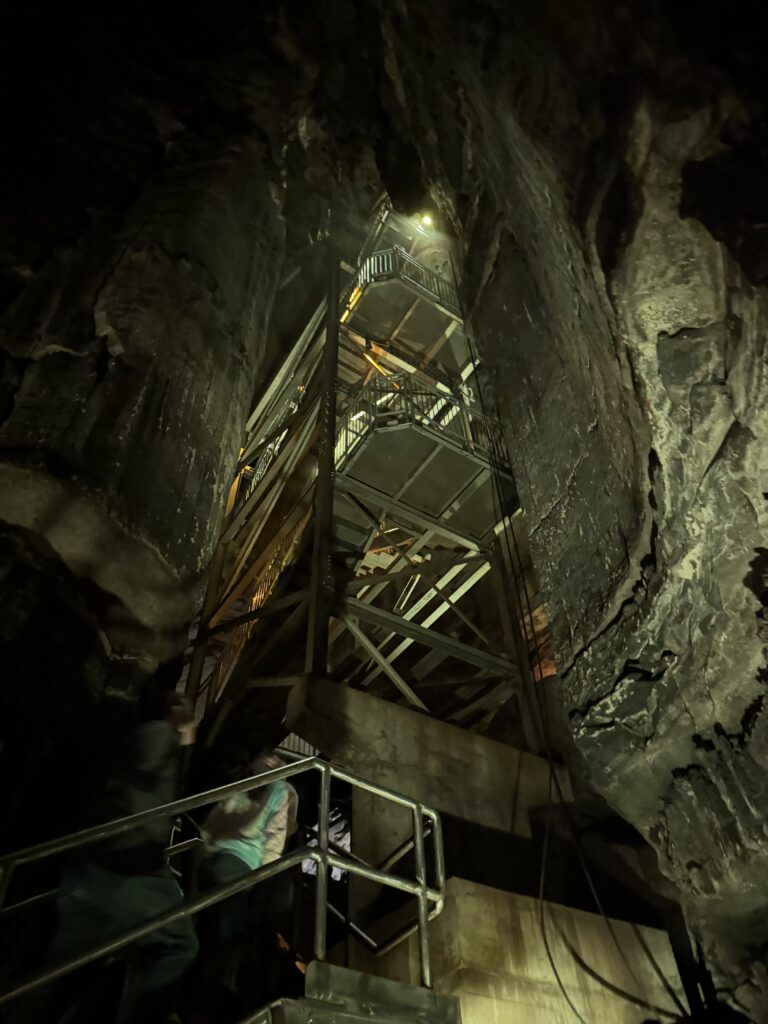
This part got the quads burning a little bit, I won’t deny it. In the end, it probably was nice not to be wearing a sweatshirt or pants down here just for this part. The exertion felt nice in cool, damp air (not tuberculosis-curing air!!!). The fire tower led back up toward the main entrance rooms. Our ranger friend gave an impassioned final talk, imploring us to enjoy America’s greatest idea. It was the sort of thing that took on an extra meaning after stupid partisan fighting had shut down tours of this place for 6 weeks – and for what? Why were we cutting off people’s access to what makes America great? Especially for this ranger – Elizabeth and I chatted with him on the hike back up to the Visitor Center, and it turned out that he had been affected far worse by the lack of paycheck than I had been over the past month and a half. He spoke of interest-free loans to federal employees, and the meager salary afforded to our park rangers, and after all that voiced his support for me, a guy who spent a good chunk of the shutdown on vacation in Europe with plenty of savings to ride out a lack of paycheck for months to come…
These truly might be the most selfless people in any profession out there.
The last moment inside Mammoth Cave (for the night – Elizabeth and I had another tour lined up in the morning) may have been one of the most memorable. When we had descended along with 100 other people into this cave a little under two hours ago, it had been a gorgeous fall afternoon. Now it was a smidge after 5:00 central time, and the sun was not just sinking, it had fully set. The cave entrance was a window into the twilight world beyond, with each tree sharply outlined against the deepening grey beyond. Even the tour guide – who of course, hadn’t done this tour since September when the sun went down an hour later – was momentarily wrought speechless by the sight.
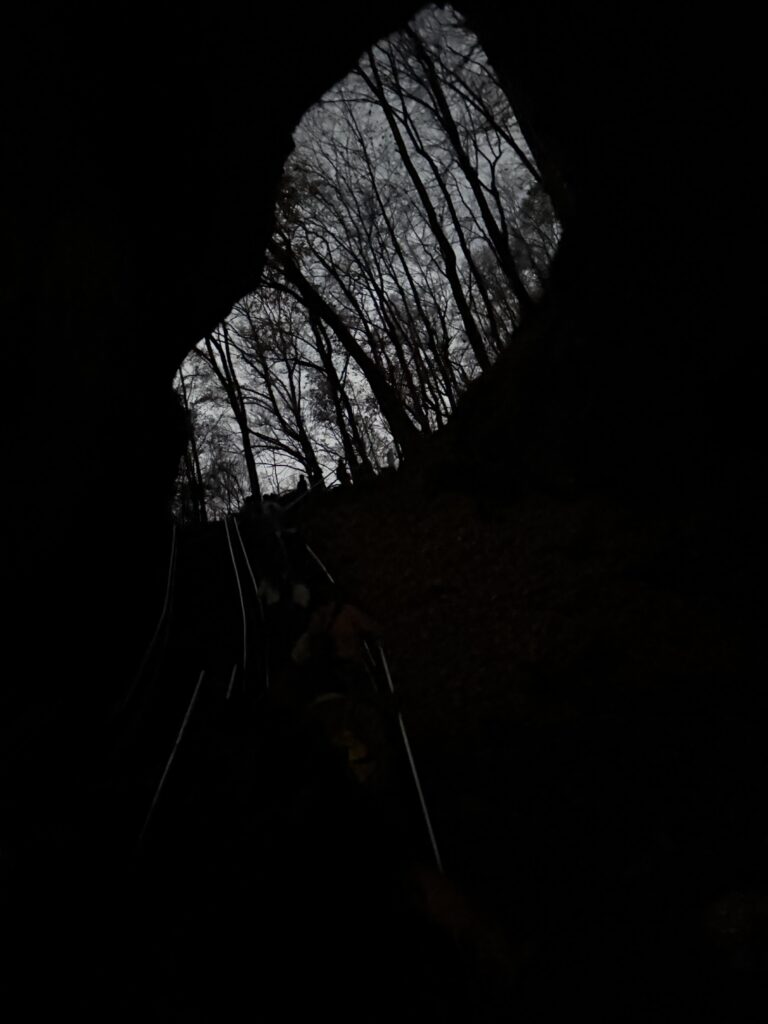
Now, as we all left the cave, the national park had set up a sanitation station for everyone’s tennis shoes and hiking boots and whatnot. Hopefully this helps us prevent the spread of white-nose syndrome, though I’ll admit I’ve begun to lose my faith. As I mentioned a moment ago, Elizabeth spent the five-minute walk back up the hill chatting up the park ranger about his job, his life, the shutdown. I listened – mostly. Part of me was just trying to figure out how I could get a signal so I could see how the Oklahoma/Alabama game was faring. Down in the cave, things like date and time didn’t matter. Back up here on the topsoil, college football Saturday still ruled.
Presently we made our way back to our rental car. It was almost fully dark out now and the hustle and bustle of Mammoth Cave had come to a close a while ago. Apart from other people on our tour getting ready to head back to Cave City or Elizabethtown or wherever, nobody remained. That remained doubly true over at the Mammoth Cave Lodge, where I quickly discovered why the property managers had been so willing to let us change the date of our stay at the last second. The reason was simple – they were nowhere close to filling up the Historic Cottages on the far side of the lot. This fact was emphasized by the fact that we got Cottage number 1, a short 30-second walk down the path from the edge of the lot. It was quiet (nobody else seemed to be around us, though it was so dark by this point that there was no way of knowing for sure) apart from the occasional rustle of deer in the brush behind the cottage. Nobody would consider it a five-star-caliber lodging, but there was something neat about being one of the only people spending the night inside a national park. I say “people” because our room was overrun by ladybugs, who were also looking to get in on free space heating. Most importantly: the room had just enough of a signal to pick up the end of the Sooners/Crimson Tide game, which Oklahoma won on a late defensive stand 23-21.
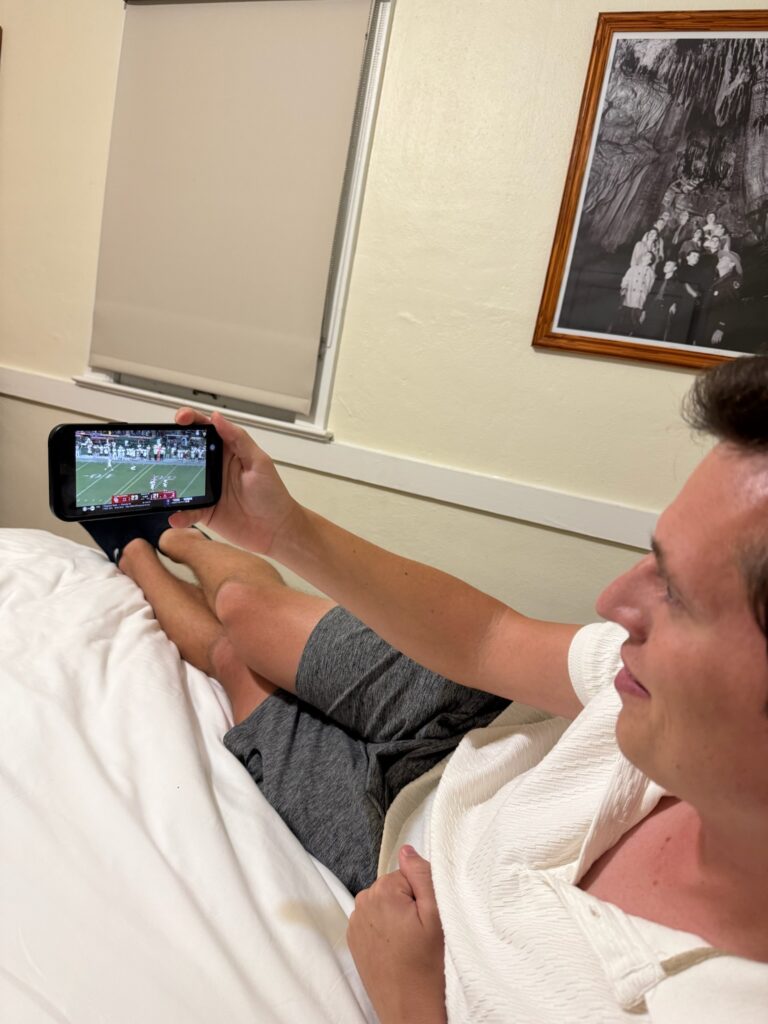
It still wasn’t really that late in the evening despite what the pitch-black sky might tell you. With no restaurants remaining open in the park, we didn’t have much choice but to drive 20 minutes into the bustling metropolis of Cave City for dinner. The section along the interstate had every single fast food chain imaginable, but this was my birthday weekend. We could find something of higher quality for sure, right?
Well… I would not consider POURter’s on Broadway to be the finest establishment ever. Despite the name, it was not a local craft brewery like I hoped but more of a mix between a local dive bar and eatery. Nor could the waitress figure out how to change the TV channel, leaving me stuck watching a really depressing football game between Florida State and NC State, two teams that clearly hoped the season would just end. At least my buffalo chicken dip french fries were exactly what the menu promised they would be: french fries and buffalo chicken dip.
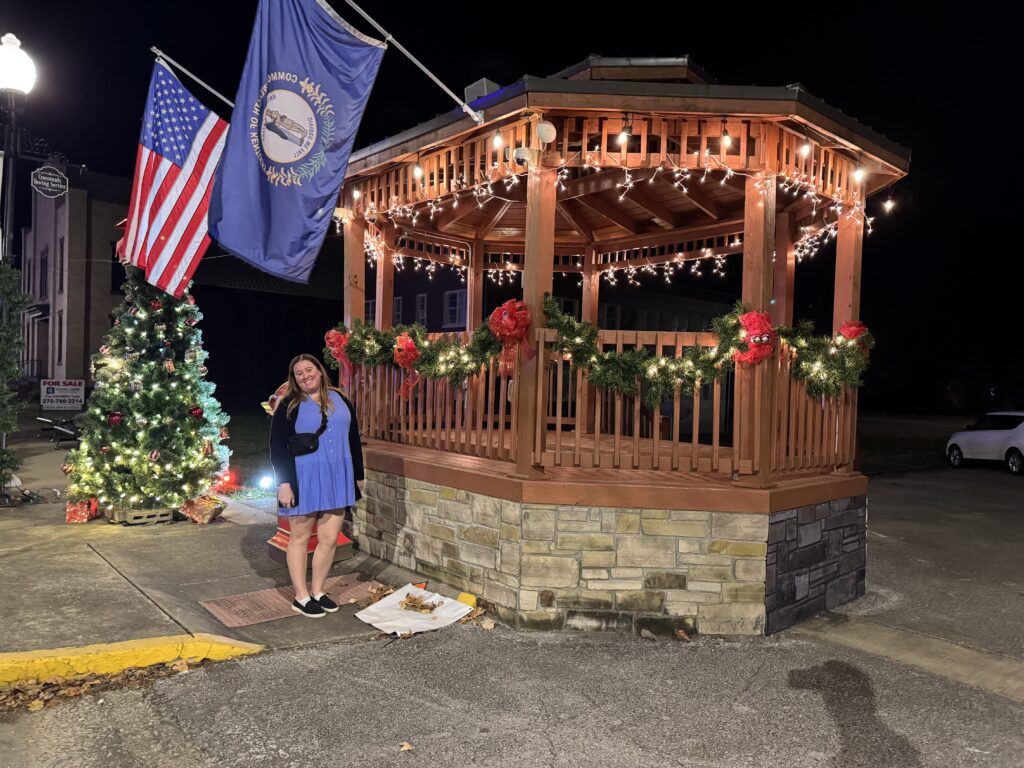
I say that and sound a little sarcastic, but the truth is that I was just happy to spend the evening with Elizabeth. The next day I would be dropping her off in Louisville for the IAEM conference for most of a week, and then heading back to Oklahoma on my own for my birthday. So this right here was just a great birthday celebration between the two of us. Many people wouldn’t consider the streets of Cave City to be romantic, but those people haven’t seen the town square when it’s all decorated for Christmas (a little early there, guys).
Elizabeth handled the drive back to the cottage in Mammoth Cave even though there hadn’t been anything in that bar that seemed worth drinking enough to get drunk. Both of us were pretty tired; it had been nice to get a good night’s sleep after our early start the day before, but 36 hours of travel after that early morning still do have a way of catching up to you. The room was cold, which only furthered us toward sleep. Alone in a cabin in the woods, above the world’s largest cave, and beneath the void of the night sky, the two of us drifted off to sleep.
